




Abstract
Under various atmospheric conditions, laser-induced breakdown spectroscopy (LIBS) is a powerful technique for elemental analysis, including in Earth- and Mars-like environments. However, understanding the plasma behavior and its dependence on ambient pressure and laser parameters remains a challenge. In this study, a numerical model based on a three-temperature Eulerian radiation framework under non-local thermodynamic equilibrium conditions is employed to investigate the interaction of a nanosecond laser pulse with a graphite target under helium (He) and carbon dioxide (CO2 atmospheres. The aim is to provide insights into the effects of focusing conditions and ambient pressure (3 to 9 mbar and 1000 mbar) on plasma parameters relevant to both Earth- and Mars-like settings. Our results show that increased ambient pressure significantly enhances electron and ion densities, while the focusing conditions influence the temperature and fluid velocity of plasma species, as well as the spatial distribution and intensity of the plasma, ultimately affecting its diagnostic potential. These findings are critical for optimizing LIBS applications in planetary exploration and contribute to improving quantitative analyses under varying atmospheric compositions.
This is a visual representation of the abstract.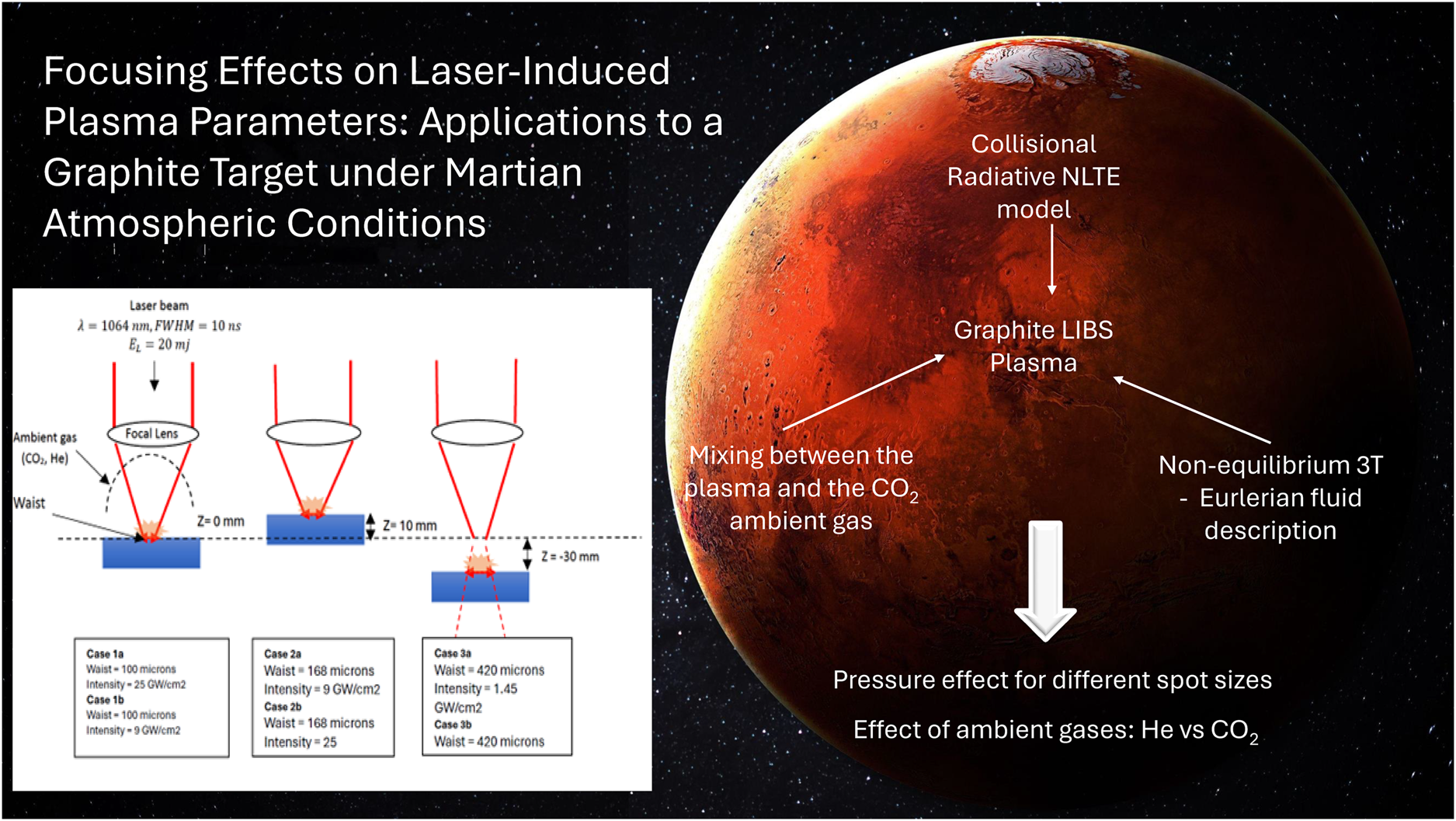
Keywords
Get full access to this article
View all access options for this article.