




Abstract
Environmental fluorescence measurements sometimes use water Raman scattering as an internal standard to compensate for path length, lensing effects, and turbidity. Fluorescent dissolved organic matter (FDOM) in water may interfere strongly with the measurement of this reference. However, fluorescence in fluid solution is largely unpolarized, while the OH stretching Raman band of water is always strongly polarized. Using an environmental sample from Lake Wateree in South Carolina, USA, we demonstrate that judicious use of this polarization allows for a significant level of improvement in the contrast or visibility of the water Raman band relative to FDOM.
This is a visual representation of the abstract.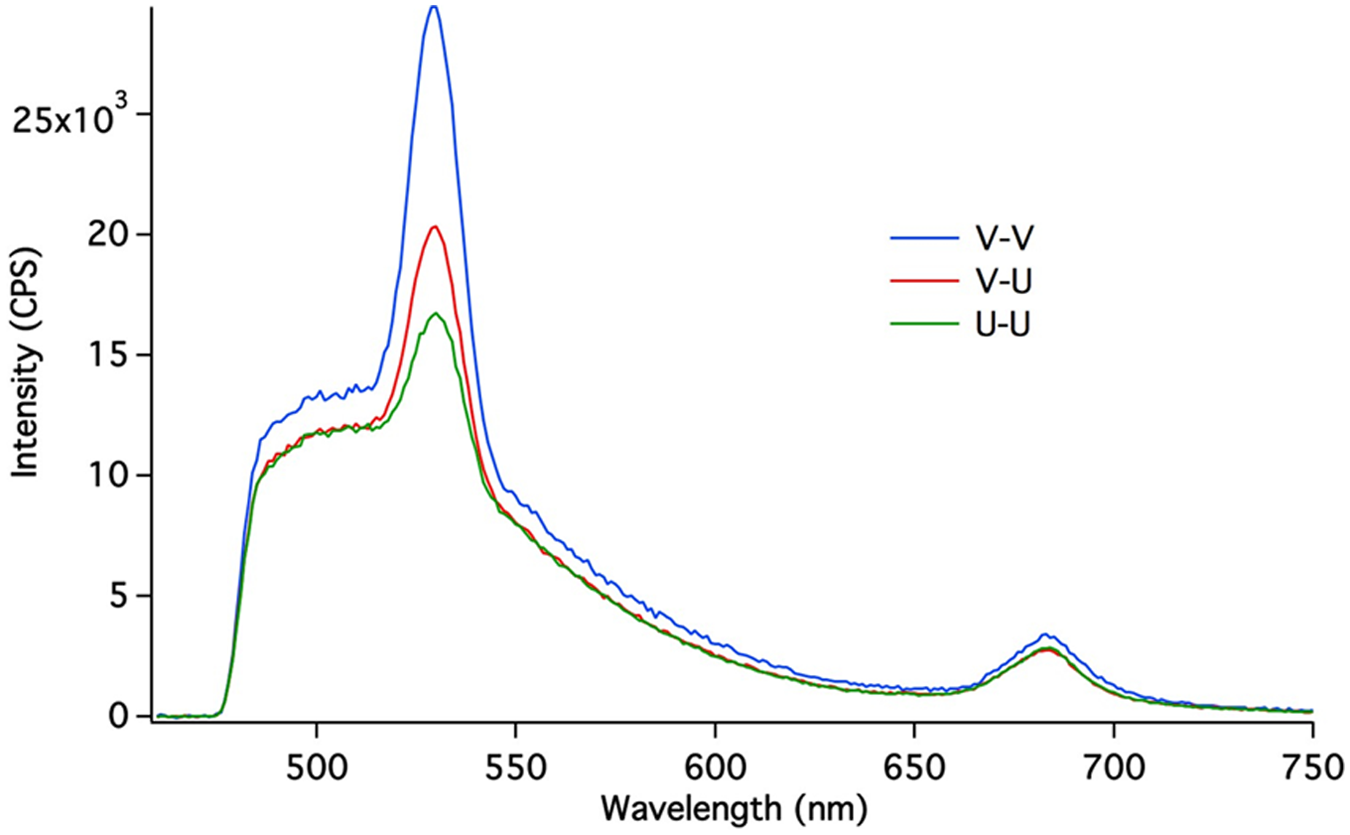
Keywords
Get full access to this article
View all access options for this article.
References
Supplementary Material
Please find the following supplemental material available below.
For Open Access articles published under a Creative Commons License, all supplemental material carries the same license as the article it is associated with.
For non-Open Access articles published, all supplemental material carries a non-exclusive license, and permission requests for re-use of supplemental material or any part of supplemental material shall be sent directly to the copyright owner as specified in the copyright notice associated with the article.
