Spectral Data Fusion from Handheld Laser-Induced Breakdown Spectroscopy (LIBS) and X-ray Fluorescence (XRF) Analyzers for Improved Detection of Cerium in a Simulated Dispersal Accident
Restricted accessResearch articleFirst published online July, 2025
Spectral Data Fusion from Handheld Laser-Induced Breakdown Spectroscopy (LIBS) and X-ray Fluorescence (XRF) Analyzers for Improved Detection of Cerium in a Simulated Dispersal Accident
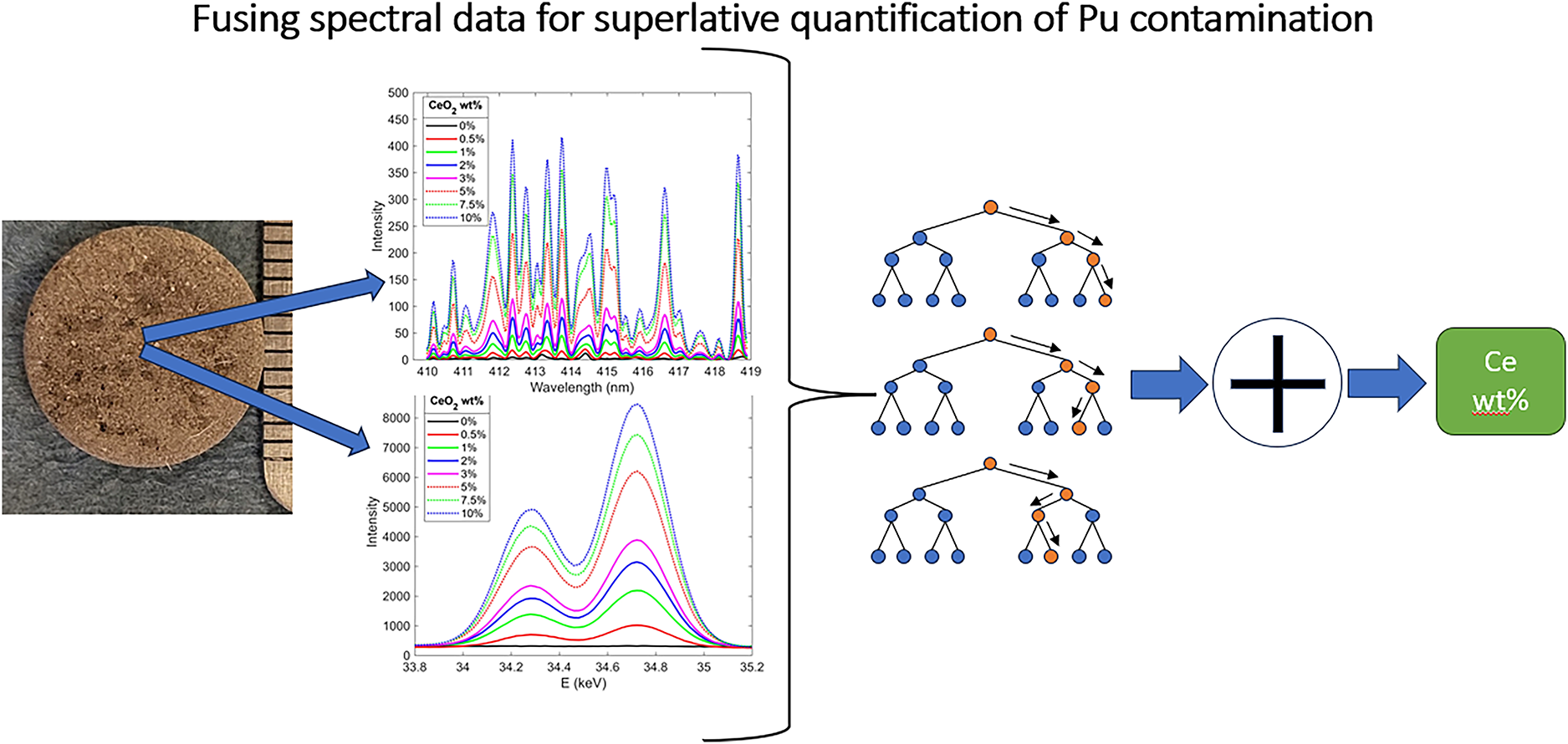
This work implements a mid-level data fusion methodology on spectral data from handheld X-ray fluorescence and laser-induced breakdown spectroscopy analyzers to quantify plutonium surrogate (CeO) contamination in soil samples for the first time. Spectral data from each analyzer were used independently to train supervised machine learning regressions to predict Ce concentration. Fused features from both data sets were then used to train the same models, comparing prediction performance by evaluating model precision and sensitivity. Fusing principal component scores from the two sensors yielded an order of magnitude improvement in precision and sensitivity of predictions made with an artificial neural network, compared to predictions made by models trained on independent sensor data. Lastly, a boosted ensemble trained on the fused spectral features yielded an ideal predictor with root-mean-squared error on the order of 10−6 and calculated limit of detection order 10−5 wt.
McElweeR.. “Project Crested Ice. USAF B-52 Accident at Thule, Greenland, 21 January 1968”. Technical Report, Defense Nuclear Agency, Washington DC, 1968.
2.
Jiménez-RamosM.García-TenorioR.VioqueI.et al. “Presence of Plutonium Contamination in Soils From Palomares (Spain)”. Environ. Pollut. 2006. 142(3): 487–492.
3.
HeffelfingerA.VarshneyG.BickleyA.A.et al. “Study of Radioactive Particles in Soil Contaminated by the Bomarc Nuclear Weapon Accident”. J. Radioanal. Nucl. Chem. 2022. 331(12): 5393–5400.
4.
LeeM.ClarkS.. “Activities of Pu and Am Isotopes and Isotopic Ratios in a Soil Contaminated by Weapons-Grade Plutonium”. Environ. Sci. Technol. 2005. 39(15): 5512–5516.
5.
AragónA.EspinosaA.De La CruzB.et al. “Characterization of Radioactive Particles From the Palomares Accident”. J. Environ. Radioact. 2008. 99(7): 1061–1067.
6.
BowenJ.GloverS.SpitzH.. “Morphology of Actinide-Rich Particles Released from the Bomarc Accident and Collected from Soil Post Remediation”. J. Radioanal. Nucl. Chem. 2013. 296: 853–857.
7.
VargaZ.WalleniusM.KrachlerM.et al. “Trends and Perspectives in Nuclear Forensic Science”. TrAC, Trends Anal. Chem. 2022. 146: 116503.
BochudF.LaedermannJ.P.NjockM.K.et al. “A Comparison of Alpha and Gamma Spectrometry for Environmental Natural Radioactivity Surveys”. Appl. Radiat. Isot. 2008. 66(2): 215–222.
10.
KwapisE.H.BorreroJ.LattyK.S.et al. “Laser Ablation Plasmas and Spectroscopy for Nuclear Applications”. Appl. Spectrosc. 2024. 78(1): 9–55.
11.
RaoA.JenkinsP.PinsonR.et al. “Machine Learning in Analytical Spectroscopy for Nuclear Diagnostics [Invited]”. Appl. Opt. 2023. 62: A83–A109.
12.
HartigK.C.GhebregziabherI.JovanovicI.. “Standoff Detection of Uranium and Its Isotopes by Femtosecond Filament Laser Ablation Molecular Isotopic Spectrometry”. Sci. Rep. 2017. 7(1): 43852.
13.
StelmaszczykK.RohwetterP.MéjeanG.et al. “Long-Distance Remote Laser-Induced Breakdown Spectroscopy Using Filamentation in Air”. Appl. Phys. Lett. 2004. 85(18): 3977–3979.
14.
HarilalS.S.MurzynC.M.KautzE.J.et al. “Spectral Dynamics and Gas-Phase Oxidation of Laser-Produced Plutonium Plasmas”. J. Anal. At. Spectrom. 2021. 36: 150–156.
15.
Villa-AlemanE.KwapisE.H.FoleyB.J.et al. “Laser-Induced Plasmas of Plutonium Dioxide in a Double-walled Cell”. Appl. Spectrosc. 2024. 78(4): 412–422.
16.
ShattanM.B.GragstonM.ZhangZ.et al. “Mapping of Uranium in Surrogate Nuclear Debris Using Laser-induced Breakdown Spectroscopy (LIBS)”. Appl. Spectrosc. 2019. 73(6): 591–600.
17.
ManardB.T.AndrewsH.B.QuarlesC.D.et al. “Exploration of LIBS as a Novel and Rapid Elemental Mapping Technique of Nuclear Fuels in the Form of Surrogate Triso Particles”. J. Anal. At. Spectrom. 2023. 38(7): 1412–1420.
18.
SkrodzkiP.J.BeckerJ.R.DiwakarP.K.et al. “A Comparative Study of Single-Pulse and Double-Pulse Laser-Induced Breakdown Spectroscopy With Uranium-Containing Samples”. Appl. Spectrosc. 2016. 70(3): 467–473.
19.
YoshiiH.YanagiharaK.ImasekiH.et al. “Methodology Using a Portable X-ray Fluorescence Device for On-Site and Rapid Evaluation of Heavy-Atom Contamination in Wounds: A Model Study for Application to Plutonium Contamination”. PLoS ONE. 2014. 9(7): 1–7.
20.
KirsanovD.PanchukV.GoydenkoA.et al. “Improving Precision of X-ray Fluorescence Analysis of Lanthanide Mixtures Using Partial Least Squares Regression”. Spectrochim. Acta, Part B. 2015. 113: 126–131.
21.
ShattanM.B.MillerD.J.CookM.T.et al. “Detection of Uranyl Fluoride and Sand Surface Contamination on Metal Substrates by Hand-Held Laser-Induced Breakdown Spectroscopy”. Appl. Opt. 2017. 56(36): 9868–9875.
22.
RaoA.P.JenkinsP.R.VuD.M.et al. “Rapid Quantitative Analysis of Trace Elements in Plutonium Alloys Using a Handheld Laser-Induced Breakdown Spectroscopy (LIBS) Device Coupled with Chemometrics and Machine Learning”. Anal. Methods. 2021. 13(30): 3368–3378.
23.
RaoA.P.JenkinsP.R.AuxierJ.D.et al. “Analytical Comparisons of Handheld LIBS and XRF Devices for Rapid Quantification of Gallium in a Plutonium Surrogate Matrix”. J. Anal. At. Spectrom. 2022. 37(5): 1090–1098.
24.
HaoZ.LiuK.LianQ.et al. “Machine Learning in Laser-Induced Breakdown Spectroscopy: A Review”. Front. Phys. 2024. 19(6): 62501.
25.
LiuH.HanK.YangW.et al. “Recent Advances in Machine Learning Methodologies for LIBS Quantitative Analysis. In: YangD.Gibson KK., editors. Pulsed Laser Processing Materials. Rijeka, Croatia: IntechOpen, 2024. Chap.7, Pp. 1–22.
26.
RaoA.P.JenkinsP.R.AuxierJ.D.et al. “Development of Advanced Machine Learning Models for Analysis of Plutonium Surrogate Optical Emission Spectra”. Appl. Opt. 2022. 61(7): D30–D38.
27.
HarkR.R.ThrockmortonC.S.HarmonR.S.et al. “Multianalyzer Spectroscopic Data Fusion for Soil Characterization”. Appl. Sci. 2020. 10(23): 8723.
28.
KhajehzadehN.HaavistoO.KoresaarL.. “On-stream Mineral Identification of Tailing Slurries of An Iron Ore Concentrator Using Data Fusion of LIBS, Reflectance Spectroscopy and XRF Measurement Techniques”. Miner. Eng. 2017. 113: 83–94.
29.
TavaresT.R.MolinJ.P.NunesL.C.et al. “Multi-Sensor Approach for Tropical Soil Fertility Analysis: Comparison of Individual and Combined Performance of VNIR, XRF, and LIBS Spectroscopies”. Agronomy. 2021. 11(6): 1028.
30.
GamelaR.R.CostaV.C.SperançaM.A.et al. “Laser-Induced Breakdown Spectroscopy (LIBS) and Wavelength Dispersive X-ray Fluorescence (WDXRF) Data Fusion to Predict the Concentration of K, Mg, and P in Bean Seed Samples”. Food Res. Int. 2020. 132: 109037.
31.
FerreiraD.S.PereiraF.M.OlivieriA.C.et al. “Electronic Waste Analysis Using Laser-induced Breakdown Spectroscopy (LIBS) and X-ray Fluorescence (XRF): Critical Evaluation of Data Fusion for the Determination of Al, Cu, and Fe”. Anal. Chim. Acta. 2024. 1303: 342522.
32.
GongY.ChoiD.HanB.Y.et al. “Remote Quantitative Analysis of Cerium Through a Shielding Window by Stand-Off Laser-Induced Breakdown Spectroscopy”. J. Nucl. Mater. 2014. 453(1–3): 8–15.
33.
CampbellK.R.JudgeE.J.BarefieldI.I.J.E.et al. “Laser-Induced Breakdown Spectroscopy of Light Water Reactor Simulated Used Nuclear Fuel: Main Oxide Phase”. Spectrochim. Acta, Part B. 2017. 133: 26–33.
34.
MartinM.Z.AllmanS.BriceD.J.et al. “Exploring Laser-Induced Breakdown Spectroscopy for Nuclear Materials Analysis and In-Situ Applications”. Spectrochim. Acta, Part B. 2012. 74: 177–183.
35.
WilliamsA.BryceK.PhongikaroonS.. “Measurement of Cerium and Gadolinium in Solid Lithium Chloride–Potassium Chloride Salt Using Laser-Induced Breakdown Spectroscopy (LIBS)”. Appl. Spectrosc. 2017. 71(10): 2302–2312.
36.
RaoA.P.JenkinsP.R.AuxierI.I.J.D.et al. “Comparison of Machine Learning Techniques to Optimize the Analysis of Plutonium Surrogate Material Via a Portable LIBS Device”. J. Anal. At. Spectrom. 2021. 36(2): 399–406.
37.
TripathiM.M.EsellerK.E.YuehF.Y.et al. “Multivariate Calibration of Spectra Obtained by Laser Induced Breakdown Spectroscopy of Plutonium Oxide Surrogate Residues”. Spectrochim. Acta, Part B. 2009. 64(11–12): 1212–1218.
38.
ZhengH.YuehF.Y.MillerT.et al. “Analysis of Plutonium Oxide Surrogate Residue Using Laser-induced Breakdown Spectroscopy”. Spectrochim. Acta, Part B. 2008. 63(9): 968–974.
39.
KwapisE.H.Villa-AlemanE.HartigK.C.. “Spectroscopic Signatures and Oxidation Characteristics of Nanosecond Laser-Induced Cerium Plasmas”. Spectrochim. Acta, Part B. 2023. 200: 106610.
FabreC.OurtiN.E.MercadierJ.et al. “Analyses of Li-Rich Minerals Using Handheld LIBS Tool”. Data. 2021. 6(6): 68.
43.
HarmonR.S.LawleyC.J.WattsJ.et al. “Laser-Induced Breakdown Spectroscopy: An Emerging Analytical Tool for Mineral Exploration”. Minerals. 2019. 9(12): 718.
44.
JudgeE.J.CampbellK.KellyD.. “Uranium Corrosion Characterization by Handheld Laser-Induced Breakdown Spectroscopy”. Spectrochim. Acta, Part B. 2021. 186: 106325.
45.
GuezenocJ.Gallet-BudynekA.BousquetB.. “Critical Review and Advices on Spectral-Based Normalization Methods for LIBS Quantitative Analysis”. Spectrochim. Acta, Part B. 2019. 160: 105688.
46.
IsmaëlA.BousquetB.PierrésK.M.L.et al. “In Situ Semi-quantitative Analysis of Polluted Soils by Laser-induced Breakdown Spectroscopy (LIBS)”. Appl. Spectrosc. 2011. 65(5): 467–473.
47.
GorlaG.TaborelliP.GiussaniB.. “A Multivariate Analysis-Driven Workflow to Tackle Uncertainties in Miniaturized NIR Data”. Molecules. 2023. 28(24): 7999.
48.
ChenT.MenJ.ZhaoM.et al. “The Spectral Fusion of Laser-Induced Breakdown Spectroscopy (LIBS) and Mid-Infrared Spectroscopy (MIR) Coupled with Random Forest (RF) for the Quantitative Analysis of Soil pH”. J. Anal. At. Spectrom. 2021. 36(5): 1084–1092.
49.
ErlerA.RiebeD.BeitzT.et al. “Soil Nutrient Detection for Precision Agriculture Using Handheld Laser-Induced Breakdown Spectroscopy (LIBS) and Multivariate Regression Methods (PLSR, LASSO, and GPR)”. Sensors. 2020. 20(2): 418.
50.
BoucherT.F.OzanneM.V.CarmosinoM.L.et al. “A Study of Machine Learning Regression Methods for Major Elemental Analysis of Rocks Using Laser-Induced Breakdown Spectroscopy”. Spectrochim. Acta, Part B. 2015. 107: 1–10.
51.
RenY.ZhangL.SuganthanP.N.. “Ensemble Classification and Regression-Recent Developments, Applications and Future Directions”. IEEE Comput. Intell. Mag. 2016. 11(1): 41–53.
DietterichT.G.. "Ensemble Learning“. In: M. A. Arbib, editor. The Handbook of Brain Theory and Neural Networks. Cambridge, Massachusetts: MIT Press, 2002. Pp. 405–408.
54.
FreundY.SchapireR.E.. “A Decision-Theoretic Generalization of On-Line Learning and an Application to Boosting”. J. Comput. Syst. Sci. 1997. 55(1): 119–139.
55.
KrenkerA.BešterJ.Kos. A."Introduction to the Artificial Neural Networks".In: K. Suzuki, editor. Artificial Neural Networks: Methodological Advances and Biomedical Applications. London, UK: IntechOpen, 2011. Pp. 1–18.
56.
HaykinS.. Neural Networks: A Comprehensive Foundation. Upper Saddle River, New Jersey: Prentice Hall, 1998.
Van den EyndeS.Diaz RomeroD.ZaplanaI.et al. “Deep Learning Regression for Quantitative LIBS Analysis”. Spectrochim. Acta, Part B. 2023. 202: 106634–106600. https://doi.org/10.1016/j.sab.2023.106634
59.
Egmont-PetersenM.de RidderD.HandelsH.. “Image Processing with Neural Networks: A Review”. Pattern Recognit. 2002. 35(10): 2279–2301.
60.
ChoH.KimY.LeeE.et al. “Basic Enhancement Strategies When Using Bayesian Optimization for Hyperparameter Tuning of Deep Neural Networks”. IEEE Access. 2020. 8: 52588–52608.
61.
SnoekJ.LarochelleH.AdamsR.P.. “Practical Bayesian Optimization of Machine Learning Algorithms”. In: PereiraF.BurgesC.BottouL., K.Q. Weinberger, editors Advances in Neural Information Processing Systems. Red Hook, New York: Curran Associates, Inc., 2012. Pp. 1–9.