



Abstract
Alcohols from biological waste sources or renewable electricity (electrofuels) are gaining attention in hard-to-decarbonize sectors such as transport. Adding alcohol to conventional fuels has positive environmental effects on automotive applications, requiring minimal engine adjustments. Employing a combination of terahertz (THz) and gigahertz (GHz) spectroscopies, a comprehensive analysis of model fitting is presented for diesel-like fuels, pure alcohols (ethanol and n-butanol), and alcohol-fuel blends. Through the integration of data from both spectroscopic techniques, new Debye parameters are introduced to improve the accuracy of fitting for various fuels. This research demonstrates that THz spectroscopy alone is valuable for reasonable fits, particularly for alcohols. However, integrating THz and GHz spectroscopies leads to improved fitting, and to better potential to understand the behavior of fuel properties. In addition, the effect of alcohol concentration on the dielectric constant spectra in blends was investigated, highlighting the importance of molecular interactions. The results reveal a linear relationship between fitted parameters and alcohol content in the blends. However, the study acknowledges limitations, including challenges in achieving satisfactory fits at low alcohol concentrations and the necessity for assumptions in the modeling process. These findings provide a basis for future research and advances in fuel property modeling.
This is a visual representation of the abstract.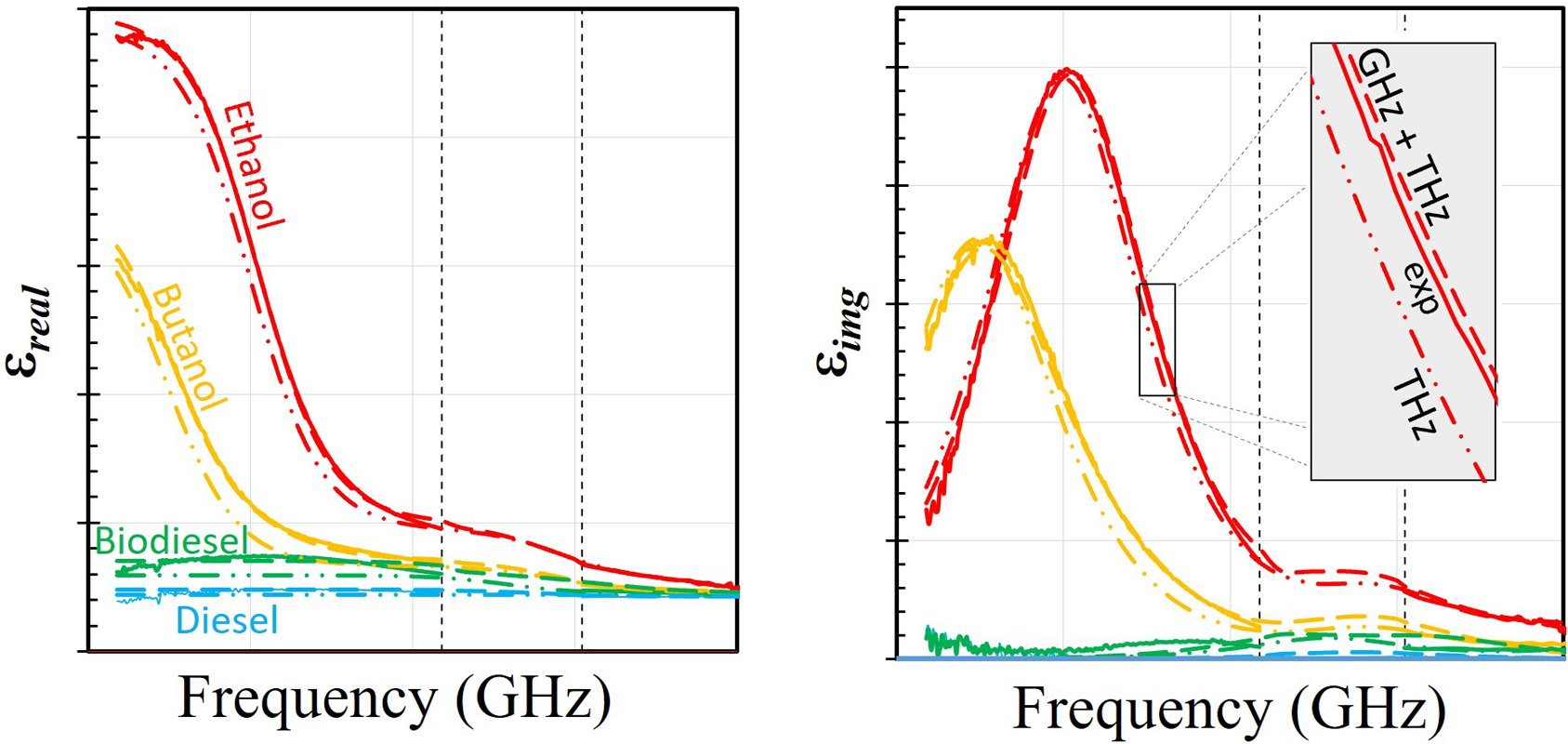
Keywords
Get full access to this article
View all access options for this article.
References
Supplementary Material
Please find the following supplemental material available below.
For Open Access articles published under a Creative Commons License, all supplemental material carries the same license as the article it is associated with.
For non-Open Access articles published, all supplemental material carries a non-exclusive license, and permission requests for re-use of supplemental material or any part of supplemental material shall be sent directly to the copyright owner as specified in the copyright notice associated with the article.
