




Abstract
Raman spectroscopy is widely used for material detection due to its specificity, but its application to spectral recognition often faces limitations due to insufficient training data, unlike fields such as image recognition. Traditional machine learning or basic neural networks are commonly used, but they have limited ability to achieve high precision. We have proposed a novel approach that combines the Triplet network (TN) and K-nearest neighbor (KNN) techniques to address this issue. TN maps the Raman spectral sequences to a 128-dimensional Euclidean space to extract features, enabling the features in the new space to more accurately represent the similarities or differences between spectra, and then utilizes the KNN algorithm to perform classification tasks in this feature space. Our method exhibits superior performance in recognizing unknown Raman spectra with minimal training samples per class. We employed a handheld Raman spectrometer with an excitation wavelength of 785 nm to collect the Raman spectra of 36 samples, including 28 safe materials and eight hazardous materials. Using only one spectrum as a support set for each category, the hazardous samples were successfully distinguished from the safe samples with an accuracy of 99.6%. Additionally, our model offers adaptability without requiring exhaustive retraining when adding new prediction classes. In situations with high background fluorescence, the TN performs better in measuring the distance between spectra of the same class than traditional distance measurement methods.
This is a visual representation of the abstract.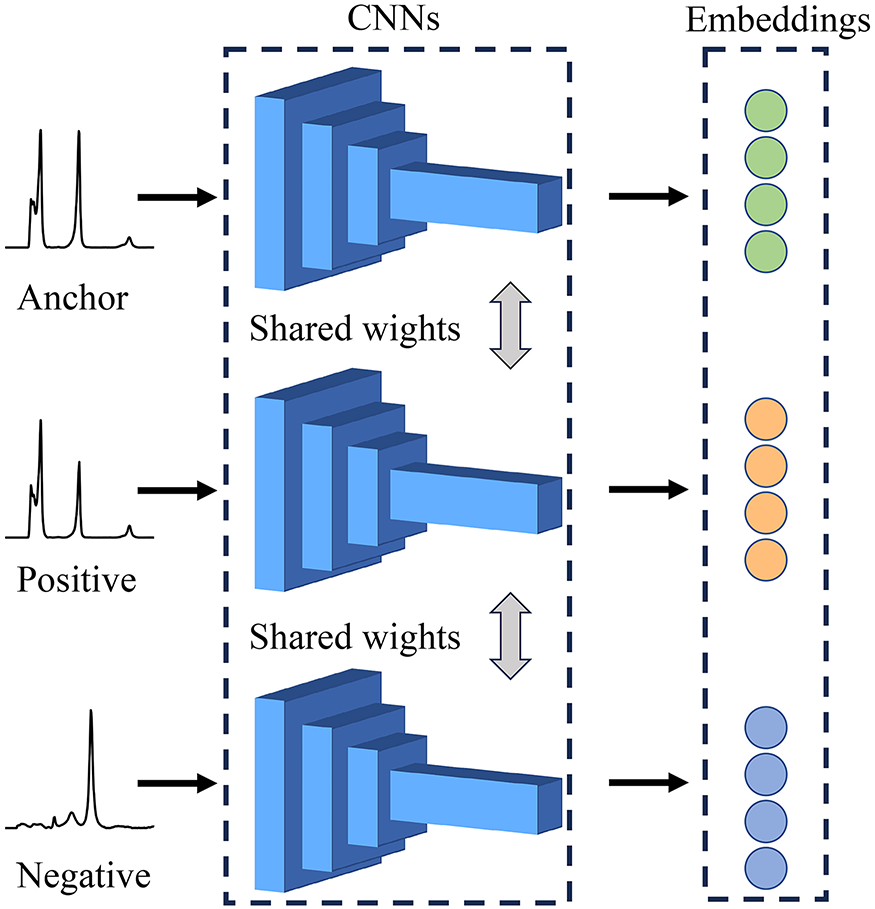
Get full access to this article
View all access options for this article.
References
Supplementary Material
Please find the following supplemental material available below.
For Open Access articles published under a Creative Commons License, all supplemental material carries the same license as the article it is associated with.
For non-Open Access articles published, all supplemental material carries a non-exclusive license, and permission requests for re-use of supplemental material or any part of supplemental material shall be sent directly to the copyright owner as specified in the copyright notice associated with the article.
