




Abstract
In this paper, a single-step synthetic approach is presented for the development of bimetallic molybdenum–copper nanoclusters (Mo–CuNCs), shielded by a small molecule 6-thioguanine (6-TG). The Mo–CuNCs possessed a small size, high fluorescence, stable behavior, and good solubility in water. The 6-TG-Mo–CuNCs exhibit strong blue fluorescence emission at 410 nm after exciting at 330 nm as compared to its monometallic nanoclusters. Utilizing 6-TG-Mo–CuNCs superior biochemical stability, uric acid (UA) can be specifically detected as an oxidative stress biomarker using an inner filter effect mechanism. The probe demonstrated good sensing capability for detecting UA within the range of 0.09–5.00 μM and a detection limit of 0.237 μM. The method feasibility is further validated by quantifying UA in urine and plasma samples.
This is a visual representation of the abstract.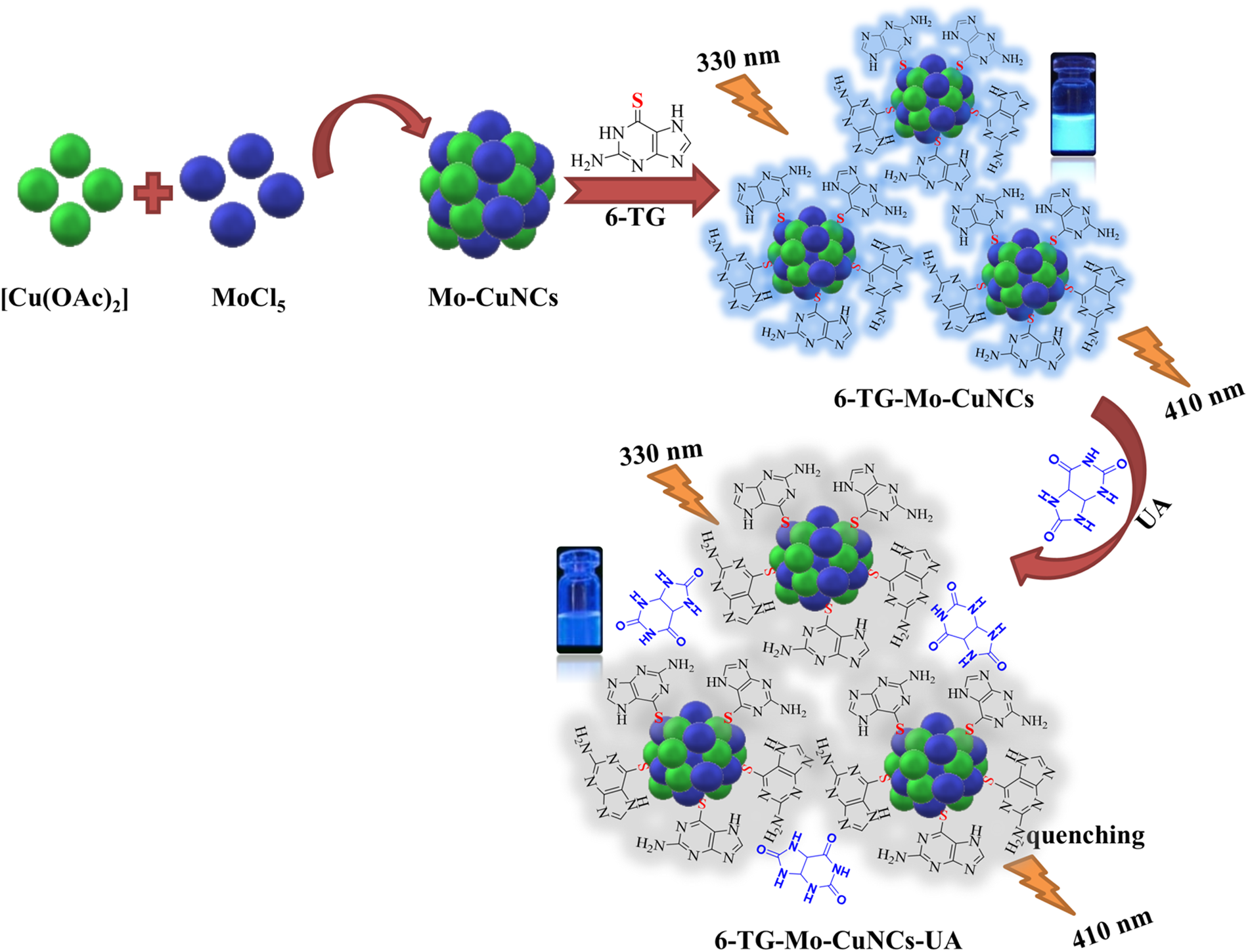
Keywords
Get full access to this article
View all access options for this article.
References
Supplementary Material
Please find the following supplemental material available below.
For Open Access articles published under a Creative Commons License, all supplemental material carries the same license as the article it is associated with.
For non-Open Access articles published, all supplemental material carries a non-exclusive license, and permission requests for re-use of supplemental material or any part of supplemental material shall be sent directly to the copyright owner as specified in the copyright notice associated with the article.
