



Abstract
Polarized Raman spectroscopy was used to analyze aqueous solutions of sodium orthophosphate and orthovanadate over a wide concentration range (0.00891–0.702 mol/L) at 23 °C. The isotropic scattering profiles were obtained by measuring polarized Raman scattering spectra. Furthermore, R-normalized spectra were calculated and presented. The tetrahedral ions, VO43–(aq) and PO43–(aq), demand four Raman active bands which have been subsequently characterized and assigned. For the PO43–(aq) ion, the deformation modes ν2(e) and ν4(f2) appear at 415 and 557 cm–1, and these modes are depolarized. In the P–O stretching region, the strongest Raman band appears at 936.5 cm–1, which is totally polarized with a depolarization ratio (ρ-value) of 0.002. The broad and depolarized mode at 1010 cm–1 constitutes the antisymmetric stretching band ν3(f2). The Raman spectrum of VO43– shows two depolarized deformation modes ν2(e) and ν4(f2) at 327 and 345.6 cm–1, which are severely overlapped. These bands are very weak. The strongest band in the Raman spectrum of VO43–(aq) is the symmetric stretching mode ν1(a1) at 820.2 cm–1 which is totally polarized with a ρ-value at 0.004. The depolarized antisymmetric stretching mode ν3(f2) appeared at 785 cm–1 as a broad and weak band. Both anions are strongly hydrated and showed extensive hydrolysis in an aqueous solution. Orthovanadate is a much stronger base than orthophosphate in aqueous solution. Therefore, a large amount of NaOH was used to suppress the hydrolysis of VO43–(aq) sufficiently, so, it was possible to characterize the VO43– modes. Quantitative Raman spectroscopy was applied to follow the hydrolysis of PO43– over a wide concentration range from 0.00891 to 0.592 mol/L. The hydrolysis data allowed the calculation of the pKa3 value for H3PO4 to be 12.330 ± 0.02 (25 °C). The hydrolysis of the VO43– ion is ∼21 times larger than that of the PO43–. The pKa3 value for H3VO4 is estimated to be 13.65 ± 0.1 (25 °C).
This is a visual representation of the abstract.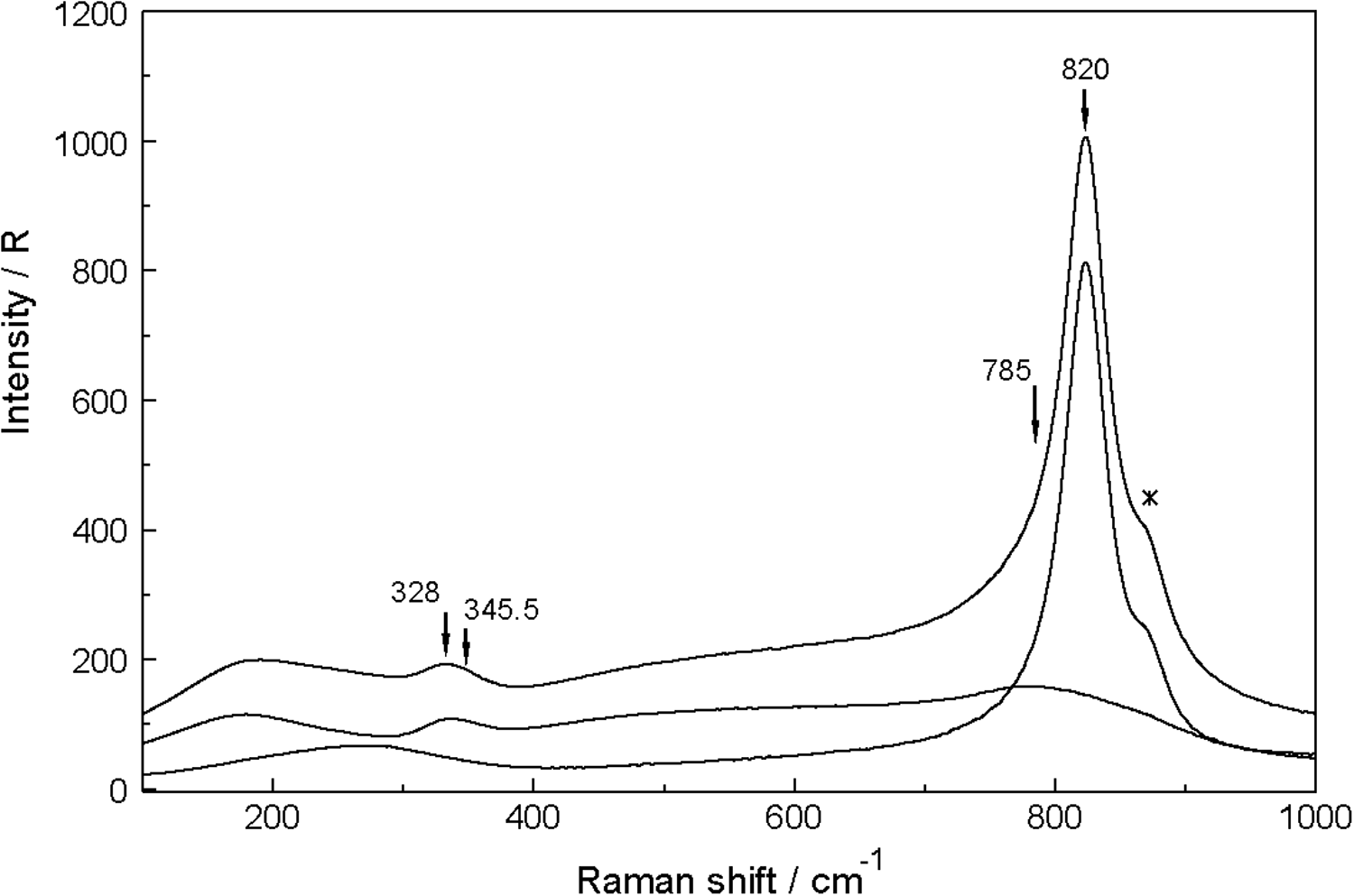
Keywords
Get full access to this article
View all access options for this article.
References
Supplementary Material
Please find the following supplemental material available below.
For Open Access articles published under a Creative Commons License, all supplemental material carries the same license as the article it is associated with.
For non-Open Access articles published, all supplemental material carries a non-exclusive license, and permission requests for re-use of supplemental material or any part of supplemental material shall be sent directly to the copyright owner as specified in the copyright notice associated with the article.
