



Abstract
A new optical diagnostic method that predicts the global fuel–air equivalence ratio of a swirl combustor using absorption spectra from only three optical paths is proposed here. Under normal operation, the global equivalence ratio and total flow rate determine the temperature and concentration fields of the combustor, which subsequently determine the absorption spectra of any combustion species. Therefore, spectra, as the fingerprint for a produced combustion field, were employed to predict the global equivalence ratio, one of the key operational parameters, in this study. Specifically, absorption spectra of water vapor at wavenumbers around 7444.36, 7185.6, and 6805.6 cm–1 measured at three different downstream locations of the combustor were used to predict the global equivalence ratio. As it is difficult to find analytical relationships between the spectra and produced combustion fields, a predictive model was a data-driven acquisition. The absorption spectra as an input were first feature-extracted through stacked convolutional autoencoders and then a dense neural network was used for regression prediction between the feature scores and the global equivalence ratio. The model could predict the equivalence ratio with an absolute error of ±0.025 with a probability of 96%, and a gradient-weighted regression activation mapping analysis revealed that the model leverages not only the peak intensities but also the variations in the shape of absorption lines for its predictions.
This is a visual representation of the abstract.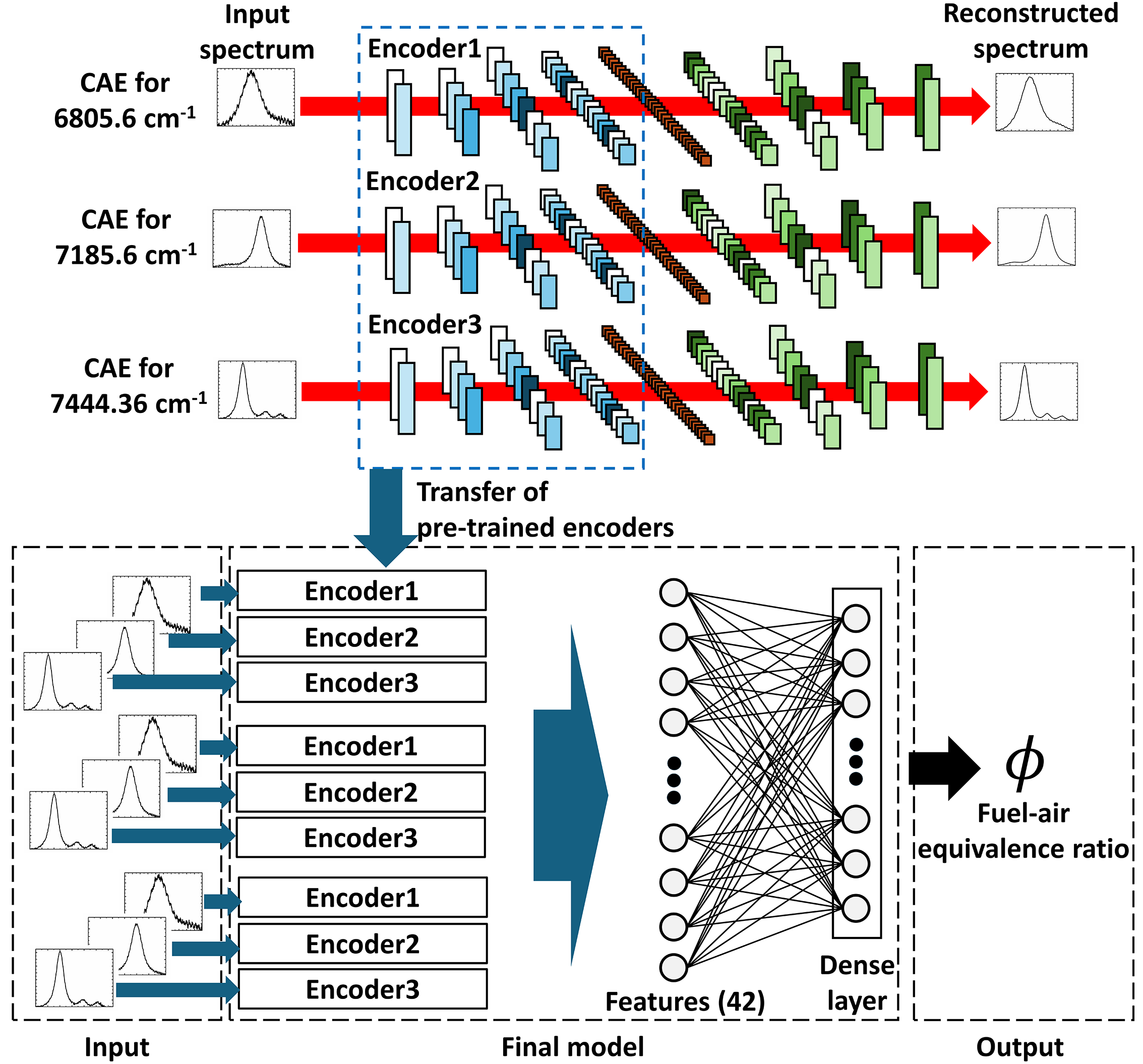
Keywords
Get full access to this article
View all access options for this article.
References
Supplementary Material
Please find the following supplemental material available below.
For Open Access articles published under a Creative Commons License, all supplemental material carries the same license as the article it is associated with.
For non-Open Access articles published, all supplemental material carries a non-exclusive license, and permission requests for re-use of supplemental material or any part of supplemental material shall be sent directly to the copyright owner as specified in the copyright notice associated with the article.
