



Abstract
The aim of this work was the development and morphological/chemical, spectroscopic, and structural characterization of titanium dioxide, niobium pentoxide, and titanium:niobium (Ti:Nb) oxides, as well as materials modified with ruthenium (Ru) with the purpose of providing improvement in photoactivation capacity with visible sunlight radiation. The new materials synthesized using the sol-gel methodology were characterized using the following techniques: scanning electron microscopy (SEM), energy dispersive X-ray spectroscopy (EDS), photoacoustic spectroscopy (PAS), and X-ray diffraction (XRD). The SEM–EDS analyses showed the high purity of the bases, and the modified samples showed the adsorption of ruthenium on the surface with the crystals’ formation and visible agglomerates for higher calcination temperature. The nondestructive characterization of PAS in the ultraviolet visible region suggested that increasing calcination temperature promoted changes in chemical structures and an apparent decrease in gap energy. The separation of superimposed absorption bands referring to charge transfers from the ligand to the metal and the nanodomains of the transition metals suggested the possible absorption centers present at the absorption threshold of the analyzed oxides. Through the XRD analysis, the formation of stable phases such as T-Nb16.8O42, o-Nb12O29, and rutile was observed at a lower temperature level, suggesting pore induction and an increase in surface area for the oxides studied, at a calcination temperature below that expected by the related literature. In addition, the synthesis with a higher temperature level altered the previously existing morphologies of the Ti:Nb, base and modified with Ru, forming the new mixed crystallographic phases Ti2Nb10O29 and TiNb2O7, respectively. As several semiconductor oxide applications aim to reduce costs with photoexcitation under visible light, the modified Ti:Ru oxide calcined at a temperature of 800 °C and synthesized according to the sol-gel methodology used in this work is suggested as the optimum preparation point. This study presented the formation of a stable crystallographic phase (rutile), a significant decrease in gap energy (2.01 eV), and a visible absorption threshold (620 nm).
This is a visual representation of the abstract.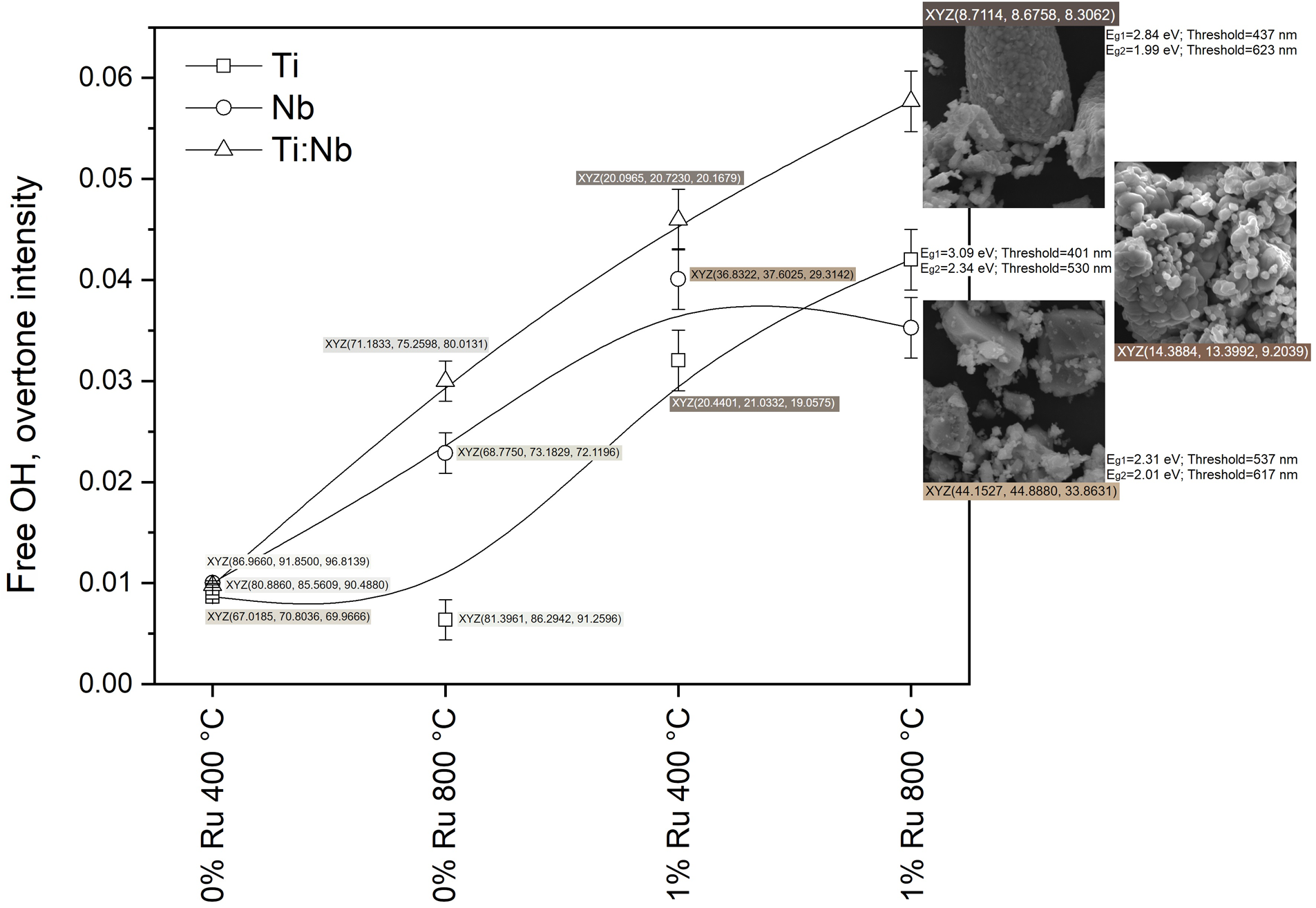
Get full access to this article
View all access options for this article.
References
Supplementary Material
Please find the following supplemental material available below.
For Open Access articles published under a Creative Commons License, all supplemental material carries the same license as the article it is associated with.
For non-Open Access articles published, all supplemental material carries a non-exclusive license, and permission requests for re-use of supplemental material or any part of supplemental material shall be sent directly to the copyright owner as specified in the copyright notice associated with the article.
