




Abstract
This study investigates the combined effects of nanoscale surface roughness and electron–phonon interaction on the vibrational modes of cadmium telluride (CdTe) using resonant Raman spectroscopy. Raman spectra simulations aided in identifying the active phonon modes and their dependence on roughness. Our results reveal that increasing surface roughness leads to an asymmetric line shape in the first-order longitudinal optical (1LO) phonon mode, attributed to an increase in the electron–phonon interaction. This asymmetry broadens the entire Raman spectrum. Conversely, the overtone (second-order longitudinal optical, or 2LO. mode exhibits a symmetrical line shape that intensifies with roughness. Additionally, we identify and discuss the contributions of surface optical phonon mode and multiphonon modes to the Raman spectra, highlighting their dependence on roughness. This work offers a deeper understanding of how surface roughness and electron–phonon scattering influence the line shape of CdTe resonant Raman spectra, providing valuable insights into its vibrational properties.
This is a visual representation of the abstract.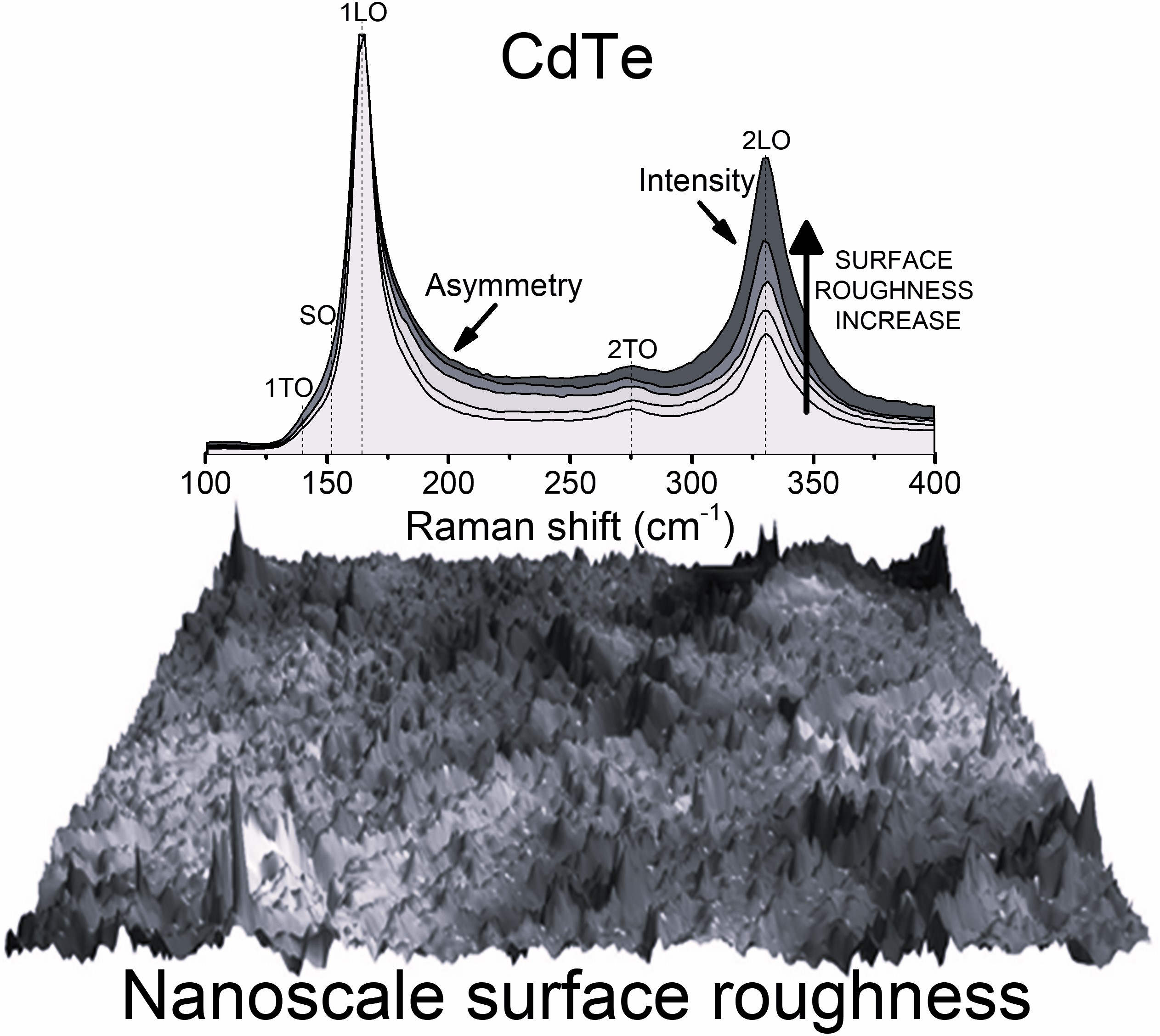
Keywords
Get full access to this article
View all access options for this article.