




Abstract
Microplastics (MPs), an emerging pollutant, widely co-occur with polycyclic aromatic hydrocarbons (PAHs) in the environment. Therefore, the interaction between MPs and PAHs has been the focus of much attention in recent years. In this study, three types of MPs, i.e., polypropylene, polystyrene, and poly(vinyl chloride), with the same main chain were selected as the adsorbents, with phenanthrene (PHE) as the representative PAHs. The adsorption mechanisms were explored from the perspective of the molecular spectral level using a combination of Fourier transform infrared spectroscopy (FT-IR) with a two-dimensional correlation technique. The adsorption kinetics results showed that the adsorption of PHE on the three MPs was dominated by chemisorption. However, the FT-IR analysis results indicated that no new covalent bond was created during the adsorption process. Based on the above research, a generalized two-dimensional (2D) correlation spectral technique was employed to investigate the sequence of functional group changes during the adsorption process for different MPs. Furthermore, the hybrid 2D correlation spectral technique explored the effect of side groups attached to the main chain molecules of MPs on adsorption. The results showed that for all three MPs, the functional groups in the side chain have a higher affinity for PHE, which is due to their higher hydrophobicity. This study provides a feasible way to analyze the adsorption of pollutants on MPs, and the results are important for understanding the adsorption interaction between PAHs and MPs in the aquatic environment.
This is a visual representation of the abstract.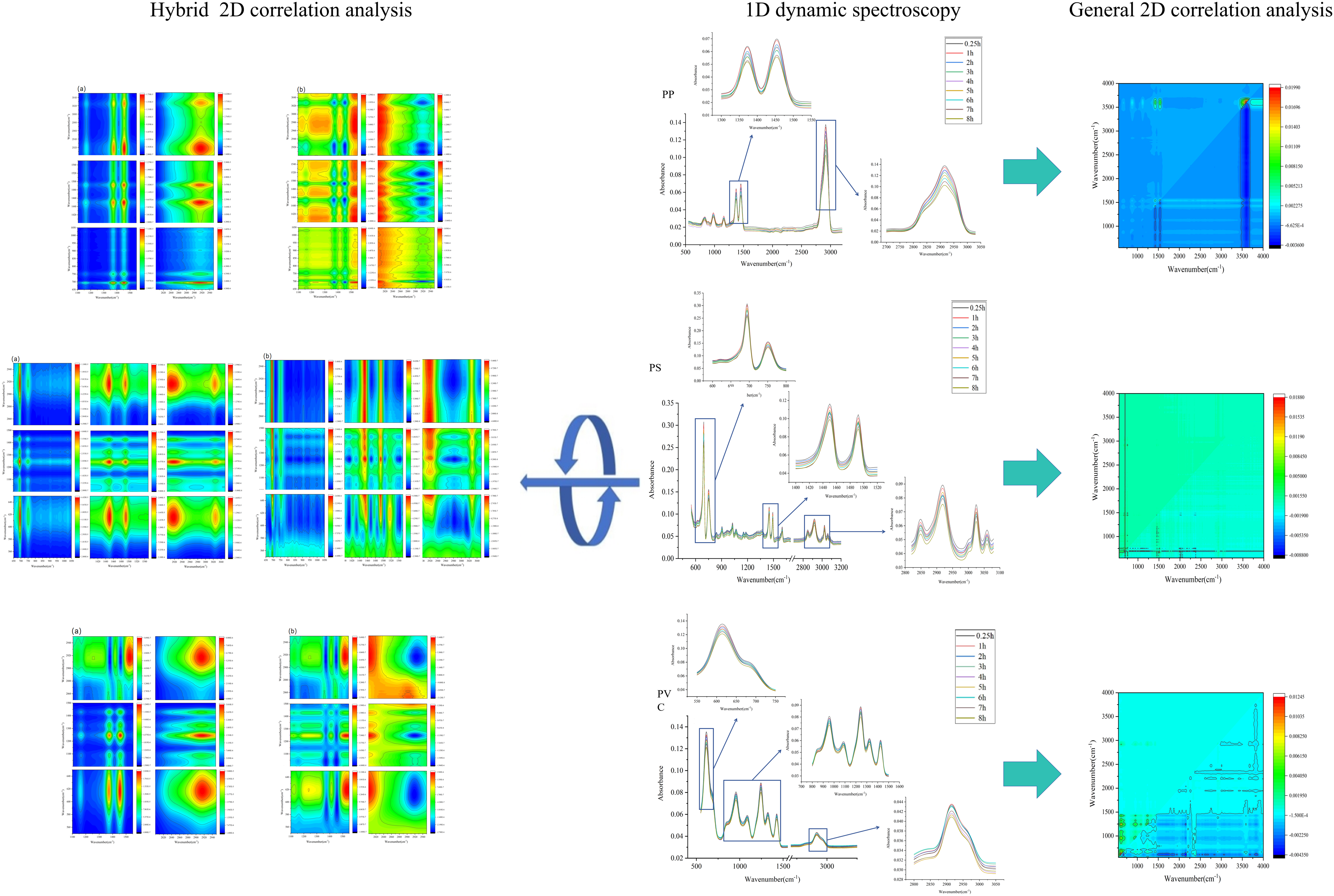
Keywords
Get full access to this article
View all access options for this article.
References
Supplementary Material
Please find the following supplemental material available below.
For Open Access articles published under a Creative Commons License, all supplemental material carries the same license as the article it is associated with.
For non-Open Access articles published, all supplemental material carries a non-exclusive license, and permission requests for re-use of supplemental material or any part of supplemental material shall be sent directly to the copyright owner as specified in the copyright notice associated with the article.
