



Abstract
Polycyclic aromatic hydrocarbons (PAHs) are widely distributed in soil and water, but fluorescence spectroscopy for PAHs is often interfered with organic matter in the environment. The aim of this paper is to evaluate a correction method using combined spectral technology in an environment where humic acids and PAHs coexist. In the present work, humic acids and benzo[ghi]perylene were analyzed in various concentrations using fluorescence and near-infrared (NIR) spectroscopy from single and mixed samples. The NIR prediction model of humic acids in mixed samples was established based on synergy interval partial least squares, and the standard curve of fluorescence spectra for humic acids was established at 478 nm (characteristic wavelength of benzo[ghi]perylene). The fluorescence intensity of humic acids in the mixed sample was predicted from the content derived from the NIR spectra. The final correction was carried out by their exclusion from the fluorescence of the mixture at the same wavelength. The corrected fluorescence intensity was linearly correlated with the concentration of benzo[ghi]perylene with R2 = 0.8362, while R2 = 0.3538 before correction. These results give a new insight into the calibration modeling of the combined spectral method.
This is a visual representation of the abstract.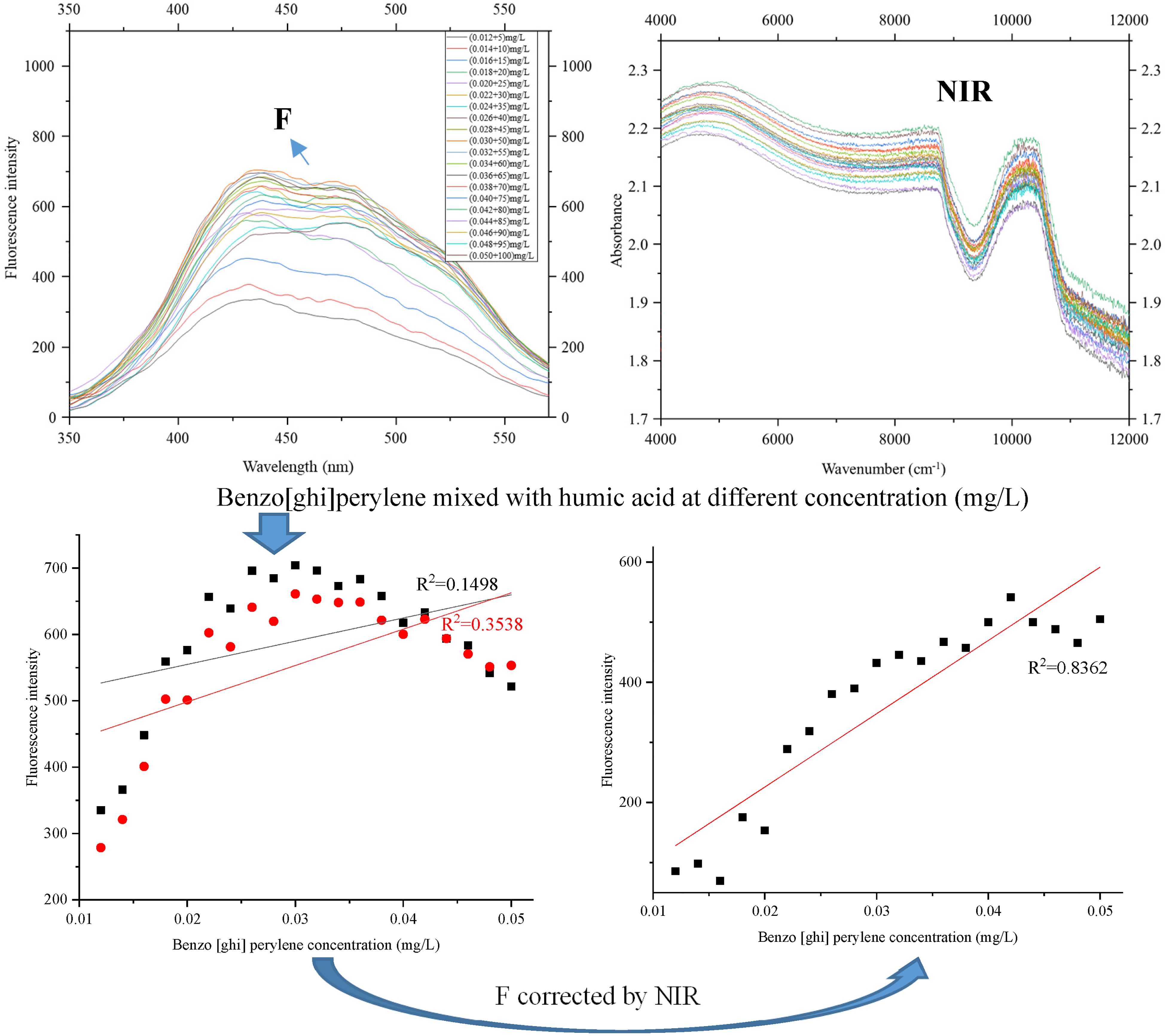
Keywords
Get full access to this article
View all access options for this article.
References
Supplementary Material
Please find the following supplemental material available below.
For Open Access articles published under a Creative Commons License, all supplemental material carries the same license as the article it is associated with.
For non-Open Access articles published, all supplemental material carries a non-exclusive license, and permission requests for re-use of supplemental material or any part of supplemental material shall be sent directly to the copyright owner as specified in the copyright notice associated with the article.
