




Abstract
The poor time stability of surface-enhanced Raman scattering (SERS) substrates greatly limits their application potential. Although core–shell structures are commonly used to enhance stability, their complex preparation processes, high costs, and susceptibility under acidic or alkaline conditions result in serious disadvantages for practical applications. Here, we propose a new method of external oxygen barrier to improve spectral stability, in which SERS substrates are stored in an oxygen-free environment. Controlled experiments are carried out under air and vacuum. Raman spectrum intensity is measured 11 times within six months for each group. Using the attenuation formula, the Raman spectrum intensity decay results of each SERS substrate over time are obtained. The effectiveness of the external oxygen barrier method is demonstrated through curve fitting using the corresponding function. The substrate spectral attenuation rates of the vacuum group and the argon group within six months are <20%, proving the effectiveness of the external oxygen barrier method.
This is a visual representation of the abstract.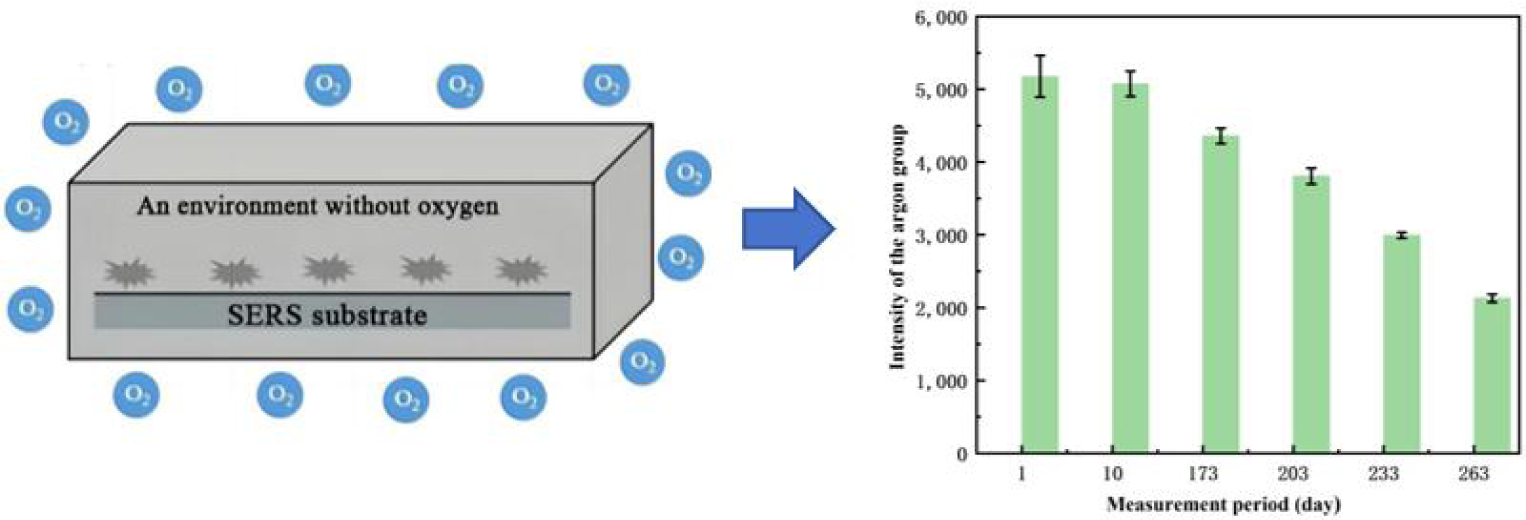
Keywords
Get full access to this article
View all access options for this article.
References
Supplementary Material
Please find the following supplemental material available below.
For Open Access articles published under a Creative Commons License, all supplemental material carries the same license as the article it is associated with.
For non-Open Access articles published, all supplemental material carries a non-exclusive license, and permission requests for re-use of supplemental material or any part of supplemental material shall be sent directly to the copyright owner as specified in the copyright notice associated with the article.
