



Abstract
The generation and presence of excessive hypochlorous acid derivative ionic form (ClO−) could cause various diseases, such as arteriosclerosis, DNA damage, and cardiovascular illness. It is a critical need to develop a highly sensitive sensor for reliable detection of ClO− in cells and water-soluble systems. In this work, a hydroxyl group has been introduced into the compound 2-amino-3-(((E)-4-(2-(2-(2-hydroxyethoxy)ethyl)-1,3-dioxo-2,3-dihydro-1H-benzo[de]isoquinolin-6-yl)benzylidene)amino)maleonitrile (NDC) to increase its solubility in water, at the same time, the hydrazone unit was designed as a specific recognition group for the “off–on” fluorescence probe of ClO−. The probe NDC presents high selectivity, sensitivity, anti-interference, and low detection limit (67 nM) for ClO−. The recognition mechanism that ClO− breaks the C=N bond and forms the fluorescent compound 4-(2-(2-(2-hydroxyethoxy)ethyl)-1,3-dioxo-2,3-dihydro-1H-benzo[de]isoquinolin-6-yl)benzaldehyde (ND-3) has been confirmed by time-of-flight mass spectrometry. The probe NDC presents a good performance in the actual test of water samples and can be designed as the test papers for the quick and convenient detection of ClO− range from 0 to 1 μM. Moreover, the practical application was demonstrated by the successful imaging of endogenous and exogenous ClO− in HeLa cells. Our fluorescent biomass-based platform opens vast possibilities for repeatability, sensitivity, and selectivity detection of ClO− in cells and water-soluble systems.
This is a visual representation of the abstract.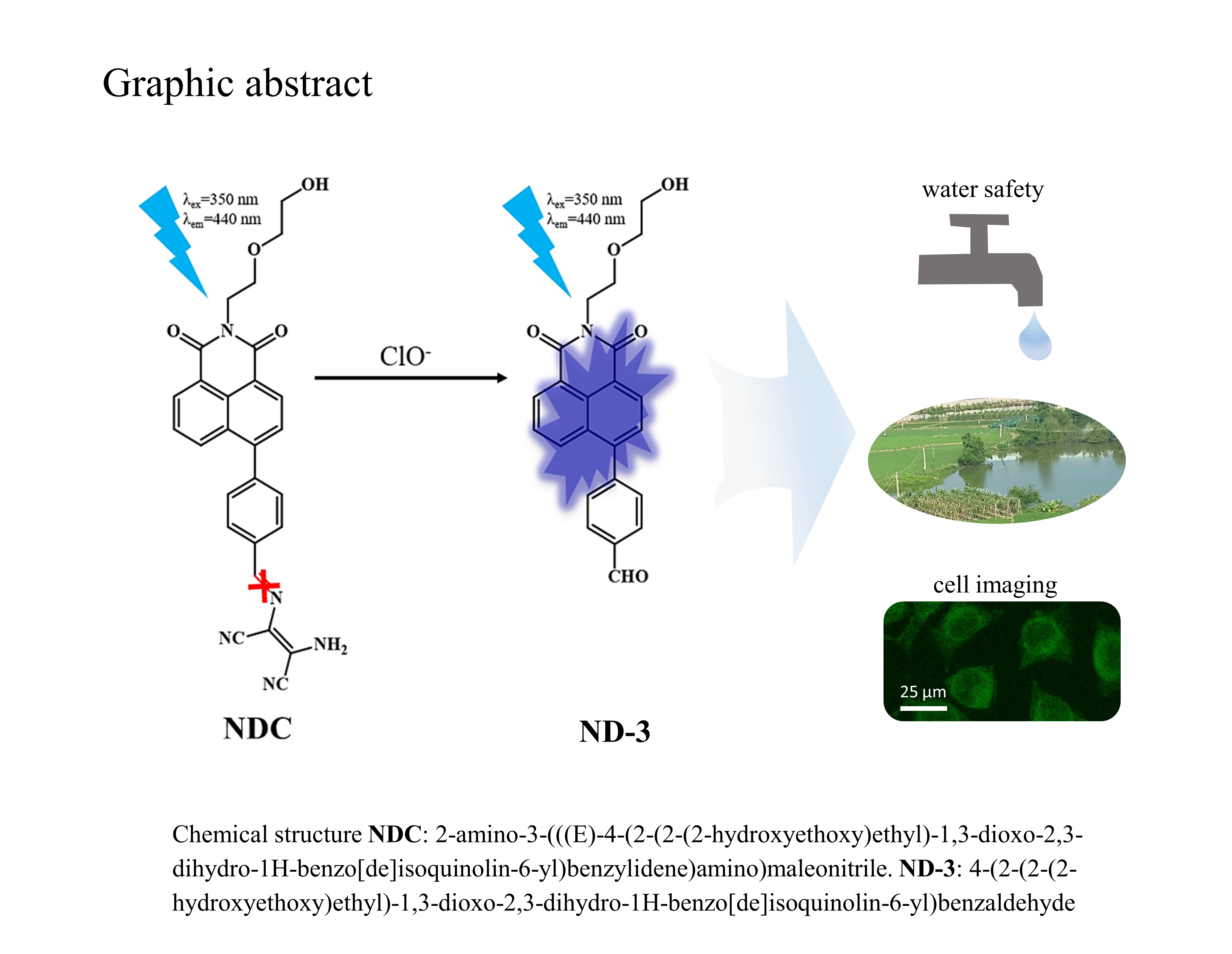
Get full access to this article
View all access options for this article.
References
Supplementary Material
Please find the following supplemental material available below.
For Open Access articles published under a Creative Commons License, all supplemental material carries the same license as the article it is associated with.
For non-Open Access articles published, all supplemental material carries a non-exclusive license, and permission requests for re-use of supplemental material or any part of supplemental material shall be sent directly to the copyright owner as specified in the copyright notice associated with the article.
