




Abstract
Near-infrared (NIR) spectroscopy is actually a well-established technique that demonstrates its performance in the frame of detection of poor-quality medicines. The use of low-cost handheld NIR spectrophotometers in low-resource contexts can allow an inexpensive and more rapid detection compared to laboratory methods. Considering these points, it was decided to develop, validate, and transfer methods for the quantification of ciprofloxacin and metronidazole tablet samples using a NIR handheld spectrophotometer in transmission mode (NIR-M-T1) coupled to chemometrics such as partial least squares regression (PLSR) algorithm. All of the models were validated with the total error approach using an accuracy profile as a decision tool, with ±10% specifications and a risk α set at 5%. Quantitative PLSR models were first validated in Belgium, which is a temperate oceanic climate zone. Second, they were transferred to Cameroon, a tropical climate zone, where issues regarding the prediction of new validation series with the initial models were highlighted. Two augmentation strategies were then envisaged to make the predictive models robust to environmental conditions, incorporating the potential variability linked to environmental effects in the initial calibration sets. The resulting models were then used for in-field analysis of ciprofloxacin and metronidazole tablet samples collected in three cities in Cameroon. The contents results obtained for each sample with the two strategies were close and not statistically different. Nevertheless, the first one is easier to implement and the second is the best regarding model diagnostic measures and accuracy profiles. Two samples were found to be noncompliant in terms of content, and these results were confirmed using high-performance liquid chromatography taken as the reference method.
This is a visual representation of the abstract.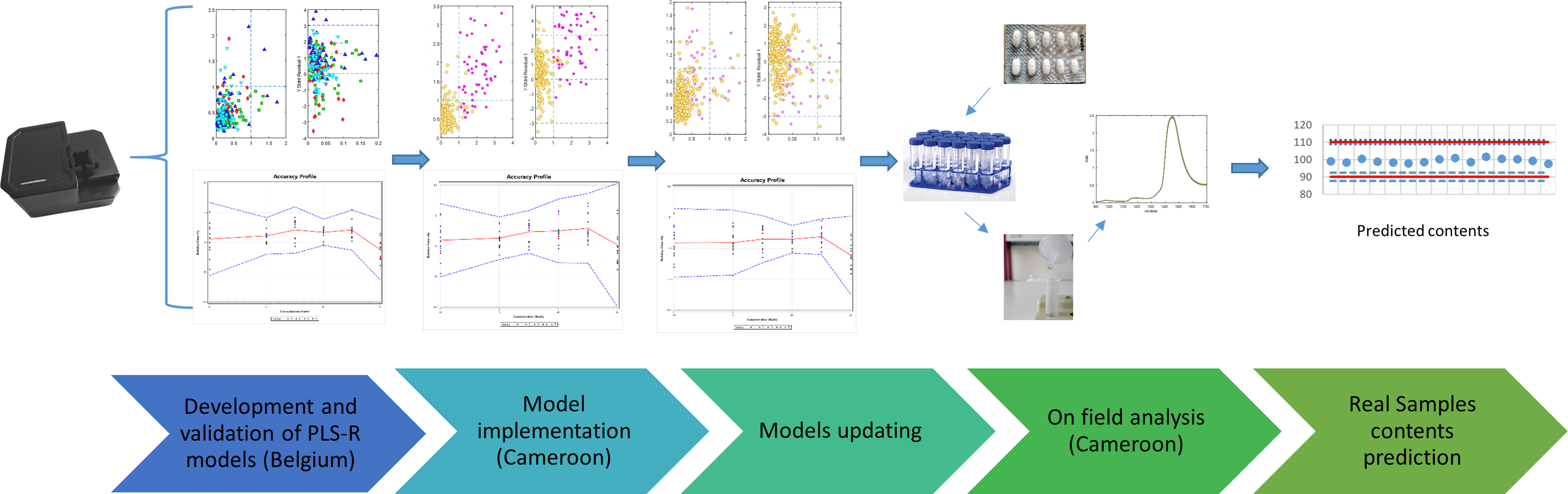
Keywords
Get full access to this article
View all access options for this article.
References
Supplementary Material
Please find the following supplemental material available below.
For Open Access articles published under a Creative Commons License, all supplemental material carries the same license as the article it is associated with.
For non-Open Access articles published, all supplemental material carries a non-exclusive license, and permission requests for re-use of supplemental material or any part of supplemental material shall be sent directly to the copyright owner as specified in the copyright notice associated with the article.
