



Abstract
We propose a novel technique to accurately predict carbon dioxide (CO2) concentrations even in flow fields with temperature gradients based on a single laser path absorption spectrum measurement and machine learning. Concentration measurements in typical tunable diode laser absorption spectroscopy are based on a ratio of two integrated absorbances, each from a spectral line with different temperature dependence. However, the inferred concentrations can deviate significantly from the actual concentrations in the presence of temperature gradients. Furthermore, it is also difficult to find an analytical expression to compensate for the effect of nonuniform temperature profiles on concentration measurements. In this study, the entire absorption feature was considered since its shape and peak intensities vary with temperature and concentration. Specifically, a predictive model is obtained in a data-driven manner that can identify and compensate for the effect of a nonuniform temperature field on the spectrum. Despite a very detailed understanding of the CO2 absorption spectrum, it is nearly impossible to collect sufficient spectra for model acquisition by varying all temperature gradient conditions. Therefore, the model was obtained using only simulated data, much like the concept of a “digital twin”. Finally, the predictive performance of the acquired model was verified using experimental data. In all test cases, the predictive performance of the model was superior to that of the two-line method. Additionally, a gradient-weighted regression activation mapping analysis confirmed that the model utilizes both the peak intensities as well as the change in the shape of absorption lines for prediction.
This is a visual representation of the abstract.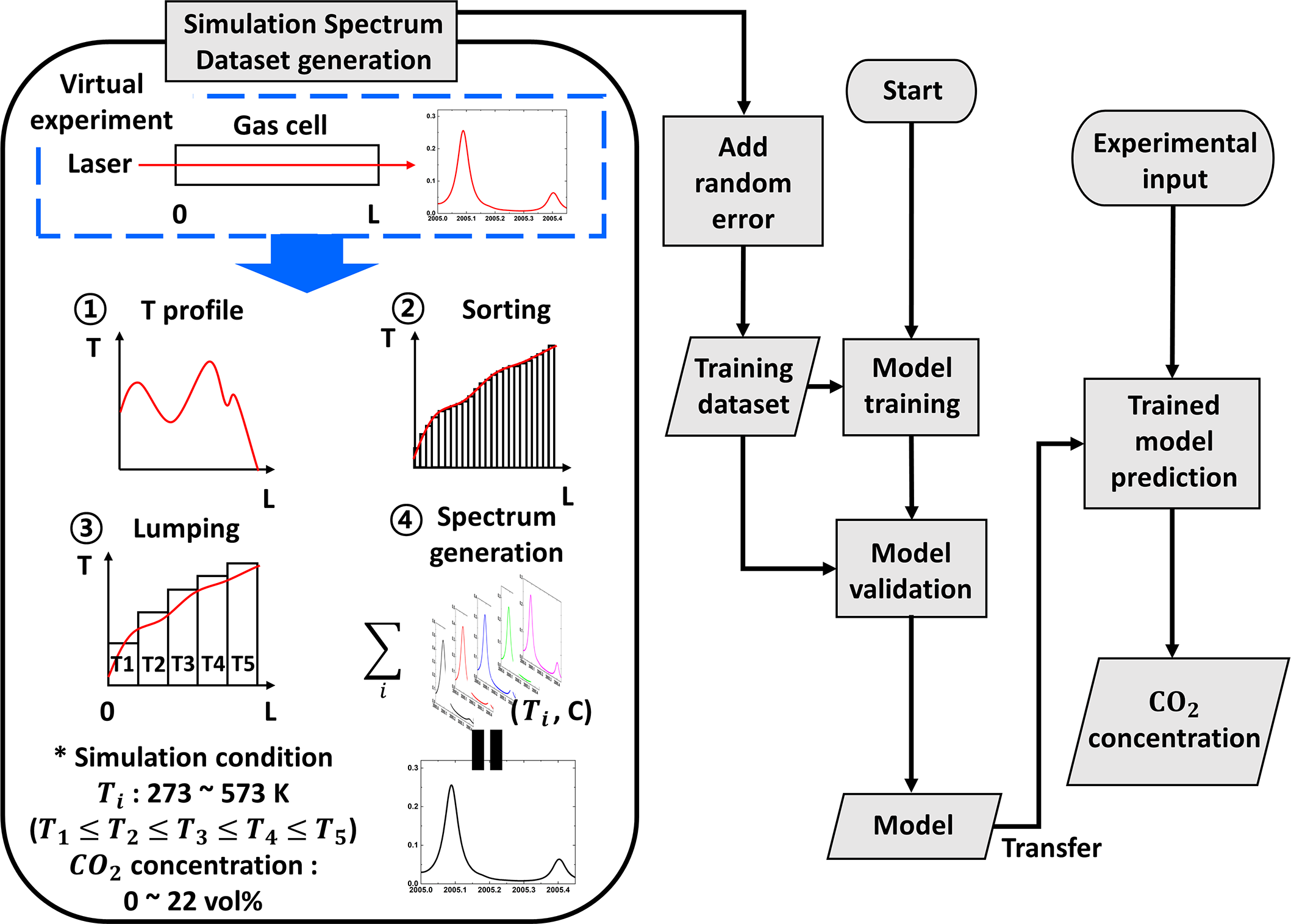
Keywords
Get full access to this article
View all access options for this article.
References
Supplementary Material
Please find the following supplemental material available below.
For Open Access articles published under a Creative Commons License, all supplemental material carries the same license as the article it is associated with.
For non-Open Access articles published, all supplemental material carries a non-exclusive license, and permission requests for re-use of supplemental material or any part of supplemental material shall be sent directly to the copyright owner as specified in the copyright notice associated with the article.
