




Abstract
A variety of innovative point-of-care (POC) solutions using Raman systems have been explored. However, the vast effort is in assay development, while studies of the characteristics required for Raman spectrometers to function in POC applications are lacking. In this study, we tested and compared the performance of eight commercial Raman spectrometers ranging in size from benchtop Raman microscopes to portable and handheld Raman spectrometers using paper fluidic cartridges, including their ability to detect cardiac troponin I and heart fatty acid binding protein, both of which are well-established biomarkers for evaluating cardiovascular health. Each spectrometer was evaluated in terms of excitation wavelength, laser characteristics, and ease of use to investigate POC utility. We found that the Raman spectrometers equipped with 780 and 785 nm laser sources exhibited a reduced background signal and provided higher sensitivity compared to those with 633 and 638 nm laser sources. Furthermore, the spectrometer equipped with the single acquisition line readout functionality showed improved performance when compared to the point scan spectrometers and allowed measurements to be made faster and easier. The portable and handheld spectrometers also showed similar detection sensitivity to the gold standard instrument. Lastly, we reduced the laser power for the spectrometer with single acquisition line readout capability to explore the system performance at a laser power that change the classification from a Class 3B laser device to a Class 3R device and found that it showed comparable performance. Overall, these findings show that portable Raman spectrometers have the potential to be used in POC settings with accuracy comparable to laboratory-grade instruments, are relatively low-cost, provide fast signal readout, are easy to use, and can facilitate access for underserved communities.
This is a visual representation of the abstract.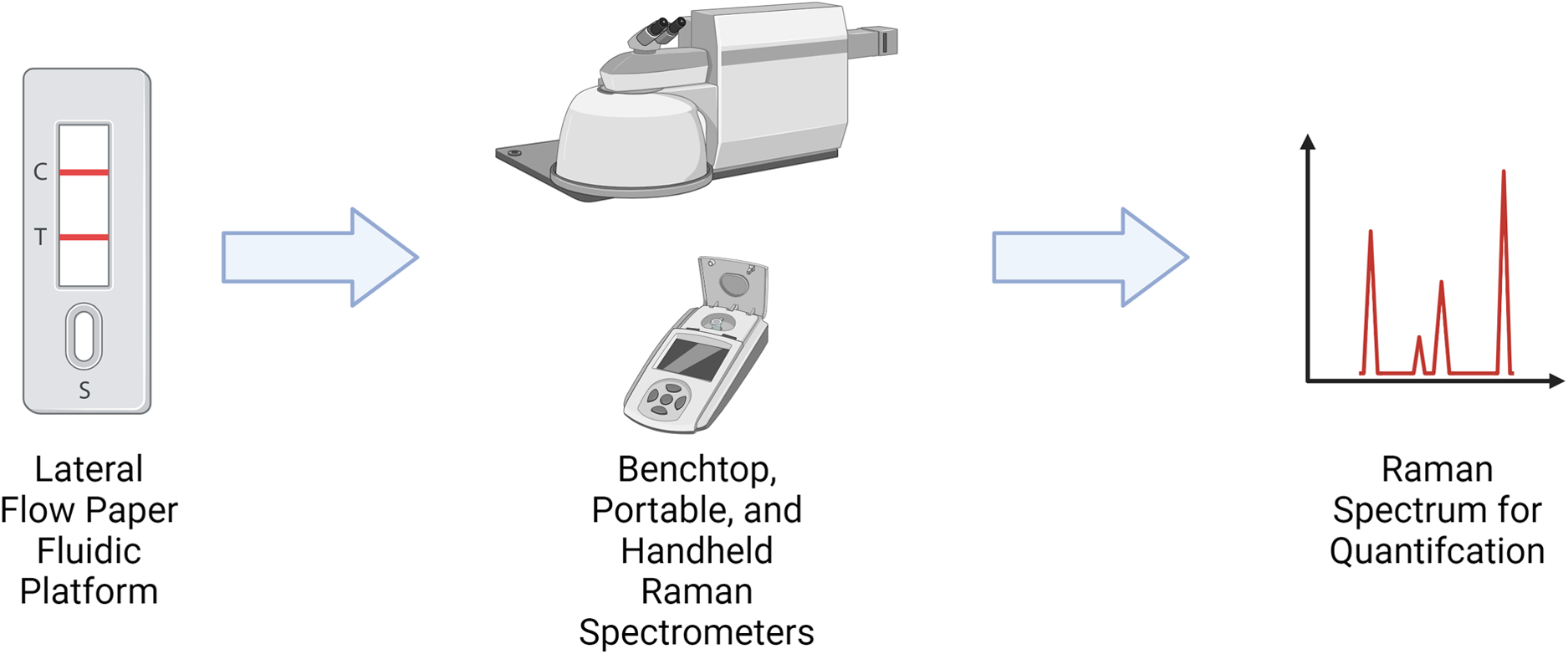
Keywords
Get full access to this article
View all access options for this article.
References
Supplementary Material
Please find the following supplemental material available below.
For Open Access articles published under a Creative Commons License, all supplemental material carries the same license as the article it is associated with.
For non-Open Access articles published, all supplemental material carries a non-exclusive license, and permission requests for re-use of supplemental material or any part of supplemental material shall be sent directly to the copyright owner as specified in the copyright notice associated with the article.
