



Abstract
A new method to determine the make and model of a vehicle from an automotive paint sample recovered at the crime scene of a vehicle-related fatality such as a hit-and-run using Raman microscopy has been developed. Raman spectra were collected from 118 automotive paint samples from six General Motors (GM) vehicle assembly plants to investigate the discrimination power of Raman spectroscopy for automotive clearcoats using a genetic algorithm for pattern recognition that incorporates model inference and sample error in the variable selection process. Each vehicle assembly plant pertained to a specific vehicle model. The spectral region between 1802 and 697 cm–1 was found to be supportive of the discrimination of these six GM assembly plants. By comparison, only one of the six automotive assembly plants could be differentiated from the other five assembly plants using Fourier transform infrared spectroscopy (FT-IR), which is the most widely used analytical method for the examination of automotive paint) and the genetic algorithm for pattern recognition. The results of this study indicate that Raman spectroscopy in combination with pattern recognition methods offers distinct advantages over FT-IR for the identification and discrimination of automotive clearcoats.
This is a visual representation of the abstract.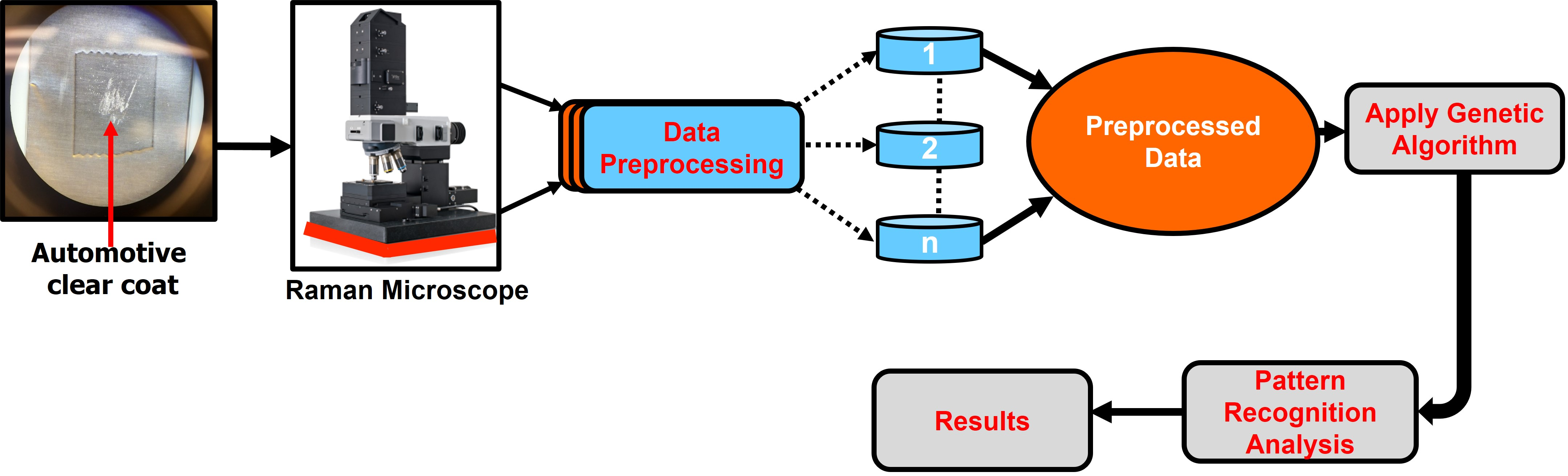
Keywords
Get full access to this article
View all access options for this article.
References
Supplementary Material
Please find the following supplemental material available below.
For Open Access articles published under a Creative Commons License, all supplemental material carries the same license as the article it is associated with.
For non-Open Access articles published, all supplemental material carries a non-exclusive license, and permission requests for re-use of supplemental material or any part of supplemental material shall be sent directly to the copyright owner as specified in the copyright notice associated with the article.
