



Abstract
It is conventionally expected that the performance of existing gas sensors may degrade in the field compared to laboratory conditions because (i) a sensor may lose its accuracy in the presence of chemical interferences and (ii) variations of ambient conditions over time may induce sensor-response fluctuations (i.e., drift). Breaking this status quo in poor sensor performance requires understanding the origins of design principles of existing sensors and bringing new principles to sensor designs. Existing gas sensors are single-output (e.g., resistance, electrical current, light intensity, etc.) sensors, also known as zero-order sensors (Karl Booksh and Bruce R. Kowalski, Analytical Chemistry, DOI: 10.1021/ac00087a718). Any zero-order sensor is undesirably affected by variable chemical background and sensor drift that cannot be distinguished from the response to an analyte. To address these limitations, we are developing multivariable gas sensors with independent responses, which are first-order analytical instruments. Here, we demonstrate self-correction against drift in two types of first-order gas sensors that operate in different portions of the electromagnetic spectrum. Our radiofrequency sensors utilize dielectric excitation of semiconducting metal oxide materials on the shoulder of their dielectric relaxation peak and achieve self-correction of the baseline drift by operation at several frequencies. Our photonic sensors utilize nanostructured sensing materials inspired by Morpho butterflies and achieve self-correction of the baseline drift by operation at several wavelengths. These principles of self-correction for drift effects in first-order sensors open opportunities for diverse emerging monitoring applications that cannot afford frequent periodic maintenance that is typical of traditional analytical instruments.
This is a visual representation of the abstract.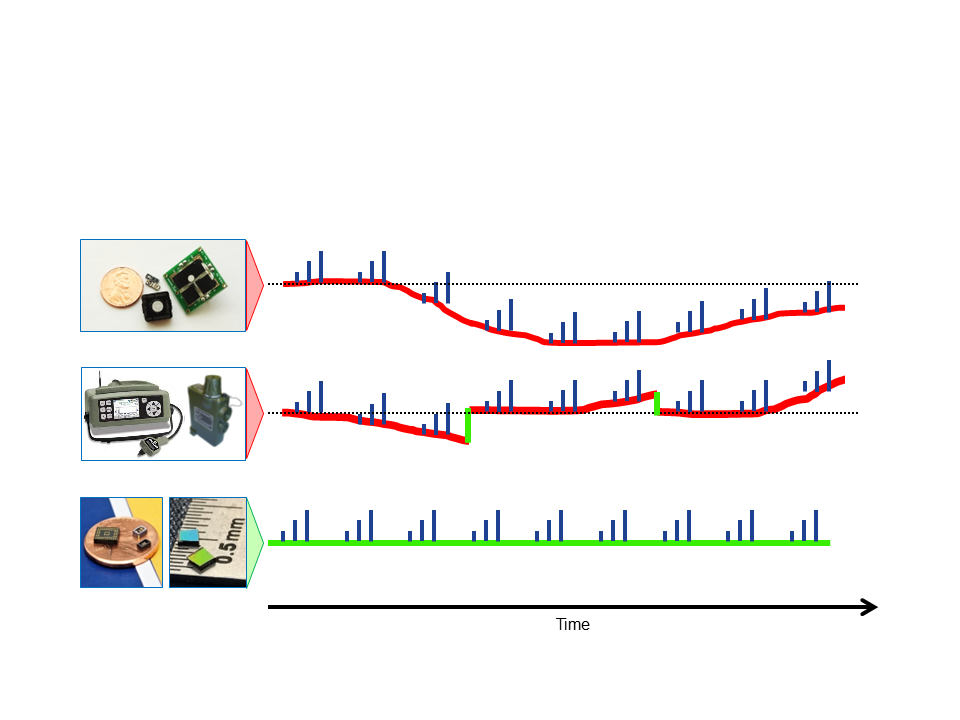
Keywords
Get full access to this article
View all access options for this article.
References
Supplementary Material
Please find the following supplemental material available below.
For Open Access articles published under a Creative Commons License, all supplemental material carries the same license as the article it is associated with.
For non-Open Access articles published, all supplemental material carries a non-exclusive license, and permission requests for re-use of supplemental material or any part of supplemental material shall be sent directly to the copyright owner as specified in the copyright notice associated with the article.
