




Abstract
In a Fourier transform infrared (IR) spectrometer, the Michelson interference signal extrapolation method based on linear prediction is often used to improve spectral resolution. In this method, an autoregressive (AR) model is established for the Michelson interference signal in the spectrometer. Once the AR model parameters are determined, the AR process is predictable. The interference signal can be used to figure out the AR model's parameters. Based on this, the AR model can be used to extrapolate the interference signal to improve the spectral resolution. In this paper, the forward–backward linear prediction total least squares (FB-TLS) method is proposed to estimate the parameters of the AR model. The parameters that are estimated are used to improve the IR spectral resolution. By simulating different order and signal-to-noise ratio situations, the effects of the Burg, the least square, and the FB-TLS parameter estimation methods on spectral resolution enhancement are studied. The simulation results demonstrate that the FB-TLS parameter estimation method can effectively suppress noise and avoid spurious peaks. The experimental results demonstrate that the FB-TLS parameter estimation method is effective for spectral resolution enhancement technology based on linear prediction. When the FB-TLS method is used to enhance NH3 IR spectral resolution from 2 cm−1 to 1 cm−1, the spectral prediction error in the NH3 characteristic band is only 0.21% compared with the measured NH3 spectrum, whose spectral resolution is 1 cm−1.
This is a visual representation of the abstract.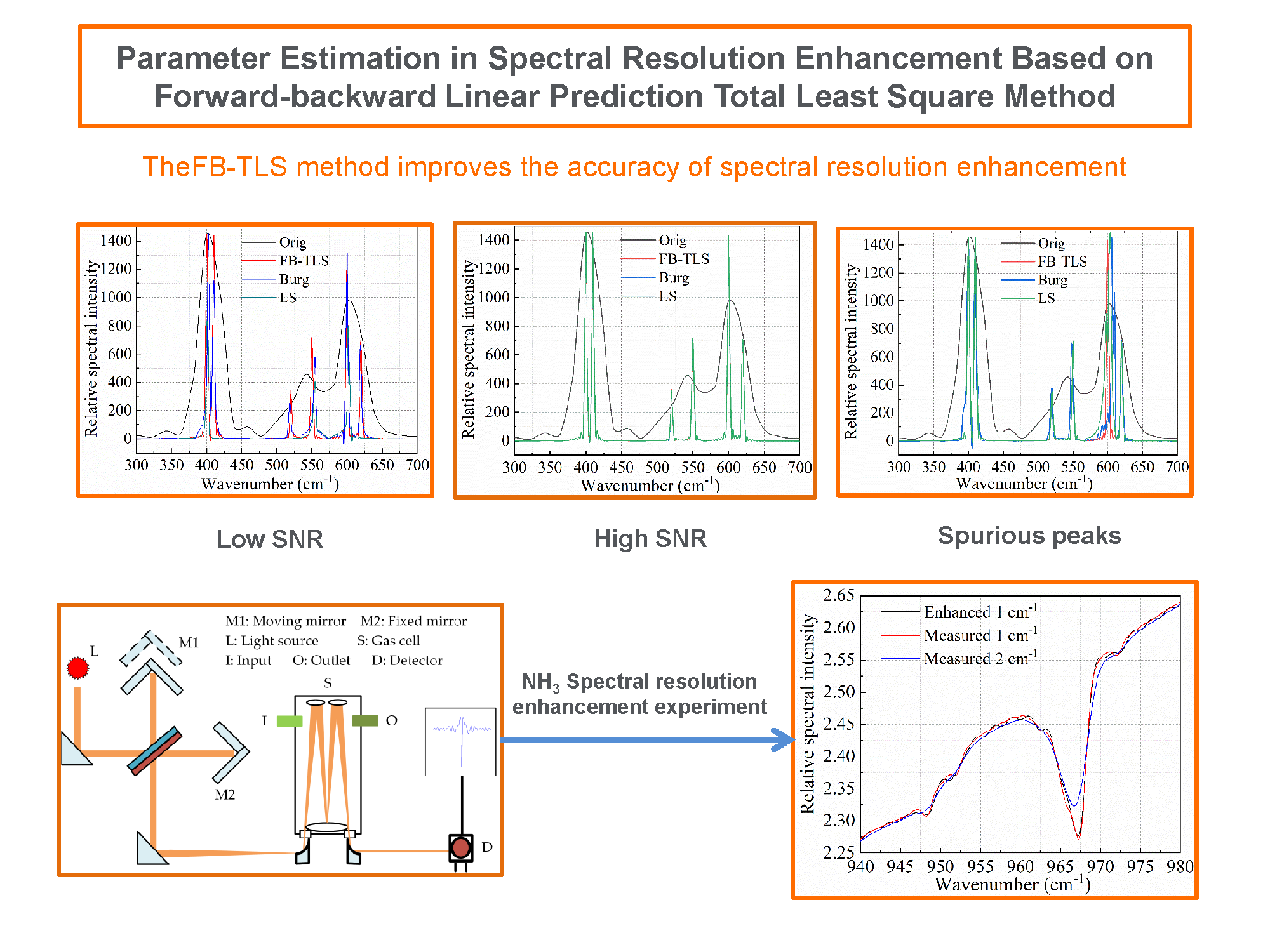
Keywords
Get full access to this article
View all access options for this article.
References
Supplementary Material
Please find the following supplemental material available below.
For Open Access articles published under a Creative Commons License, all supplemental material carries the same license as the article it is associated with.
For non-Open Access articles published, all supplemental material carries a non-exclusive license, and permission requests for re-use of supplemental material or any part of supplemental material shall be sent directly to the copyright owner as specified in the copyright notice associated with the article.
