




Abstract
Germination rate is important for seed selection and planting and quality. In this study, hyperspectral image technology integrated with germination tests was applied for feature association analysis and germination performance prediction of sugarbeet seeds. In this study, we proposed a nondestructive prediction method for sugarbeet seed germination. Sugarbeet seed was studied, and hyperspectral imaging (HIS) performed by binarization, morphology, and contour extraction was applied as a nondestructive and accurate technique to achieve single seed image segmentation. Comparative analysis of nine spectral pretreatment methods, SNV + 1D was used to process the average spectrum of sugarbeet seeds. Fourteen characteristic wavelengths were obtained by the Kullback–Leibler (KL) divergence, as the spectral characteristics of sugarbeet seeds. Principal component analysis (PCA) and material properties verified the validity of the extracted characteristic wavelengths. It was extracted of six image features of the hyperspectral image of a single seed obtained based on the gray-level co-occurrence matrix (GLCM). The spectral features, image features, and fusion features were used to establish partial least squares discriminant analysis (PLS-DA), CatBoost, and support vector machine radial-basis function (SVM-RBF) models respectively to predict the germination. The results showed that the prediction effect of fusion features was better than spectral features and image features. By comparing other models, the prediction results of the CatBoost model accuracy were up to 93.52%. The results indicated that, based on HSI and fusion features, the prediction of germinating sugarbeet seeds was more accurate and nondestructive.
This is a visual representation of the abstract.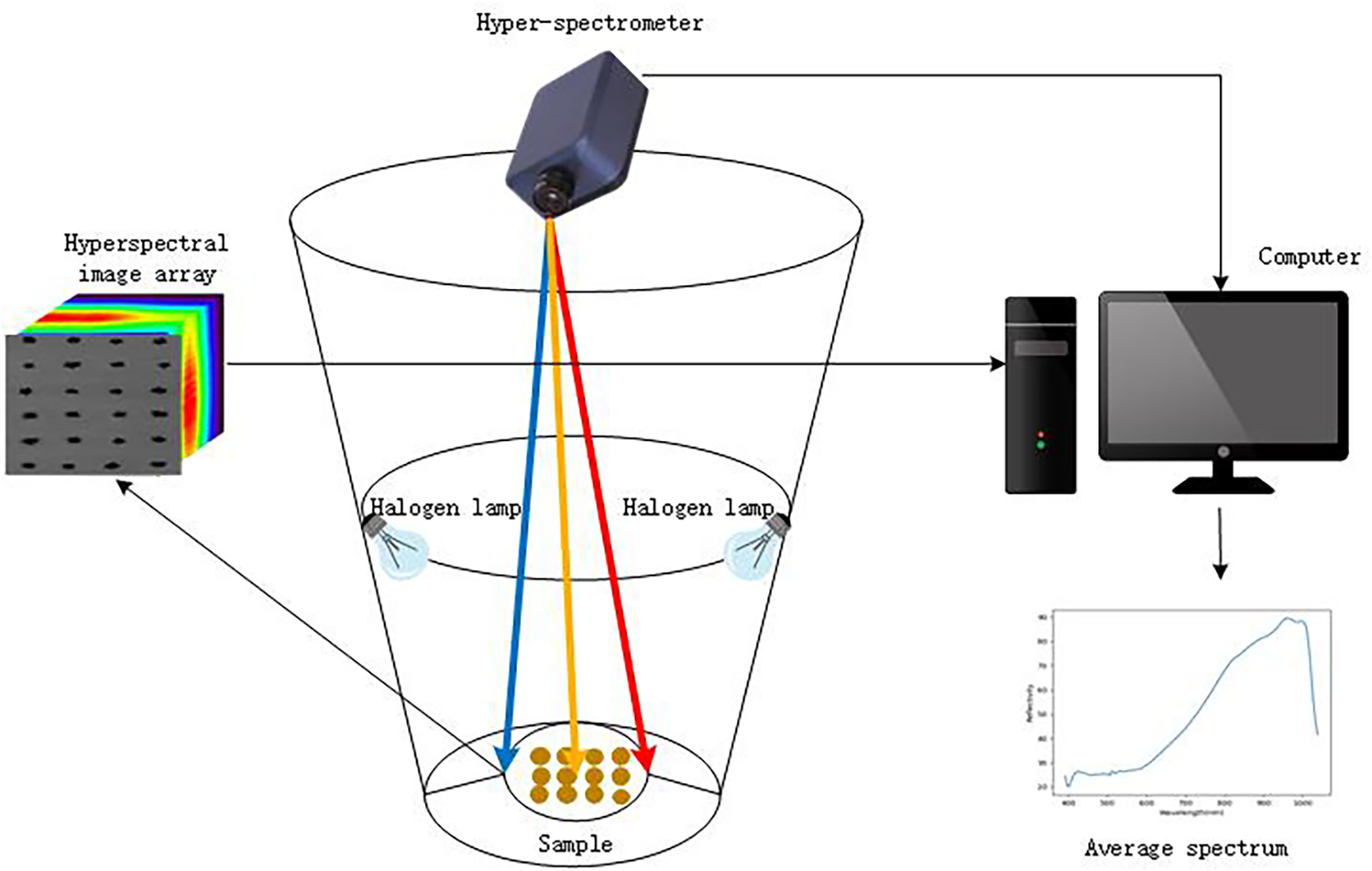
Get full access to this article
View all access options for this article.
References
Supplementary Material
Please find the following supplemental material available below.
For Open Access articles published under a Creative Commons License, all supplemental material carries the same license as the article it is associated with.
For non-Open Access articles published, all supplemental material carries a non-exclusive license, and permission requests for re-use of supplemental material or any part of supplemental material shall be sent directly to the copyright owner as specified in the copyright notice associated with the article.

