




Abstract
Gold nanostars (AuNSs) are synthesized using a seed-mediated growth method. The synthesized AuNSs solution is stable and shows a localized surface plasmon resonance (LSPR) band in the visible range, which is confirmed using ultraviolet–visible (UV–Vis) spectroscopy. Furthermore, the as-synthesized AuNSs were functionalized with melamine and used as a sensor for the colorimetric detection of uric acid (UA). The detection mechanism could be assessed through various analytical techniques such as UV–Vis spectroscopy, Fourier transform infrared (FT-IR) spectroscopy, dynamic light scattering (DLS), zeta potential, field emission scanning electron microscopy (FE-SEM), and transmission electron microscopic techniques. These methods exhibited a good linear regression between the absorption ratio of LSPR band of melamine–AuNSs and the concentration of UA (0–120 µM), with the detection limit of 8.50 nm. As a result, UA was quantitatively detected in biofluids by using melamine-AuNSs as a colorimetric sensor, revealing melamine–AuNSs–based colorimetric approach which could be used as a simple platform for UA assay in biofluids.
This is a visual representation of the abstract.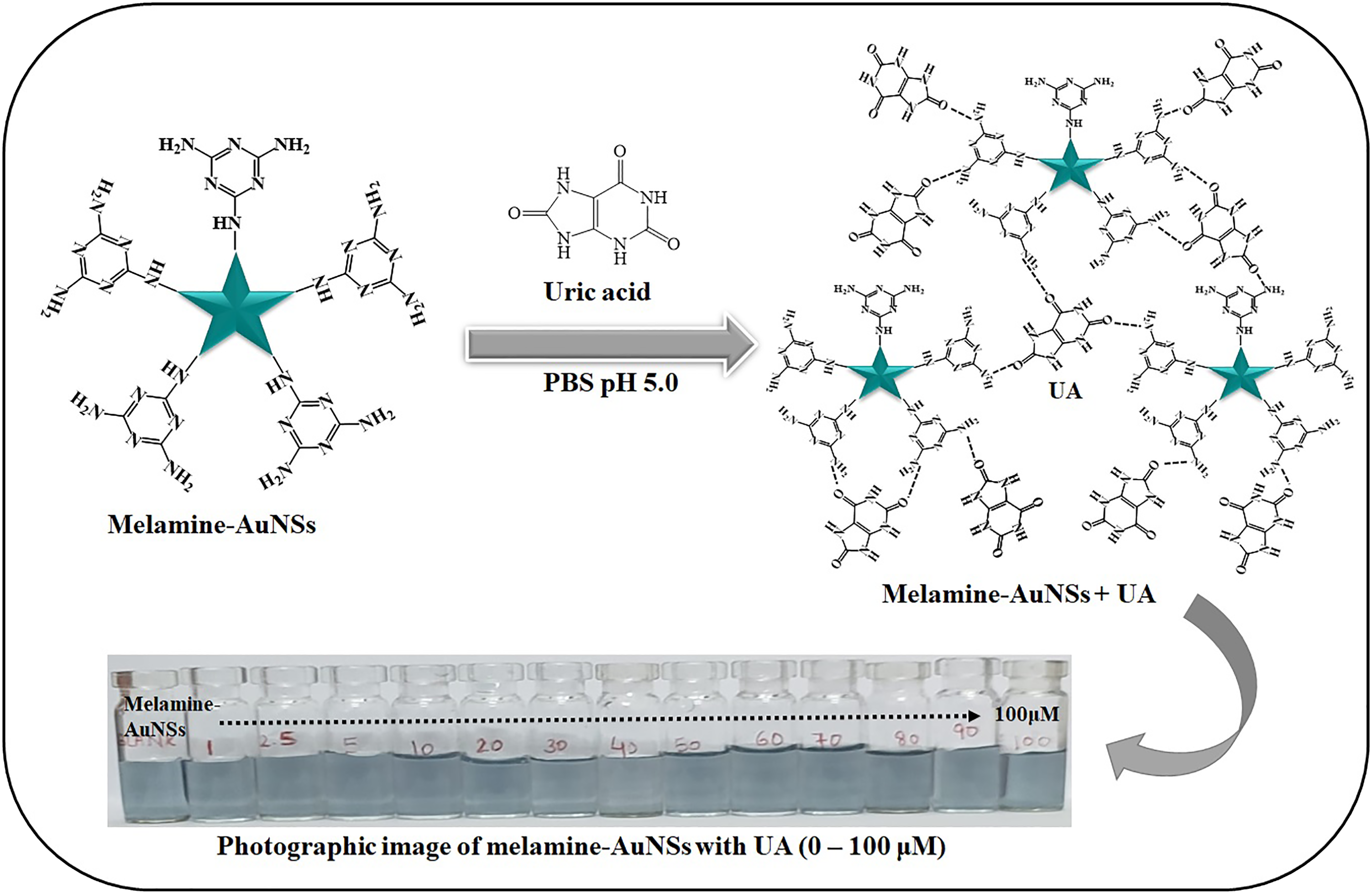
Keywords
Get full access to this article
View all access options for this article.
References
Supplementary Material
Please find the following supplemental material available below.
For Open Access articles published under a Creative Commons License, all supplemental material carries the same license as the article it is associated with.
For non-Open Access articles published, all supplemental material carries a non-exclusive license, and permission requests for re-use of supplemental material or any part of supplemental material shall be sent directly to the copyright owner as specified in the copyright notice associated with the article.
