




Abstract
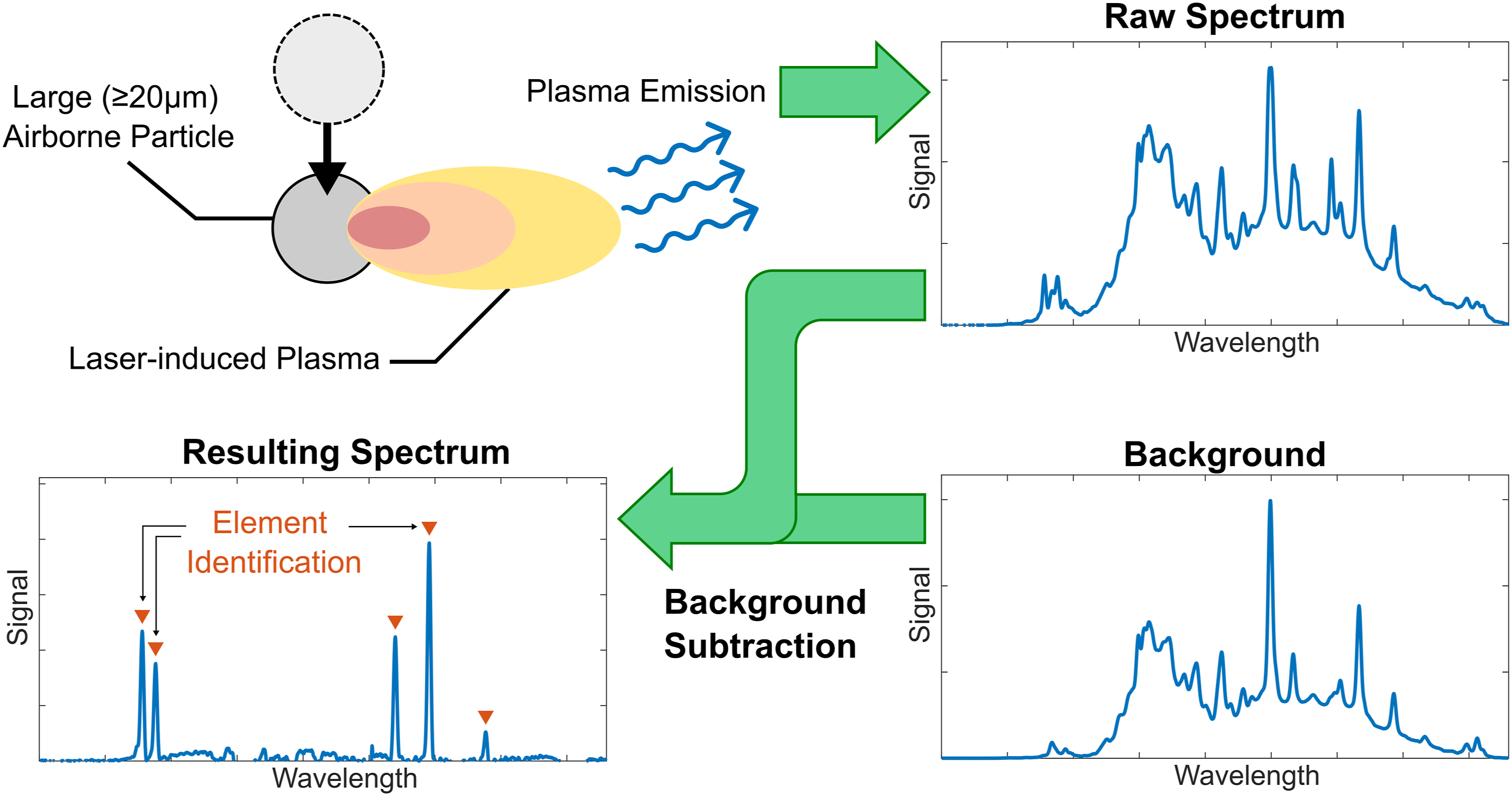
The ability to obtain information on the composition of airborne particles is a necessary part of identifying and controlling risks from exposure to potentially toxic materials, especially in the workplace. However, very few aerosol sampling instruments can characterize elemental composition in real time or measure large inhalable particles with aerodynamic diameter exceeding 20 µm. Here, we present the development and validation of a method for real time elemental composition analysis of large inhalable particles using laser-induced breakdown spectroscopy (LIBS). The prototype sensor uses a passive inlet and an optical triggering system to ablate falling particles with an LIBS plasma. Particle composition is quantified based on collected emission spectra using a real-time material classification algorithm. The approach was validated with a set of 1480 experimental spectra from four different aerosol test materials. We have studied effects of varying detection thresholds and find operating conditions with good agreement to truth values (F1 score ≥ 0.9). Details of the analysis method, including subtracting the spectral contribution from the air plasma and reasons for the infrequent misclassifications, are discussed. The LIBS elemental analysis can be combined with our previously demonstrated direct-reading particle sizer (DRPS) to provide a system capable of both counting, sizing, and elemental analysis of large inhalable particles.
Get full access to this article
View all access options for this article.
References
Supplementary Material
Please find the following supplemental material available below.
For Open Access articles published under a Creative Commons License, all supplemental material carries the same license as the article it is associated with.
For non-Open Access articles published, all supplemental material carries a non-exclusive license, and permission requests for re-use of supplemental material or any part of supplemental material shall be sent directly to the copyright owner as specified in the copyright notice associated with the article.
