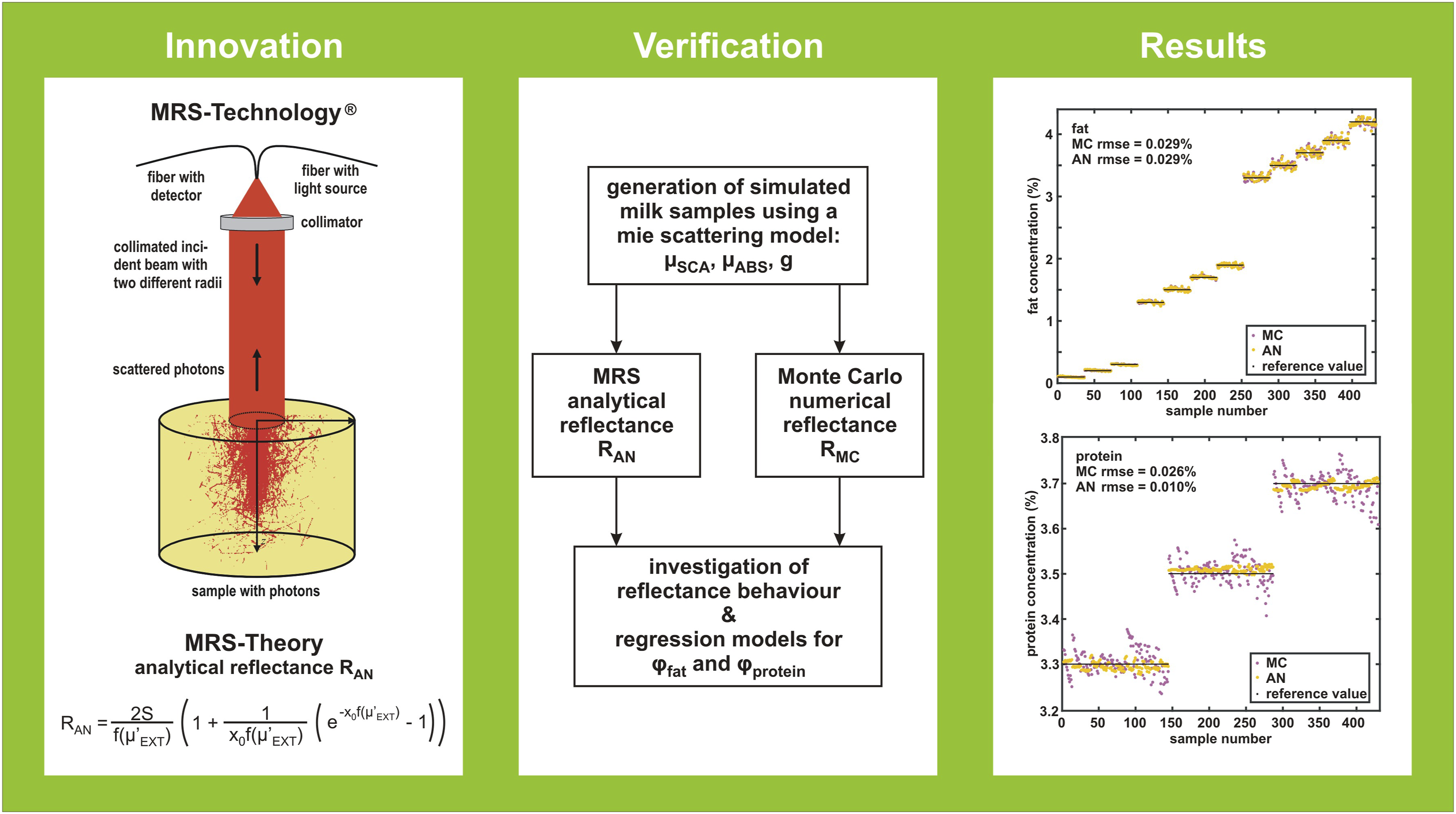
Optical methods are appropriate for monitoring of constituents in suspensions and emulsions. A simple multi-wavelength, multi-reflectance spectroscopic technique, called MRS-Technology, is introduced. Two different signals of a sample are measured: the reflectance from a small and from a large measuring volume corresponding to the reduced scattering coefficient and to the sum of and the absorption coefficient μABS, respectively. Analytical relations between the MRS reflectance and μABS as well as are derived. The investigations on MRS method are carried out using milk as an example. For this purpose “virtual” milk samples are defined. μABS and are calculated by means of the Mie scattering theory in the ultraviolet–visible–shortwave near-infrared (UV-Vis-SWNIR) spectral range. Using this data analytical reflectances can be calculated based on MRS theory as well as numerical reflectances obtained by Monte Carlo (MC) simulation. Analytical and numerical results are compared and investigated. The spectral behavior of the analytical reflectances is very similar to that of the numerical MC reflectances in the case of medium and low absorptions. By means of simple multilinear regression techniques (MLR), simple correlations between fat and protein volume fractions and reflectances could be generated with acceptable root mean square error (RMSE) values. Each correlation shows that best results will be achieved by using reflectances at sample-specific wavelengths for small and large measuring volumes of a sample indicating the potential of the MRS-Technology.
MieG.. “Beiträge zur Optik trüber Medien, speziell kolloidaler Metallösungen”. Ann. Phys. 1908. 330(3): 377–445. 10.1002/andp.19083300302
5.
HulstH.C.. Light Scattering by Small Particles. New York: Dover Publications, 1981.
6.
BohrenC.F.HuffmanD.R.. Absorption and Scattering of Light by Small Particles. New York: John Wiley and Sons, Ltd, 1998.
7.
KerkerM.. The Scattering of Light and Other Electromagnetic Radiation. New York: Academic Press, 1969.
8.
IshimaruA.. Electromagnetic Wave Propagation, Radiation, and Scattering: From Fundamentals to Applications. New York: John Wiley and Sons, 2017.
9.
ChandrasekharA.. Radiative Transfer. New York: Dover Publications, 1960.
10.
FarrellT.J.PattersonM.S.WilsonB.. “A Diffusion Theory Model of Spatially Resolved, Steady-State Diffuse Reflectance for the Noninvasive Determination of Tissue Optical Properties in Vivo”. Med. Phys. 1992. 19(4): 879–888. 10.1118/1.596777
11.
ZoniosG.DimouA.. “Modeling Diffuse Reflectance from Semi-infinite Turbid Media: Application to the Study of Skin Optical Properties”. Opt. Express. 2006. 14(19): 8661–8674. 10.1364/OE.14.008661
12.
ReifR.A’AmarO.BigioI.J.. “Analytical Model of Light Reflectance for Extraction of the Optical Properties in Small Volumes of Turbid Media”. Appl. Opt. 2007. 46(29): 7317–7328. 10.1364/AO.46.007317
13.
CalabroK.W.BigioI.J.. “Influence of the Phase Function in Generalized Diffuse Reflectance Models: Review of Current Formalisms and Novel Observations”. J. Biomed. Opt. 2014. 19(7): 1–15. 10.1117/1.JBO.19.7.075005
14.
WangL.JacquesS.L.. “Monte Carlo Modeling of Light Transport in Multi-Layered Tissues in Standard C”. 1992. http://coilab.caltech.edu/mcr5/Mcman.pdf [accessed Aug 25 2022].
15.
StockerS.. Optik der Milch: Experimente und Simulationen. [Doctoral Thesis]. Ulm, Germany: Universität Ulm, 2018.
16.
OelkrugD.BrunM.RebnerK.BoldriniB.KesslerR.. “Penetration of Light into Multiple Scattering Media: Model Calculations and Reflectance Experiments. Part I: The Axial Transfer”. Appl. Spectrosc. 2012. 66(8): 934–943. 10.1366/12-06800
17.
LiemertA.KienleA.. “Light Diffusion in a Turbid Cylinder. I. Homogeneous Case”. Opt. Express. 2010. 18(9): 9456–9473. 10.1364/OE.18.009456
18.
SaikoG.DouplikA.. “Reflectance of Biological Turbid Tissues under Wide Area Illumination: Single Backward Scattering Approach”. Int. J. Photoenergy. 2014: 1‐8. 10.1155/2014/241364
19.
GomesA.J.BackmanV.. “Analytical Light Reflectance Models for Overlapping Illumination and Collection Area Geometries”. Appl. Opt2012. 51(33): 8013–8021. 10.1364/AO.51.008013
20.
GomesA.J.BackmanV.. “Algorithm For Automated Selection of Application-Specific Fiber-Optic Reflectance Probes”. J. Biomed. Opt. 2013. 18(2): 1–13. 10.1117/1.JBO.18.2.027012
21.
ZoniosG.PerelmanL.T.BackmanV.ManoharanR., et al. “Diffuse Reflectance Spectroscopy of Human Adenomatous Colon Polyps in Vivo”. Appl. Opt. 1999. 38(31): 6628–6637. 10.1364/AO.38.006628
22.
AernoutsB.PolshinE.LammertynJ.SaeysW.. “Visible and Near-Infrared Spectroscopic Analysis of Raw Milk for Cow Health Monitoring: Reflectance or Transmittance?” J. Dairy Sci2011. 94(11): 5315–5329. 10.3168/jds.2011-4354
23.
BogomolovA.DietrichS.BoldriniB.KesslerR.W.. “Quantitative Determination of Fat and Total Protein in Milk Based on Visible Light Scatter”. Food Chem. 2012. 134(1): 412–418. 10.1016/j.foodchem.2012.02.077
24.
BassM.. Handbook of Optics: Volume I - Geometrical and Physical Optics, Polarized Light, Components and Instruments. New York: The McGraw-Hill Companies, 2010.
25.
TuchinV.V.. Tissue Optics: Light Scattering Methods and Instruments for Medical Diagnosis. Bellingham, Washington: SPIE Press, 2015.
26.
FrisvadJ.R.ChristensenN.J.JensenH.W.. “Computing the Scattering Properties of Participating Media Using Lorenz-Mie Theory”. ACM Trans. Graph. 2007. 26(3): 60. 10.1145/1276377.1276452
27.
PrahlS.. Light Transport in Tissue. [Doctoral Thesis]. Austin, Texas: University of Texas at Austin, 1988.
28.
ChaJ.KimJ.KimS.. “Noninvasive Determination of Fiber Orientation and Tracking 2-Dimensional Deformation of Human Skin Utilizing Spatially Resolved Reflectance of Infrared Light Measurement in Vivo”. Measurement. 2019. 142: 170–180. 10.1016/j.measurement.2019.04.065
29.
LuckW.. “Zur Assoziation des Wassers II. Salzeffekte auf die Ultrarotbanden des Wassers”. Ber. Bunsenges. Phys. Chem. 1965. 69(1): 69–76. 10.1002/bbpc.19650690111
30.
HaleG.M.QuerryM.R.. “Optical Constants of Water in the 200-nm to 200μm Wavelength Region”. Appl. Opt. 1973. 12(3): 555–563. 10.1364/AO.12.000555
31.
VeenR.SterenborgH.PifferiA.TorricelliA., et al. “Determination of VIS- NIR absorption Coefficients of Mammalian Fat, with Time- and Spatially Resolved Diffuse Reflectance and Transmission Spectroscopy”. Paper presented at: Biomedical Topical Meeting.Miami Beach, Florida, 14–17 April 2004. 10.1364/BIO.2004.SF4
32.
CraigB.M.. “Refractive Indices of Some Saturated and Monoethenoid Fatty Acids and Methyl Esters”. Can. J. Chem. 1953. 31(5): 499–504. 10.1139/v53-068
33.
Sample Dispersion and Refractive Index Guide[Reference Manual]. Malvern, UK: Malvern Instruments Ltd., 2007.
HemleyR.KohlerB.E.SiviskiP.. “Absorption Spectra from the Complexes Formed from Vitamin-A and I3-Lactoglobulin”. Biophys. J. 1979. 28(3): 447–455. 10.1016/S0006-3495(79)85192-9
36.
GolubentsevA.A.. “The Suppression of Interference Effects in the Multiple Scattering of Light”. Zh. Eksp. Teor. Fiz1984. 86: 47–59. http://jetp.ras.ru/cgi-bin/dn/e_059_01_0026.pdf [accessed Aug 25 2022].
37.
GargR.Prud’hommeR.K.AksayI.A.LiuF., et al. “Optical Transmission in Highly Concentrated Dispersions”. J. Opt. Soc. Am. A. 1998. 15(4): 932–935. 10.1364/JOSAA.15.000932
38.
TwerskyV.. “Low-Frequency Scattering by Correlated Distributions of Randomly Oriented Particles”. J. Acoust. Soc. Am. 1987. 81(5): 1609–1618. 10.1121/1.394513
39.
AernoutsB.BeersR.V.WattéR.LammertynJ.SaeysW.. “Dependent Scattering in Intralipid® Phantoms in the 600-1850 nm Range”. Opt. Express. 2014. 22(5): 6086–6098. 10.1364/OE.22.006086
40.
MulderH.WalstraP.. The Milk Fat Globule: Emulsion Science as Applied to Milk Products and Comparable Foods. Buckinghamshire, UK: Farnham Royal Commonwealth Agricultural Bureaux, 1974.
41.
TöpelA.. Chemie und Physik der Milch. Hamburg, Germany: Behr’s Verlag, 2016.
42.
FoxP.F.McSweeneyP.L.H.. Dairy Chemistry and Biochemistry. New York: Kluwer Academic/Plenum Publishers, 1998.
Supplementary Material
Please find the following supplemental material available below.
For Open Access articles published under a Creative Commons License, all supplemental material carries the same license as the article it is associated with.
For non-Open Access articles published, all supplemental material carries a non-exclusive license, and permission requests for re-use of supplemental material or any part of supplemental material shall be sent directly to the copyright owner as specified in the copyright notice associated with the article.