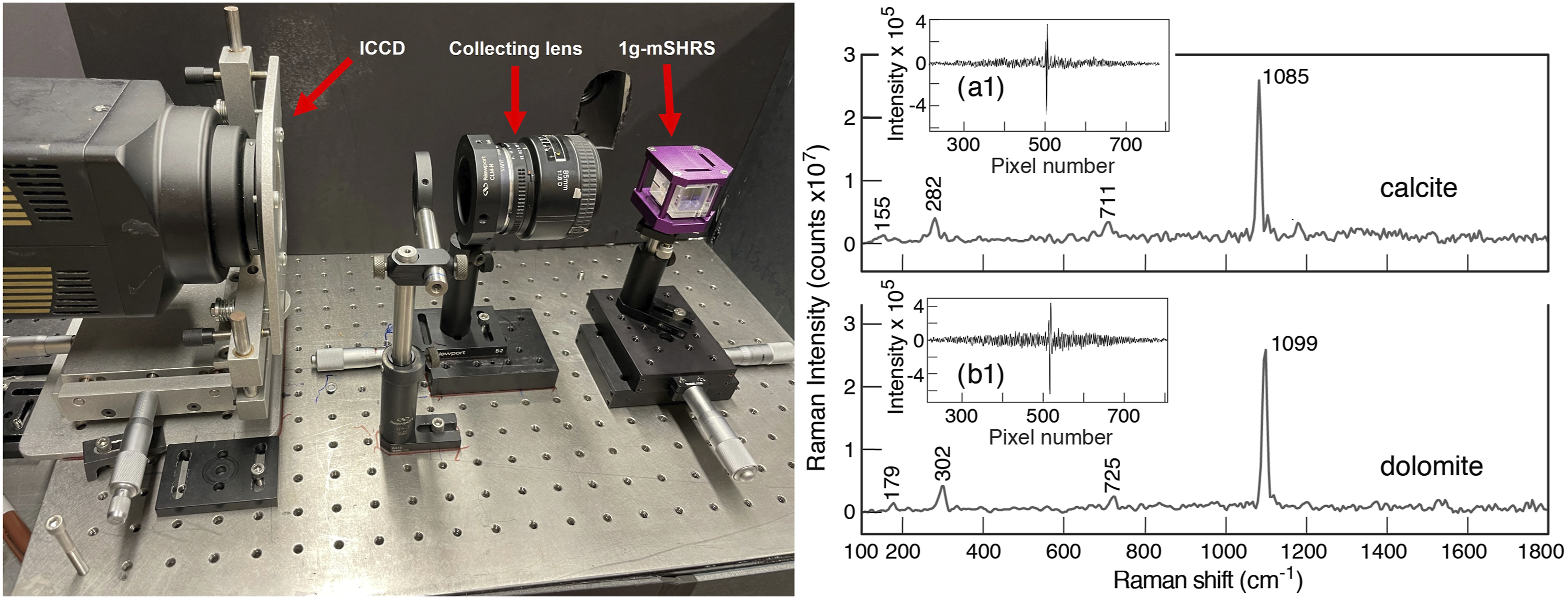
Advances in Raman instrumentation have led to the implementation of a remote dispersive Raman spectrometer on the Perseverance rover on Mars, which is used for remote sensing. For remote applications, dispersive spectrometers suffer from a few setbacks such as relatively larger sizes, low light throughput, limited spectral ranges, relatively low resolutions for small devices, and high sensitivity to misalignment. A spatial heterodyne Raman spectrometer (SHRS), which is a fixed grating interferometer, helps overcome some of these problems. Most SHRS devices that have been described use two fixed diffraction gratings, but a variance of the SHRS called the one-grating SHRS (1g-SHRS) replaces one of the gratings with a mirror, which makes it more compact. In a recent paper we described monolithic two-gratings SHRS, and in this paper, we investigate a single-grating monolithic SHRS (1g-mSHRS), which combines the 1g-SHRS with a monolithic setup previously tested at the University of South Carolina. This setup integrates the beamsplitter, grating, and mirror into a single monolithic device. This reduces the number of adjustable components, allows for easier alignment, and reduces the footprint of the device (35 × 35 × 25 mm with a weight of 80 g). This instrument provides a high spectral resolution (∼9 cm−1) and large spectral range (7327 cm−1) while decreasing the sensitivity to alignment with a field of view of 5.61 mm at 3m. We discuss the characteristics of the 1g-mSHRS by measuring the time-resolved remote Raman spectra of a few inorganic salts, organics, and minerals at 3 m. The 1g-mSHRS makes a good candidate for planetary exploration because of its large spectral range, greater sensitivity, competitively higher spectral resolution, low alignment sensitivity, and high light throughput in a compact easily aligned system with no moving parts.
ManriqueJ.A.Lopez-ReyesG.CousinA.RullF., et al. “SuperCam Calibration Targets: Design and Development”. Space Sci. Rev. 2020. 216(8): 138. doi:10.1007/S11214-020-00764-W
2.
WiensR.C.MauriceS.RobinsonS.H.NelsonA.E., et al. “The Supercam Instrument Suite on the NASA Mars 2020 Rover: Body Unit and Combined System Tests”. Space Sci. Rev.2020. 217(1): 4. doi:10.1007/S11214-020-00777-5
3.
ConnesP.. “Spectromètre Interférentiel à Sélection par l'amplitude de Modulation”. J. Phys. Radium. 1958. 19(3): 215–222. doi:10.1051/jphysrad:01958001903021500
4.
RoeslerF.L.HarlanderJ.M.. “Spatial Heterodyne Spectroscopy: Interferometric Performance at Any Wavelength Without Scanning”. In: McNamaraB.J.LernerJ.M., editors. Optical Spectroscopic Instrumentation and Techniques for the 1990s: Applications in Astronomy, Chemistry, and Physics. Bellingham, Washington: SPIE, 1990. Pp. 234‐243.
5.
HarlanderJ.M.RoeslerF.L.CardonJ.G.EnglertC.R., et al. “SHIMMER: A Spatial Heterodyne Spectrometer for Remote Sensing of Earth’s Middle Atmosphere”. Appl. Opt2002. 41(7): 1343‐1352. doi:10.1364/Ao.41.001343
6.
WatchornS.RoeslerF.L.HarlanderJ.M.JaehnigK.P., et al. “Development of the Spatial Heterodyne Spectrometer for VUV Remote Sensing of the Interstellar Medium”. In: SiegmundO.H.W.FineschiS.GumminM.A., editors. Proc. SPIE 4498 UV/EUV Visible Space Instrumentation for Astronomy and Solar Physics. Bellingham, Washington: SPIE, 2001. Pp. 284‐295.
7.
DawsonO.RHarrisW.M. “Tunable, All-Reflective Spatial Heterodyne Spectrometer for Broadband Spectral Line Studies in the Visible and Near-Ultraviolet”. Appl. Opt. 2009. 48(21): 4227–4238. doi:10.1364/Ao.48.004227
8.
GomerN.R.GordonC.M.LuceyP.G.SharmaS.K., et al. “Raman Spectroscopy Using a Spatial Heterodyne Spectrometer: Proof of Concept”. Appl. Spectrosc. 2011. 65(8): 849‐857. doi:10.1366/11-06298
9.
StrangeK.A.PaulK.C.AngelS.M.. “Transmission Raman Measurements Using a Spatial Heterodyne Raman Spectrometer (SHRS)”. Appl. Spectrosc. 2016. 71(2): 250‐257. doi:10.1177/0003702816654156
10.
LamsalN.AngelS.M.. “Deep-Ultraviolet Raman Measurements Using a Spatial Heterodyne Raman Spectrometer (SHRS)”. Appl. Spectrosc. 2015. 69(5): 525‐534. doi:10.1366/14-07844
11.
HirschfeldT.ChaseB.. “FT-Raman Spectroscopy: Development and Justification”. Appl. Spectrosc. 1986. 40(2): 133‐137. doi:10.1366/0003702864509538
das Chagas e Silva de CarvalhoL.F.SatoE.T.AlmeidaJ.D.da Silva MartinhoH. “Diagnosis of Inflammatory Lesions by High-Wavenumber FT-Raman Spectroscopy”. Theor. Chem. Acc. 2011. 130(4): 1221‐1229. doi:10.1007/S00214-011-0972-2
14.
GomerN.R.. The Development of a Spatial Heterodyne Spectrometer for Raman Spectroscopy. [Doctoral dissertation]. Columbia, South Carolina: University of South Carolina, 2012. https://scholarcommons.sc.edu/etd/684 [accessed Aug 8 2022].
15.
QiuJ.QiX.LiX.MaZ., et al. “Development of a Spatial Heterodyne Raman Spectrometer with Echelle-Mirror Structure”. Opt. Express. 2018. 26(9): 11994. doi:10.1364/Oe.26.011994
16.
CorlissJ.B.HarrisW.M.MierkiewiczE.J.RoeslerF.L.. “Development and Field Tests of a Narrowband All-Reflective Spatial Heterodyne Spectrometer”. Appl. Opt. 2015. 54(30): 8835‐8843. doi:10.1364/AO.54.008835
17.
HarlanderJ.M.LawlerJ.E.CorlissJ.RoeslerF.L., et al. “First Results from an All-Reflection Spatial Heterodyne Spectrometer with Broad Spectral Coverage”. Opt. Express. 2010. 18(6): 6205‐6210. doi:10.1364/Oe.18.006205
18.
EganM.J.Acosta-MaedaT.E.AngelS.M.SharmaS.K.. “One-Mirror, One-Grating Spatial Heterodyne Spectrometer for Remote-Sensing Raman Spectroscopy”. J. Raman Spectrosc. 2020. 51(9): 1794–1801. doi:10.1002/Jrs.5788
EganM.J.AngelS.M.SharmaS.K. “Standoff Spatial Heterodyne Raman Spectrometer for Mineralogical Analysis”. J. Raman Spectrosc. 2017. 48(11): 1613–1617. doi:10.1002/Jrs.5121
22.
MitraK.CatalanoJ.G.. “Chlorate as a Potential Oxidant on Mars: Rates and Products of Dissolved Fe(II) Oxidation”. J. Geophys. Res.: Planets. 2019. 124(11): 2893‐2916. doi:10.1029/2019je006133
23.
SharmaS.K.HoweB.M.MisraA.K.RognstadM.R., et al. “Underwater Time-Gated Standoff Raman Sensor for In Situ Chemical Sensing”. Appl. Spectrosc. 2021. 76(6): 739‐746. doi:10.1177/00037028211001923
24.
BatesJ.B.. “Polarized Vibrational Spectra of Potassium Chlorate”. J. Chem. Phys. 1971. 55(2): 494‐503. doi:10.1063/1.1675779
25.
AkiyamaK.MoriokaY.NakagawaI.. “Cheminform Abstract: Raman Scattering and Phase Transition of Ammonium Nitrate–Potassium Nitrate Mixed Crystals”. Chem. Informationsdiest. 1981. 12(37): 1667‐1670. doi:10.1002/Chin.198137006
26.
MisraA.K.SharmaS.K.AcostaT.E.PorterJ.N.BatesD.E.. “Single-Pulse Standoff Raman Detection of Chemicals from 120 M Distance During Daytime”. Appl. Spectrosc. 2012. 66(11): 1279‐1285. doi:10.1366/12-06617
27.
HarjuM.E.E.. “Solid-State Transition Mechanisms of Ammonium Nitrate Phases IV, III, and II Investigated by Simultaneous Raman Spectrometry and Differential Scanning Calorimetry”. Appl. Spectrosc. 1993. 47(11): 1926‐1930. doi:10.1366/0003702934066127
28.
PelletierM.J.. “Effects of Temperature on Cyclohexane Raman Bands”. Appl. Spectrosc. 1999. 53(9): 1087‐1096. doi:10.1366/0003702991947865
29.
RekhaT.N.UmadeviM.RajkumarB.J.M.. “Structural and Spectroscopic Study of Adsorption of Naphthalene on Silver”. J. Mol. Struct. 2015. 1079: 155‐162. doi:10.1016/j.molstruc.2014.09.022
30.
SrivastavaA.SinghV.B.. “Theoretical and Experimental Studies of Vibrational Spectra of Naphthalene and Its Cation”. Indian J. Pure Appl. Phys. 2007. 45(9): 714‐720.
31.
ChakrabortyS.BanikS.DasP.K.. “Anharmonicity in the Vibrational Spectra of Naphthalene and Naphthalene-d8: Experiment and Theory”. J. Phys. Chem. A. 2016. 120(49): 9707‐9718. doi:10.1021/acs.jpca.6b09034
32.
ShinoharaH.YamakitaY.OhnoK.. “Raman Spectra of Polycyclic Aromatic Hydrocarbons. Comparison of Calculated Raman Intensity Distributions with Observed Spectra for Naphthalene, Anthracene, Pyrene, and Perylene”. J. Mol. Struct. 1998. 442(1–3): 221–234. doi:10.1016/S0022-2860(97)00335-9
Méndez HarperJ.A.McDonaldG.D.DufekJ.MalaskaM.J., et al. “Electrification of Sand on Titan and Its Influence on Sediment Transport”. Nature Geosci. 2017. 10(4): 260‐265. doi:10.1038/ngeo2921
35.
NiemannH.B.AtreyaS.K.BauerS.J.CarignanG.R., et al. “The Abundances of Constituents of Titan’s Atmosphere from the GCMS Instrument on the Huygens Probe”. Nature. 2005. 438(7069): 779‐784. doi:10.1038/nature04122
36.
CorralesL.R.YiT.D.TrumboS.K.ShallowayD., et al. “Acetonitrile Cluster Solvation in a Cryogenic Ethane–Methane–Propane Liquid: Implications for Titan Lake Chemistry”. J. Chem. Phys. 2017. 146(10): 104308. doi:10.1063/1.4978395
37.
ZhangSJiaHSongMShenH, et al. “Raman Spectroscopy Study of Acetonitrile at Low Temperature”. Spectrochim. Acta, Part A. 2021. 246: 119065‐119071. doi:10.1016/J.Saa.2020.119065
38.
MammoneJ.F.SharmaS.K.NicolM.. “Raman Spectra of Methanol and Ethanol at Pressures Up to 100 Kbar”. J. Phys. Chem. 1980. 84(23): 3130‐3134. doi:10.1021/J100460a032
39.
YuY.WangY.LinK.HuN., et al. “Complete Raman Spectral Assignment of Methanol in the C–H Stretching Region”. J. Phys. Chem. A. 2013. 117(21): 4377‐4384. doi:10.1021/jp400886y
40.
BernsteinH.J.PowlingJ.. “Erratum: The Vibrational Spectra and Structure of Inorganic Molecules. II. Sulfur S8, Sulfur Chloride S2Cl2, Phosphorous P4”. J. Chem. Phys. 1951. 19(1): 139. 10.1063/1.1747976
41.
TrofimovB.A.SinegovskayaL.M.GusarovaN.K.. “Vibrations of the S–S Bond in Elemental Sulfur and Organic Polysulfides: A Structural Guide”. J. Sulfur Chem. 2009. 30(5): 518‐554. doi:10.1080/17415990902998579
42.
SmithM.R.BandfieldJ.L.. “Geology of Quartz and Hydrated Silica-Bearing Deposits Near Antoniadi Crater, Mars”. J. Geophys. Res.: Planets. 2012. 117(E6): E06007. doi:10.1029/2011JE004038
43.
KnittleE.PhillipsW.WilliamsQ.. “An Infrared and Raman Spectroscopic Study of Gypsum at High Pressures”. Phys. Chem. Miner. 2001. 28(9): 630‐640. doi:10.1007/S002690100187
44.
ZhouL.MernaghT.P.MoBWangL, et al. “Raman Study of Barite and Celestine at Various Temperatures”. Minerals. 2020. 10(3): 260. doi:10.3390/Min10030260
45.
BerenbultB.J.DawsonP.WilkinsonG.R.. “The Raman Spectrum of Gypsum”. Spectrochim. Acta, Part A. 1971. 27(9): 1849‐1863.
ZolotoyabkoE.CaspiE.B.FieramoscaJ.S.Von DreeleR.B., et al. “Differences Between Bond Lengths in Biogenic and Geological Calcite”. Cryst. Growth Des. 2010. 10(3): 1207‐1214. doi:10.1021/Cg901195t
48.
GunasekaranS.AnbalaganG.PandiS.. “Raman and Infrared Spectra of Carbonates of Calcite Structure”. J. Raman Spectrosc. 2006. 37(9): 892‐899. doi:10.1002/Jrs.1518
49.
PrencipeM.PascaleF.Zicovich-WilsonC.M.SaundersV.R., et al. “The Vibrational Spectrum of Calcite (CaCo3): An Ab Initio Quantum-Mechanical Calculation”. Phys. Chem. Miner. 2004. 3(8): 559‐564. doi:10.1007/S00269-004-0418-7
50.
HosseiniS.HarrisW.. “Khayyam, A Tunable, Cyclical Spatial Heterodyne Spectrometer on Mt. Hamilton”. J. Astron. Telesc. Instrum. Syst. 2020. 6(1): 015005. doi:10.1117/1.Jatis.6.1.015005
51.
CraneL.SparkesM.. “First Helicopter Flight on Another Planet Takes Off”. New Sci. 2021. 250(3331): 13. doi:10.1016/S0262-4079(21)00674-6
52.
LorenzR.D.MackenzieS.M.NeishC.D.GallA.L., et al. “Selection and Characteristics of the Dragonfly Landing Site Near Selk Crater, Titan”. Planet. Sci. J. 2021. 2(1): 24. doi:10.3847/PSJ/abd08f
53.
SharmaS.K.MisraA.K.AcostaT.E.LuceyP.G.. “Time-Resolved Remote Raman and Fluorescence Spectrometers for Planetary Exploration”. Proc. SPIE 8379, Laser Radar Technology and Applications XVII. 2012. 83790J. doi:10.1117/12.920955
54.
EganM.J.ColónA.AngelS.M.SharmaS.K.. “Suppressing the Multiplex Disadvantage in Photon-Noise-Limited Interferometry Using Cross-Dispersed Spatial Heterodyne Spectrometry”. Appl. Spectrosc. 2020. 75(2): 208‐215. doi:10.1177/0003702820946739
55.
BhartiaR.BeegleL.DefloresL.AbbeyW., et al. “Perseverance’s Scanning Habitable Environments with Raman and Luminescence for Organics and Chemicals (SHERLOC) Investigation”. Space Sci. Rev. 2021. 217(4): 58. doi:10.1007/S11214-021-00812-Z