




Abstract
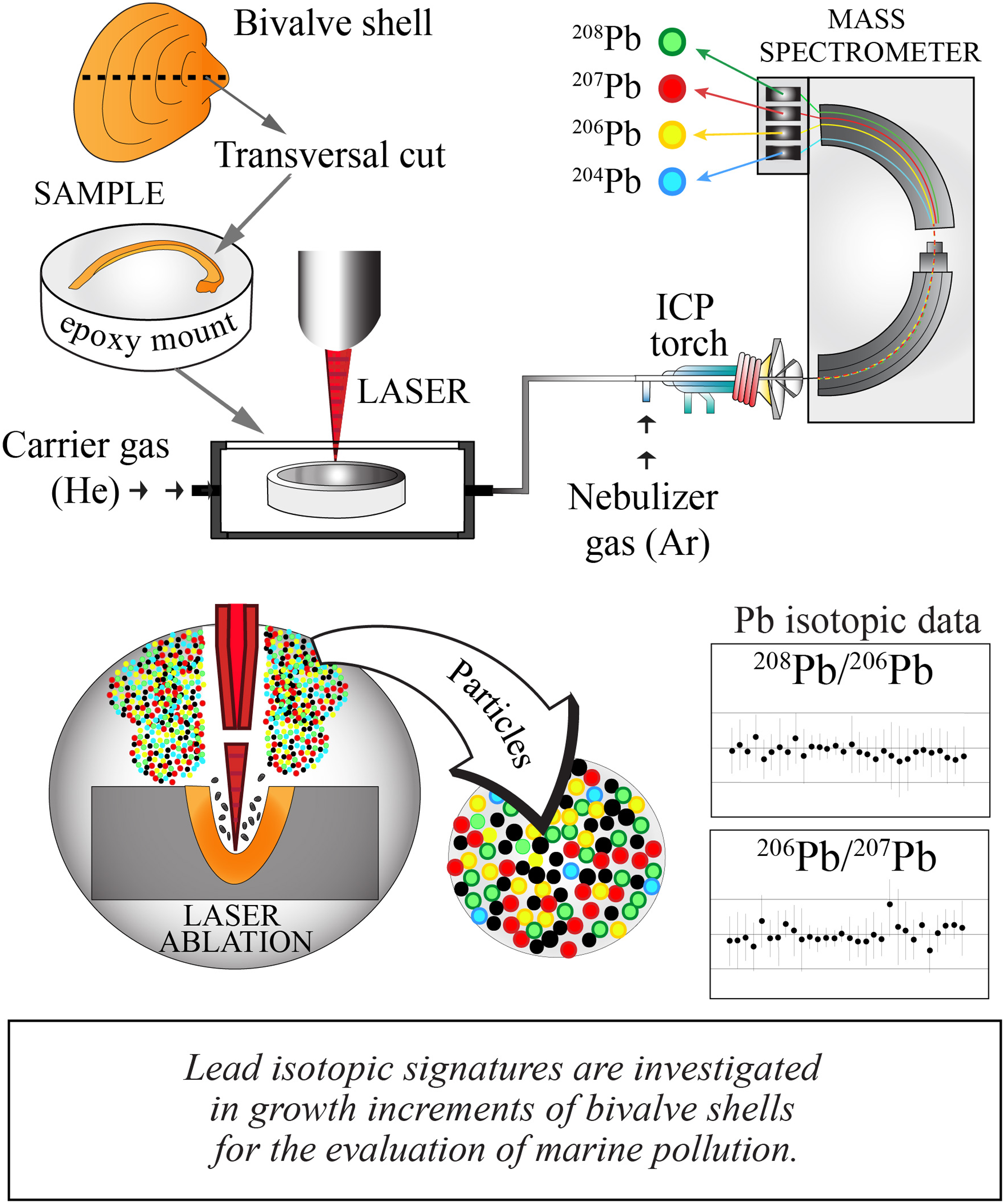
Lead, like other trace elements, is incorporated in the growing bands of bivalve shells. The chemicals stored into the shells can provide valuable information about seawater conditions during the period of shell formation. In this study, we present a practical approach to determine Pb isotopic signatures in bivalve shells as a tool for evaluating lead pollution in coastal waters. To demonstrate the applicability of the method, Pb isotopic fingerprinting in bivalve shell layers were investigated using laser ablation multicollector inductively coupled plasma mass spectrometry (LA-MC-ICP-MS). Lead isotope ratios (208Pb/206Pb and 206Pb/207Pb) were measured along distinct sections of the maximum growth axis of the shells. Calibration and quantification of Pb isotopes were performed using NIST 612 as reference material. Our results demonstrated that Pb isotope ratios in the shells ranged from 1.143 to 1.201 for 206Pb/207Pb and from 2.061 to 2.161 for 208Pb/206Pb. The isotopic signatures recorded in the sample shells correspond to similar ranges of Pb signatures reported for marine sediments from the same study area. In general, this work shows that LA-MC-ICP-MS is a suitable technique for determining spatially resolved lead isotopic signatures in bivalve shells and that it can be used to estimate the origin of Pb pollution in aquatic environments.
Keywords
Get full access to this article
View all access options for this article.
References
Supplementary Material
Please find the following supplemental material available below.
For Open Access articles published under a Creative Commons License, all supplemental material carries the same license as the article it is associated with.
For non-Open Access articles published, all supplemental material carries a non-exclusive license, and permission requests for re-use of supplemental material or any part of supplemental material shall be sent directly to the copyright owner as specified in the copyright notice associated with the article.
