




Abstract
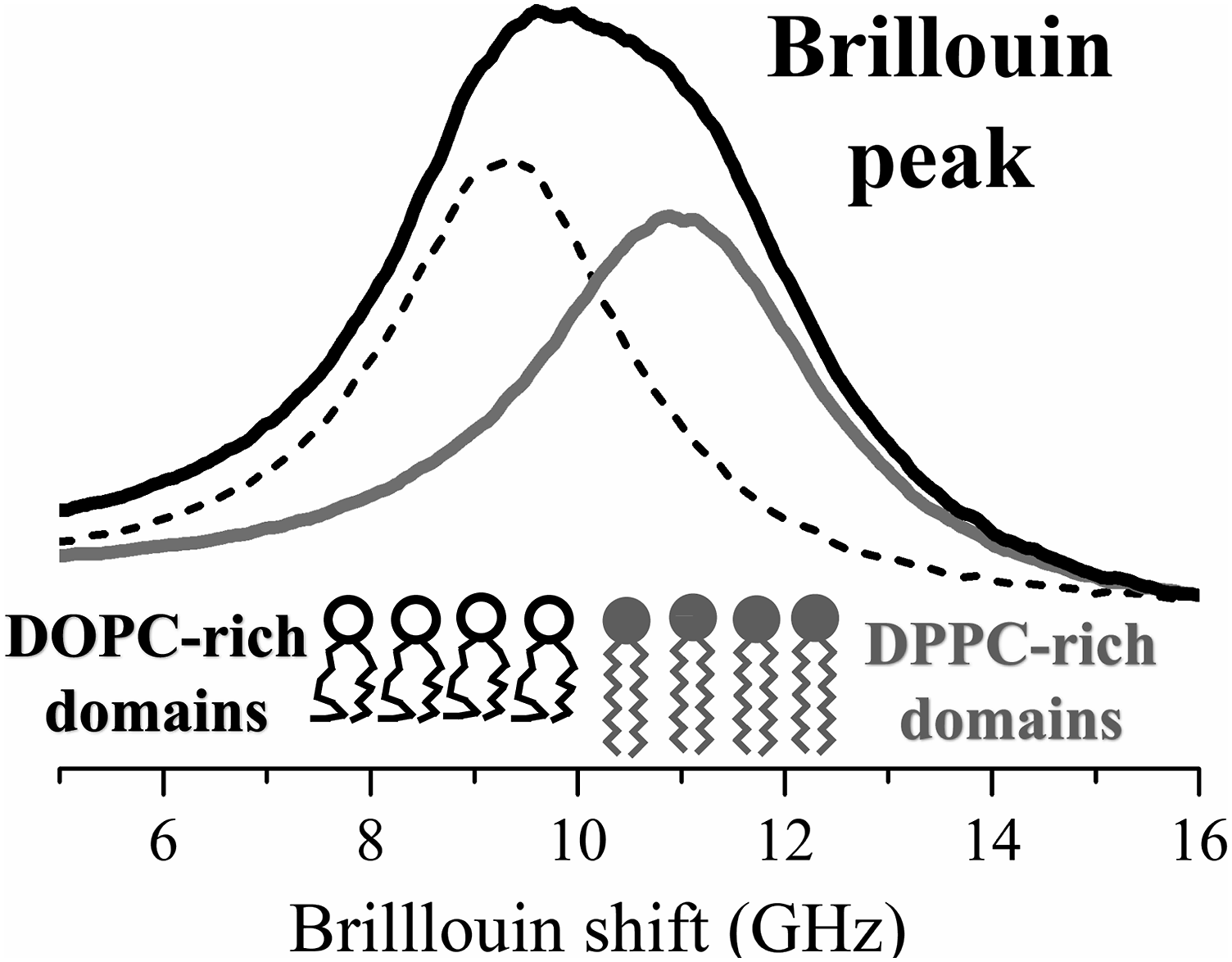
Multicomponent lipid bilayers are used as models for searching the origin of spatial heterogeneities in biomembranes called lipid rafts, implying the coexistence of domains of different phases and compositions within the lipid bilayer. The spatial organization of multicomponent lipid bilayers on a scale of a hundred nanometers remains unknown. Brillouin spectroscopy providing information about the acoustic phonons with the wavelength of several hundred nanometers has an unexplored potential for this problem. Here, we applied Brillouin spectroscopy for three binary bilayers composed of 1,2-dioleoyl-sn-glycero-3-phosphocholine (DOPC), 1,2-palmitoyl-sn-glycero-3-phosphocholine (DPPC), and cholesterol. The Brillouin experiment for the oriented planar multibilayers was realized for two scattering geometries involving phonons for the lateral and normal directions of the propagation. The DPPC–DOPC mixtures known for the coexistence of the solid-ordered and liquid-disordered phases had bimodal Brillouin peaks, revealing the phase domains with sizes more than a hundred nanometers. Analysis of the Brillouin data for the binary mixtures concluded that the lateral phonons are preferable for testing the lateral homogeneity of the bilayers, while the phonons spreading across the bilayers are sensitive to the layered packing at the mesoscopic scale.
Keywords
Get full access to this article
View all access options for this article.
References
Supplementary Material
Please find the following supplemental material available below.
For Open Access articles published under a Creative Commons License, all supplemental material carries the same license as the article it is associated with.
For non-Open Access articles published, all supplemental material carries a non-exclusive license, and permission requests for re-use of supplemental material or any part of supplemental material shall be sent directly to the copyright owner as specified in the copyright notice associated with the article.
