




Abstract
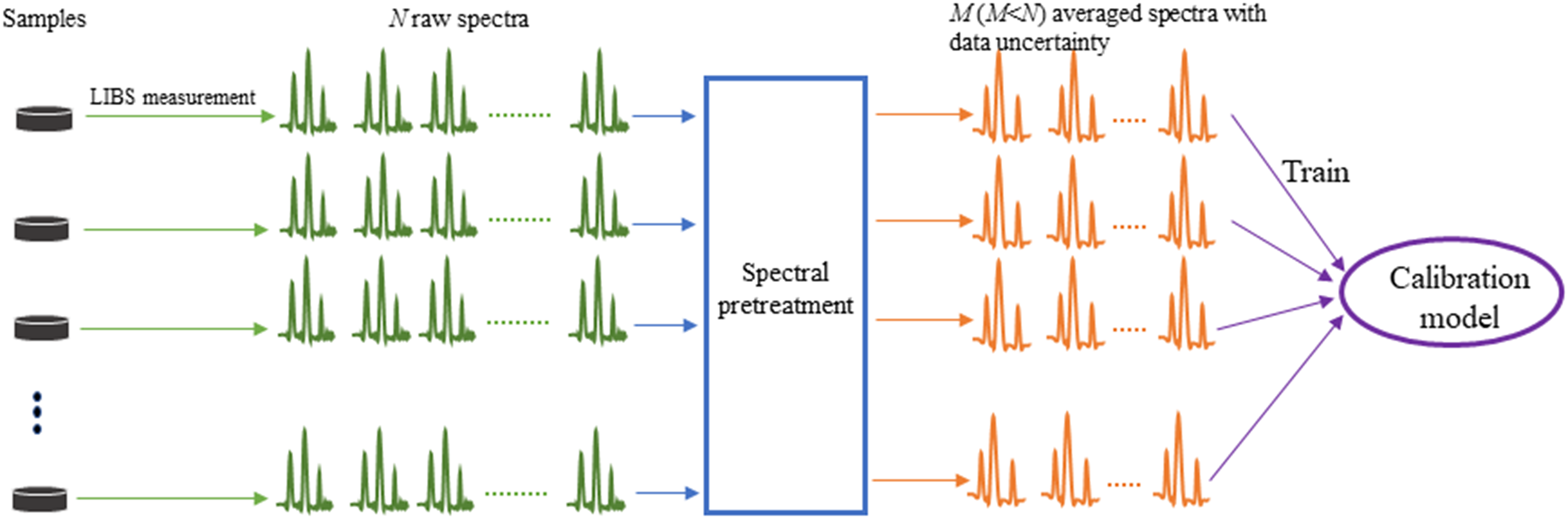
The accuracy and precision of laser-induced breakdown spectroscopy (LIBS) quantitative analysis are significantly limited by the spectral noise. Normalization and ensemble averaging of multiple spectra were often used to preprocess spectra. However, these methods cannot completely remove the spectral noise. Data uncertainty due to the irremovable spectral noise will affect LIBS quantitative analysis. Therefore, this paper proposes a method using data uncertainty to improve the performance of LIBS quantitative analysis. The proposed method uses several spectra to characterize each sample to preserve some data uncertainty in the calibration data matrix. Thus, the data uncertainty is used to optimize the calibration model for improving the toleration to the spectral signal variation. As a result, the optimized calibration model had better accuracy and robustness than the calibration model trained by conventional method. The best root mean square error of prediction (RMSEP) of the ash content of coal was 1.152% for the optimized calibration model, while that for the conventional calibration model was 1.718%. The optimized calibration model also showed a lower relative standard deviation (RSD) value of repeated predictions. Moreover, the calibration model for predicting the ash content in biomass was also optimized by the proposed method. The optimized calibration model outperformed the conventional calibration model again, which demonstrated the extensive applicability of the proposed method.
Get full access to this article
View all access options for this article.
References
Supplementary Material
Please find the following supplemental material available below.
For Open Access articles published under a Creative Commons License, all supplemental material carries the same license as the article it is associated with.
For non-Open Access articles published, all supplemental material carries a non-exclusive license, and permission requests for re-use of supplemental material or any part of supplemental material shall be sent directly to the copyright owner as specified in the copyright notice associated with the article.
