




Abstract
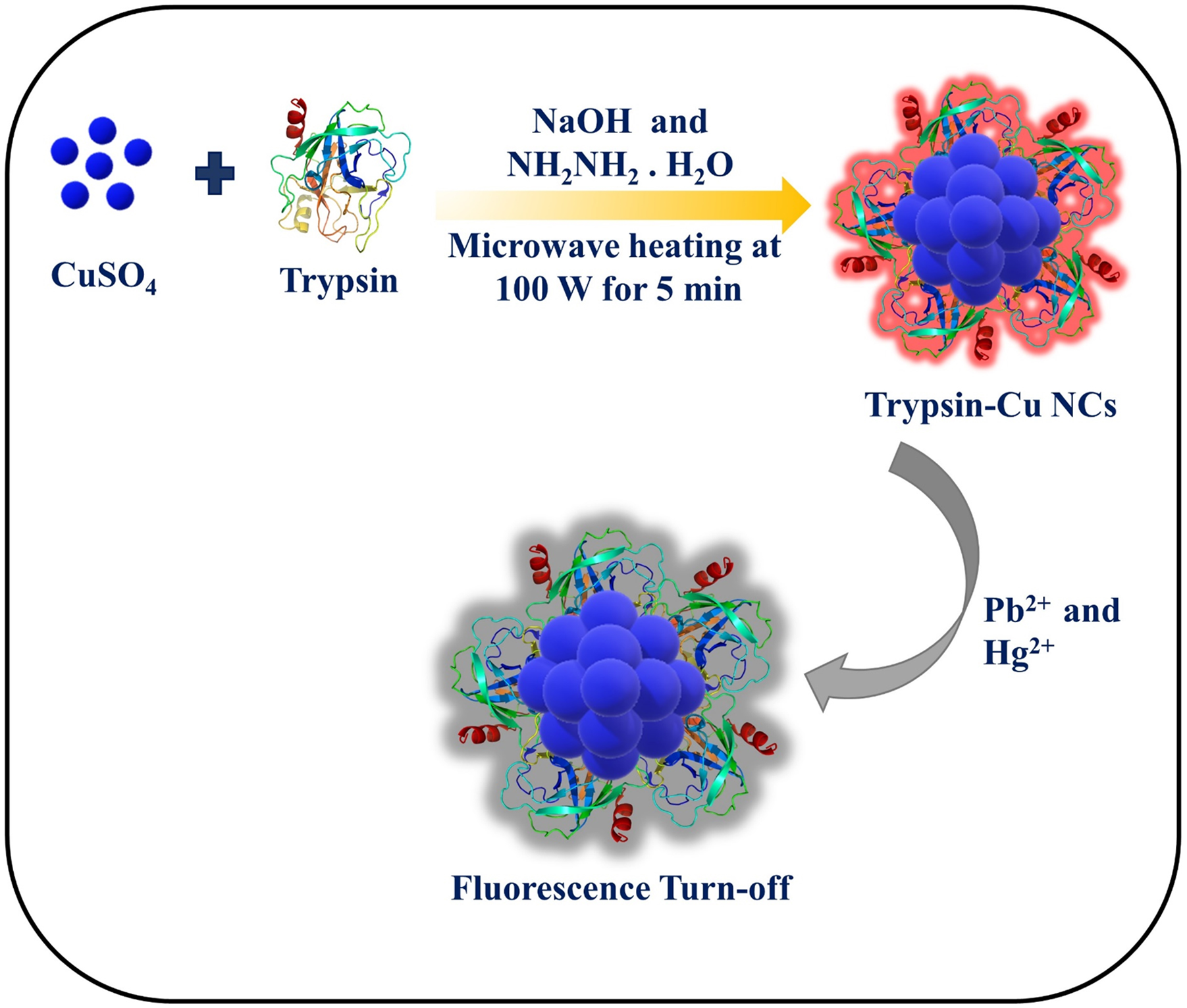
In this work, a microwave assisted method was developed for synthesis of red fluorescent copper nanoclusters (NCs) using trypsin as a template (trypsin–Cu). The as-synthesized trypsin–Cu NCs are stable and water soluble, exhibiting fluorescence emission at 657 nm when excited at 490 nm. The as-prepared red-emitting trypsin–Cu NCs were characterized by using several analytical techniques such as ultraviolet–visible (UV–Vis) and fluorescence, fluorescence lifetime, Fourier transform infrared, and X-ray photoelectron spectroscopic techniques. Red-emitting trypsin–Cu NCs acted as a nanosensor for sensing both Pb2+ and Hg2+ ions through fluorescence quenching. Using this approach, good linearities are observed in the range of 0.1–25 and of 0.001–1 μM with the lower limit of detection of 14.63 and 56.81 nM for Pb2+ and Hg2+ ions, respectively. Trypsin–Cu NCs-based fluorescence assay was successfully applied to detect both Hg2+ and Pb2+ ions in water and tobacco samples.
Keywords
Get full access to this article
View all access options for this article.
References
Supplementary Material
Please find the following supplemental material available below.
For Open Access articles published under a Creative Commons License, all supplemental material carries the same license as the article it is associated with.
For non-Open Access articles published, all supplemental material carries a non-exclusive license, and permission requests for re-use of supplemental material or any part of supplemental material shall be sent directly to the copyright owner as specified in the copyright notice associated with the article.
