




Abstract
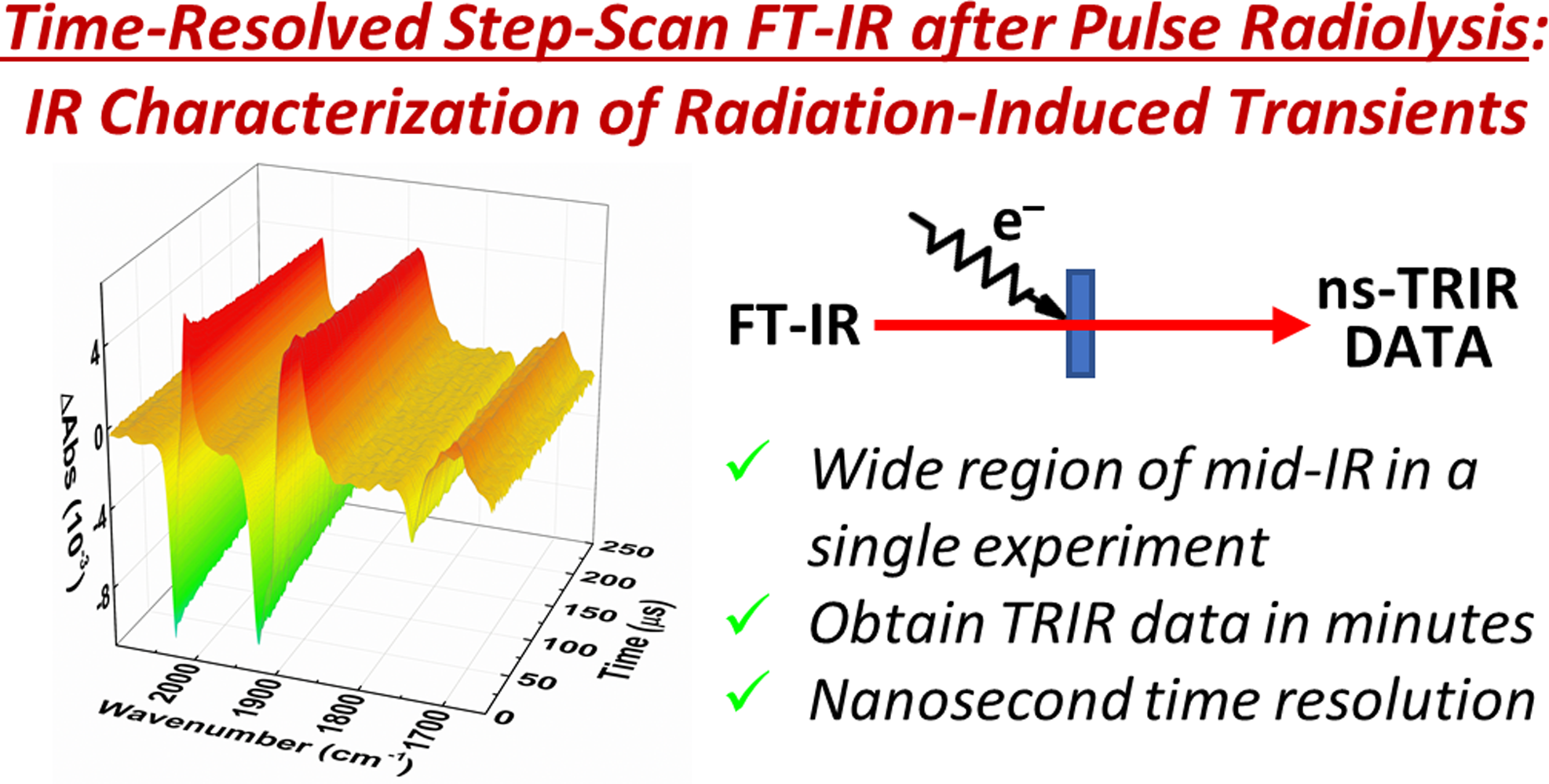
We describe the first implementation of broadband, nanosecond time-resolved step-scan Fourier transform infrared (S2-FT-IR) spectroscopy at a pulse radiolysis facility. This new technique allows the rapid acquisition of nano- to microsecond time-resolved infrared (TRIR) spectra of transient species generated by pulse radiolysis of liquid samples at a pulsed electron accelerator. Wide regions of the mid-infrared can be probed in a single experiment, which often takes < 20–30 min to complete. It is therefore a powerful method for rapidly locating the IR absorptions of short-lived, radiation-induced species in solution, and for directly monitoring their subsequent reactions. Time-resolved step-scan FT-IR detection for pulse radiolysis thus complements our existing narrowband quantum cascade laser-based pulse radiolysis-TRIR detection system, which is more suitable for acquiring single-shot kinetics and narrowband TRIR spectra on small-volume samples and in strongly absorbing solvents, such as water. We have demonstrated the application of time-resolved step-scan FT-IR spectroscopy to pulse radiolysis by probing the metal carbonyl and organic carbonyl vibrations of the one-electron-reduced forms of two Re-based CO2 reduction catalysts in acetonitrile solution. Transient IR absorption bands with amplitudes on the order of 1 × 10⁻³ are easily detected on the sub-microsecond timescale using electron pulses as short as 250 ns.
Get full access to this article
View all access options for this article.
References
Supplementary Material
Please find the following supplemental material available below.
For Open Access articles published under a Creative Commons License, all supplemental material carries the same license as the article it is associated with.
For non-Open Access articles published, all supplemental material carries a non-exclusive license, and permission requests for re-use of supplemental material or any part of supplemental material shall be sent directly to the copyright owner as specified in the copyright notice associated with the article.
