



Abstract
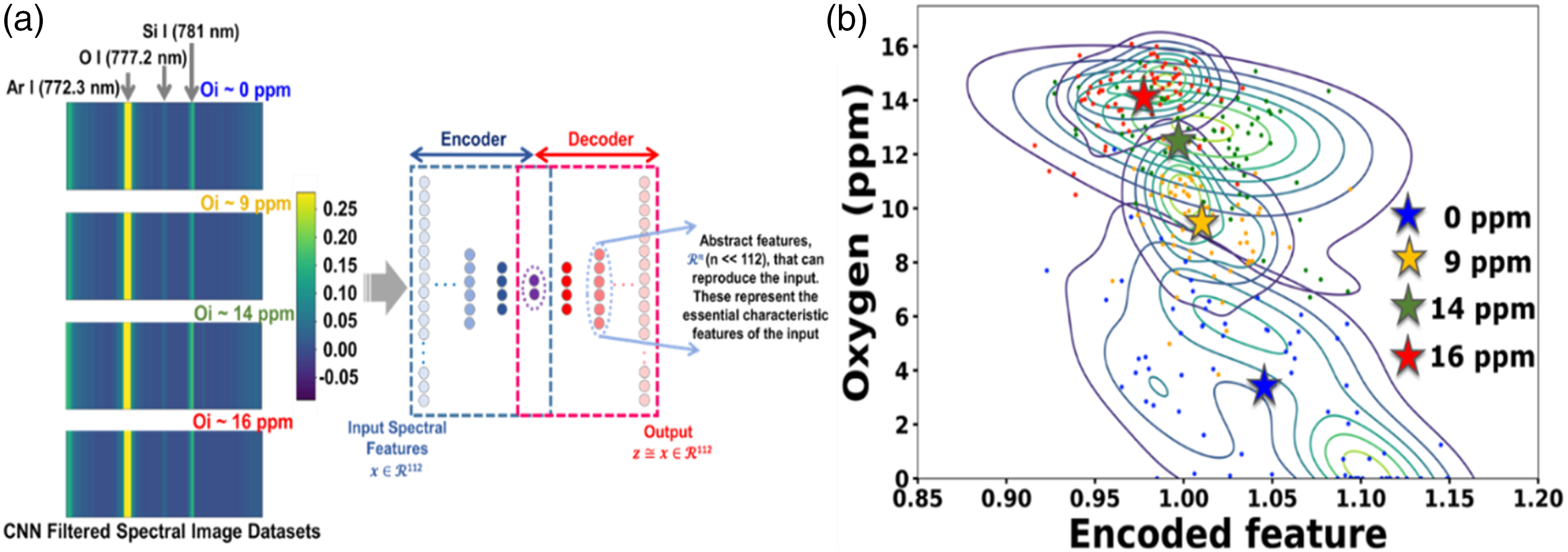
Analytical advantages of facile and expeditious spectral data collections from laser-induced breakdown spectroscopy (LIBS) are often offset by the low-accuracy quantitative analyses offered by the technique due to non-equilibrium plasma–matrix interactions. Herein, we developed a one-dimensional (1D) convolutional neural network (CNN) and a least absolute shrinkage and selection operator (LASSO) models for LIBS data analyses to predict trace amounts of interstitial oxygen impurities in commercial Czochralski-silicon (Cz-Si) crystals with known interstitial oxygen concentrations at 0–16 parts per million (ppm). While traditional spectral analyses from O(I) (777.2 nm) atomic lines offer poor accuracy, CNN and LASSO analyses generate excellent predictions for the interstitial oxygen concentrations. Specifically, CNN-based spectral analyses uniquely identified systematic alterations in LIBS fingerprints manifested by laser-matter interactions. Our results pave the path for combining facile and voluminous LIBS data collection with deep learning driven high-fidelity data analytics.
Keywords
Get full access to this article
View all access options for this article.
References
Supplementary Material
Please find the following supplemental material available below.
For Open Access articles published under a Creative Commons License, all supplemental material carries the same license as the article it is associated with.
For non-Open Access articles published, all supplemental material carries a non-exclusive license, and permission requests for re-use of supplemental material or any part of supplemental material shall be sent directly to the copyright owner as specified in the copyright notice associated with the article.
