



Abstract
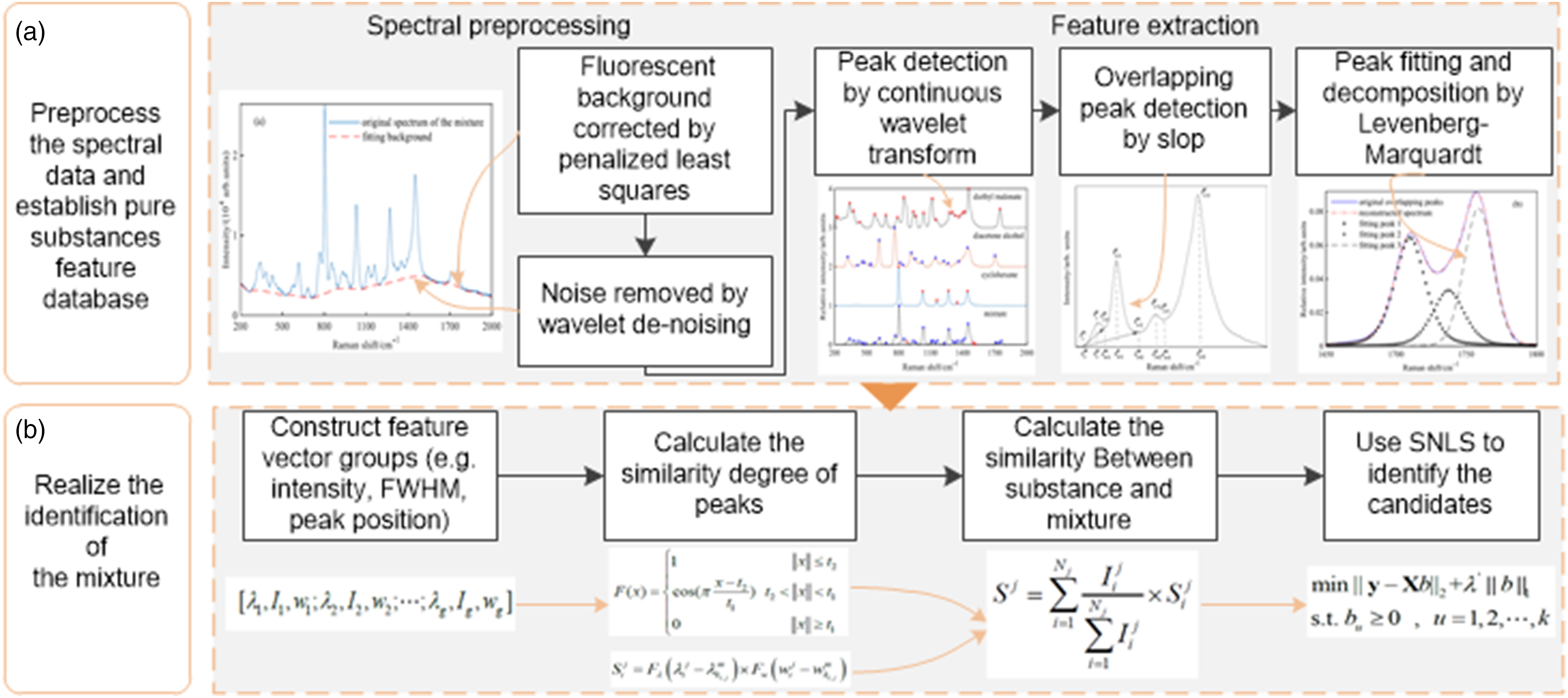
Due to the advantages of low price and convenience for end-users to conduct field-based, in-situ analysis, handheld Raman spectrometers are widely used in the identification of mixture components. However, the spectra collected by handheld Raman spectrometer usually have serious peak overlapping and spectral distortion, resulting in difficulties in component identification in the mixture. A novel method for mixture components identification based on the handheld Raman spectrometer was proposed in this study. The wavelet transform and Voight curve fitting method were used to extract the feature parameters from each Raman spectral peak, including Raman shift, maximum intensity, and full width at half-maximum (FWHM), and the similarities between the mixture and each substance in the database were calculated by fuzzy membership function based on extracted feature parameters. Then, the possible substances in the mixture were preliminarily screened out as candidates according to the similarity. Finally, the Raman spectra of these candidates were used to fit the spectra of the mixture, and the fitting coefficients obtained by sparse non-negative least squares algorithm were employed to further determine the suspected substance in the mixture. The Raman spectra of 190 liquid mixture samples and 158 powder mixture samples were collected using a handheld Raman spectrometer and these spectra were used to validate the identification performance of the proposed method. The proposed method could achieve good identification accuracy for different mixture samples. It shows that the proposed method is an effective way for the component identification in mixture by using a handheld Raman spectrometer.
Keywords
Get full access to this article
View all access options for this article.
References
Supplementary Material
Please find the following supplemental material available below.
For Open Access articles published under a Creative Commons License, all supplemental material carries the same license as the article it is associated with.
For non-Open Access articles published, all supplemental material carries a non-exclusive license, and permission requests for re-use of supplemental material or any part of supplemental material shall be sent directly to the copyright owner as specified in the copyright notice associated with the article.
