




Abstract
Based on hybrid 2D correlation analysis, we recently derived and introduced a “smart error sum,” a sophisticated loss function that can be used for solving nonlinear inverse problems like the determination of optical constants and oscillator parameters from a series of optical spectra in the infrared spectral region. The advantage of the smart error sum compared to the conventional sum of squared errors lies in its ability to marginalize multiplicative systematic errors such as, for example, reflectance values above unity in transflection spectra. This is enabled by a transformation, which allows fits to not exclusively focus on forcing fit spectra to agree with experimental spectra at every wavenumber point by all means, but also to take correlations such as spectral similarities and their changes with certain perturbations into account. In this work, we extend our approach to accommodate the treatment of individual spectra, instead of only series, based on hybrid two-trace two-dimensional (2T2D) correlation analysis. We evaluate and prove the value of our approach by individually analyzing experimental transflection spectra of polymethyl methacrylate (PMMA) layers on gold substrates. The comparison of the results with those obtained by the original smart error sum based on the whole set of spectra as well as those resulting from conventional fitting of series and individual spectra (using the conventional sum of squared errors) confirms the validity and soundness of the 2T2D smart error sum.
This is a visual representation of the abstract.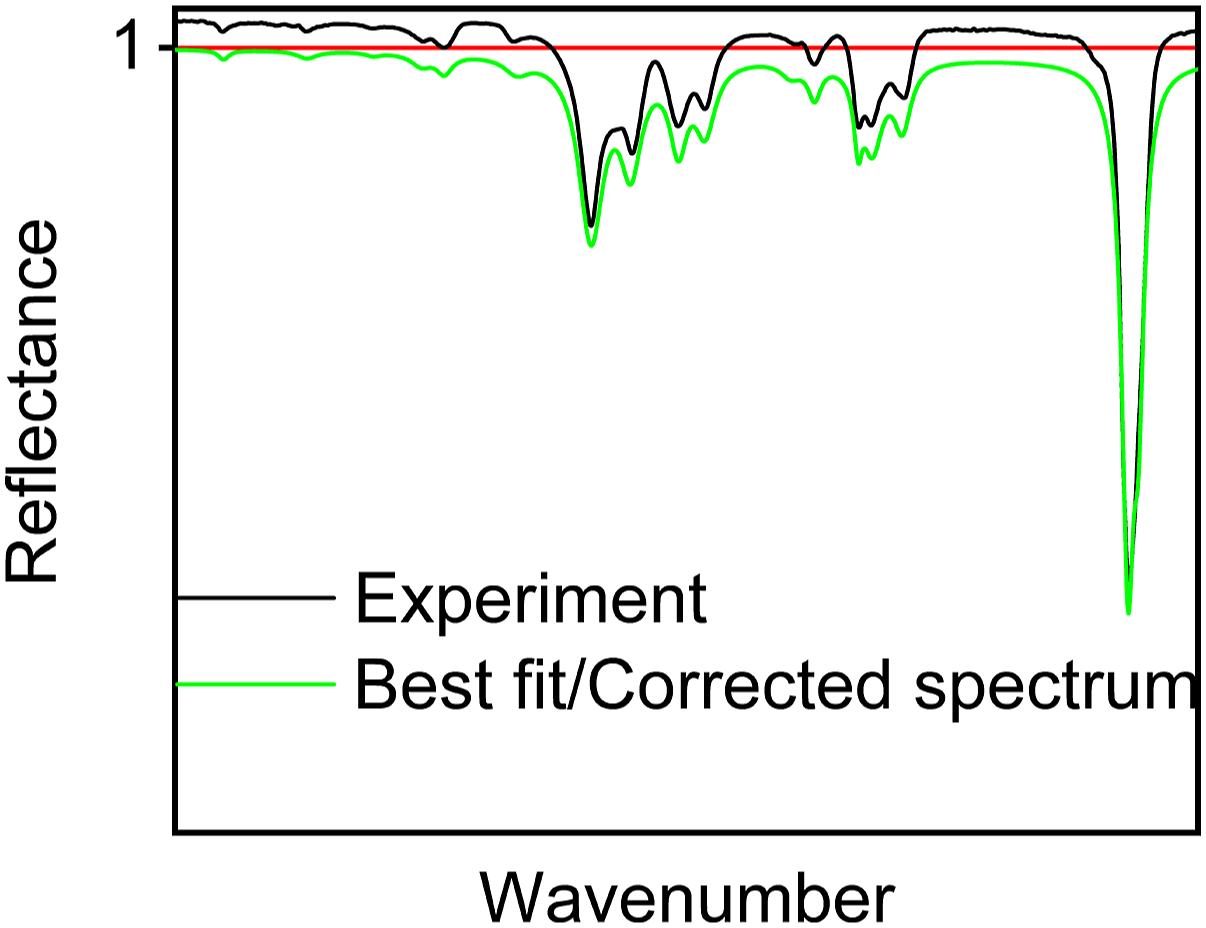
Keywords
Get full access to this article
View all access options for this article.
References
Supplementary Material
Please find the following supplemental material available below.
For Open Access articles published under a Creative Commons License, all supplemental material carries the same license as the article it is associated with.
For non-Open Access articles published, all supplemental material carries a non-exclusive license, and permission requests for re-use of supplemental material or any part of supplemental material shall be sent directly to the copyright owner as specified in the copyright notice associated with the article.
