




Abstract
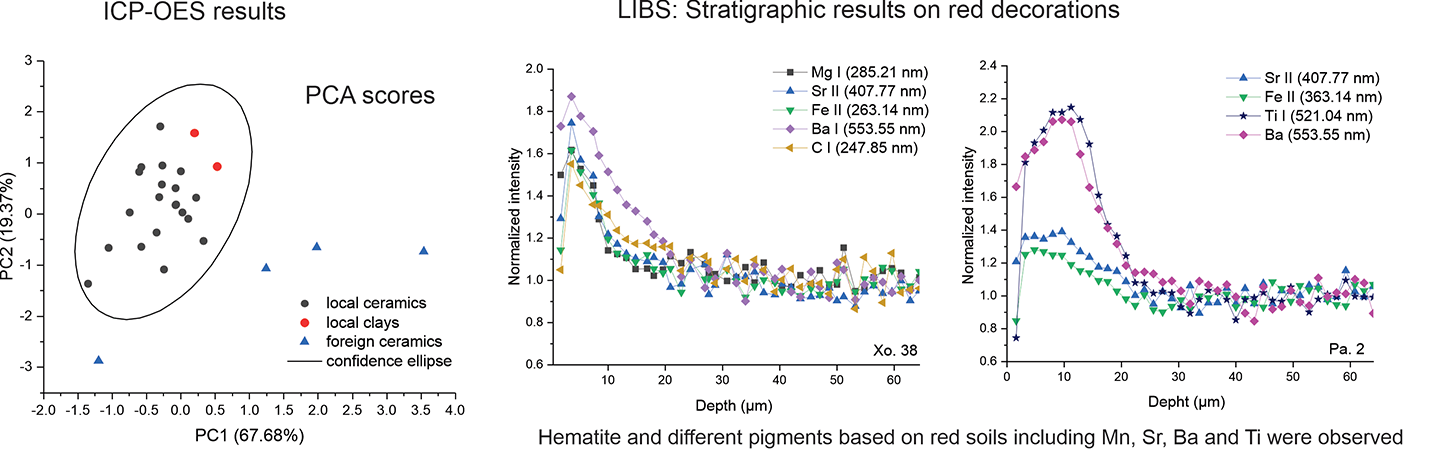
Pottery sherds from Teotihuacan, Mexico, belonging to the Formative and Classic periods (150 BCE–700 CE) were investigated using laser-induced breakdown spectroscopy (LIBS) and inductively coupled plasma optical emission spectrometry (ICP-OES). LIBS results show that most of the investigated samples have primarily the same elemental composition. Nevertheless, there are also a few sherds that could be associated to foreign ceramic groups with characteristic concentrations of Na, K, Ca, Mn, Rb, and Sr. The relative elemental composition of red pigments applied on ceramic bodies was also analyzed through a LIBS depth profiling. Diverse hematite-based pigments were distinguished according to the detected iron content. Hematite was also combined with red soils with a high relative content of Mn, Sr, Ba, or Ti. The ICP-OES analysis of ceramic pastes is consistent with the emission intensities obtained using LIBS. Principal component analysis indicates that all samples identified as locals belong to a single chemical group. Moreover, locally made ceramics and the analyzed clays from the nearby area have the same elemental composition, which appears clearly differentiated from imported samples.
Keywords
Get full access to this article
View all access options for this article.
References
Supplementary Material
Please find the following supplemental material available below.
For Open Access articles published under a Creative Commons License, all supplemental material carries the same license as the article it is associated with.
For non-Open Access articles published, all supplemental material carries a non-exclusive license, and permission requests for re-use of supplemental material or any part of supplemental material shall be sent directly to the copyright owner as specified in the copyright notice associated with the article.
