



Abstract
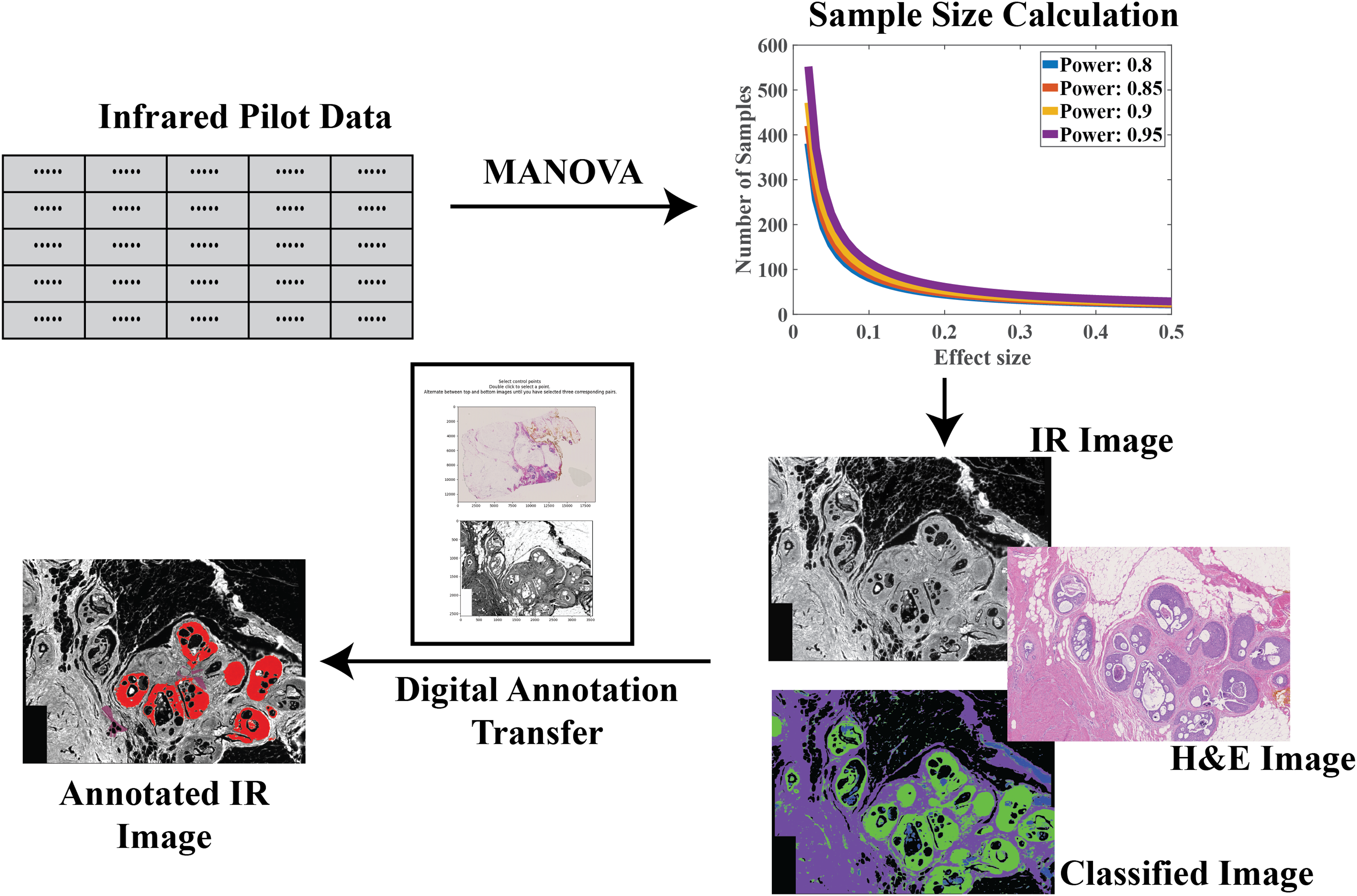
Advances in infrared (IR) spectroscopic imaging instrumentation and data science now present unique opportunities for large validation studies of the concept of histopathology using spectral data. In this study, we examine the discrimination potential of IR metrics for different histologic classes to estimate the sample size needed for designing validation studies to achieve a given statistical power and statistical significance. Next, we present an automated annotation transfer tool that can allow large-scale training/validation, overcoming the limitations of sparse ground truth data with current manual approaches by providing a tool to transfer pathologist annotations from stained images to IR images across diagnostic categories. Finally, the results of a combination of supervised and unsupervised analysis provide a scheme to identify diagnostic groups/patterns and isolating pure chemical pixels for each class to better train complex histopathological models. Together, these methods provide essential tools to take advantage of the emerging capabilities to record and utilize large spectroscopic imaging datasets.
Keywords
Get full access to this article
View all access options for this article.
References
Supplementary Material
Please find the following supplemental material available below.
For Open Access articles published under a Creative Commons License, all supplemental material carries the same license as the article it is associated with.
For non-Open Access articles published, all supplemental material carries a non-exclusive license, and permission requests for re-use of supplemental material or any part of supplemental material shall be sent directly to the copyright owner as specified in the copyright notice associated with the article.
