



Abstract
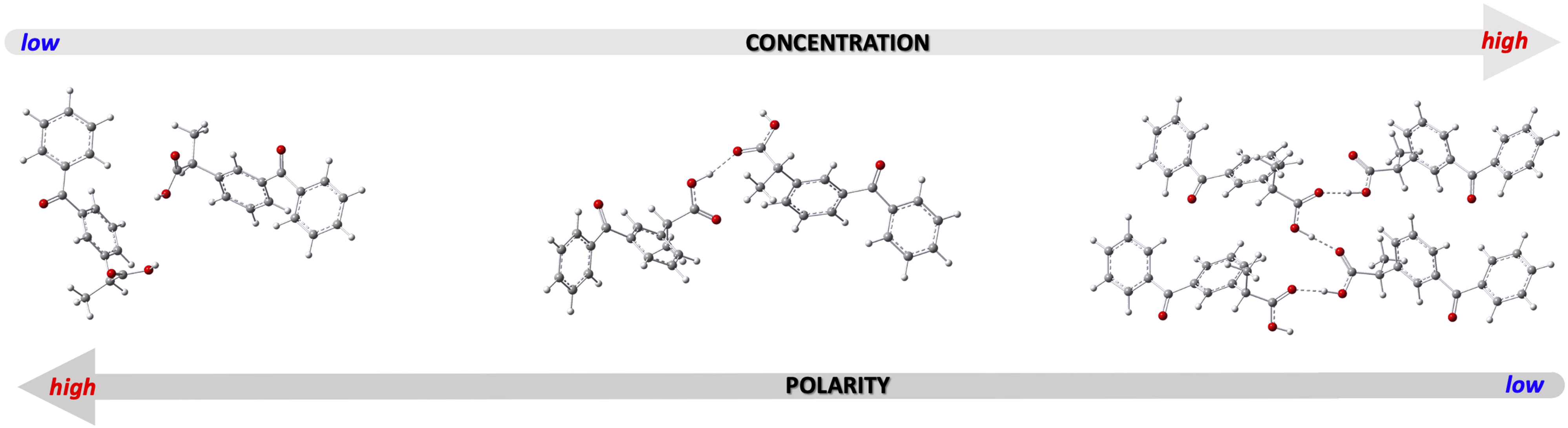
The molecular structure and solution-state molecular interactions in the popular non-steroidal anti-inflammatory drug, ketoprofen, are extensively studied with the aim of gaining a better understanding of the chemical behavior of its solution state and its connection to its nucleation pathway and crystallization outcome. Using as reference solid-state X-ray structures of enantiomeric and racemic forms of ketoprofen, a set of self-assembly models underpinned by density functional theory calculations has been considered for the analysis of spectroscopic data, infrared (IR) and vibrational circular dichroism (VCD), obtained for solutions of the samples as a function of composition and solvent. From our results it can be concluded that, contrary to the general belief for generic carboxylic acids, there are no cyclic dimeric structures of ketoprofen present in solution, but rather linear arrays made up of two (in high polar or diluted media) or more units (in low polar or low dilution media). This observation is in line with the idea that the weak contacts (other than H-bonding) would hold the key to molecular self-assembly, in agreement with recent studies on other aromatic carboxylic acids.
Keywords
Get full access to this article
View all access options for this article.
References
Supplementary Material
Please find the following supplemental material available below.
For Open Access articles published under a Creative Commons License, all supplemental material carries the same license as the article it is associated with.
For non-Open Access articles published, all supplemental material carries a non-exclusive license, and permission requests for re-use of supplemental material or any part of supplemental material shall be sent directly to the copyright owner as specified in the copyright notice associated with the article.
