



Abstract
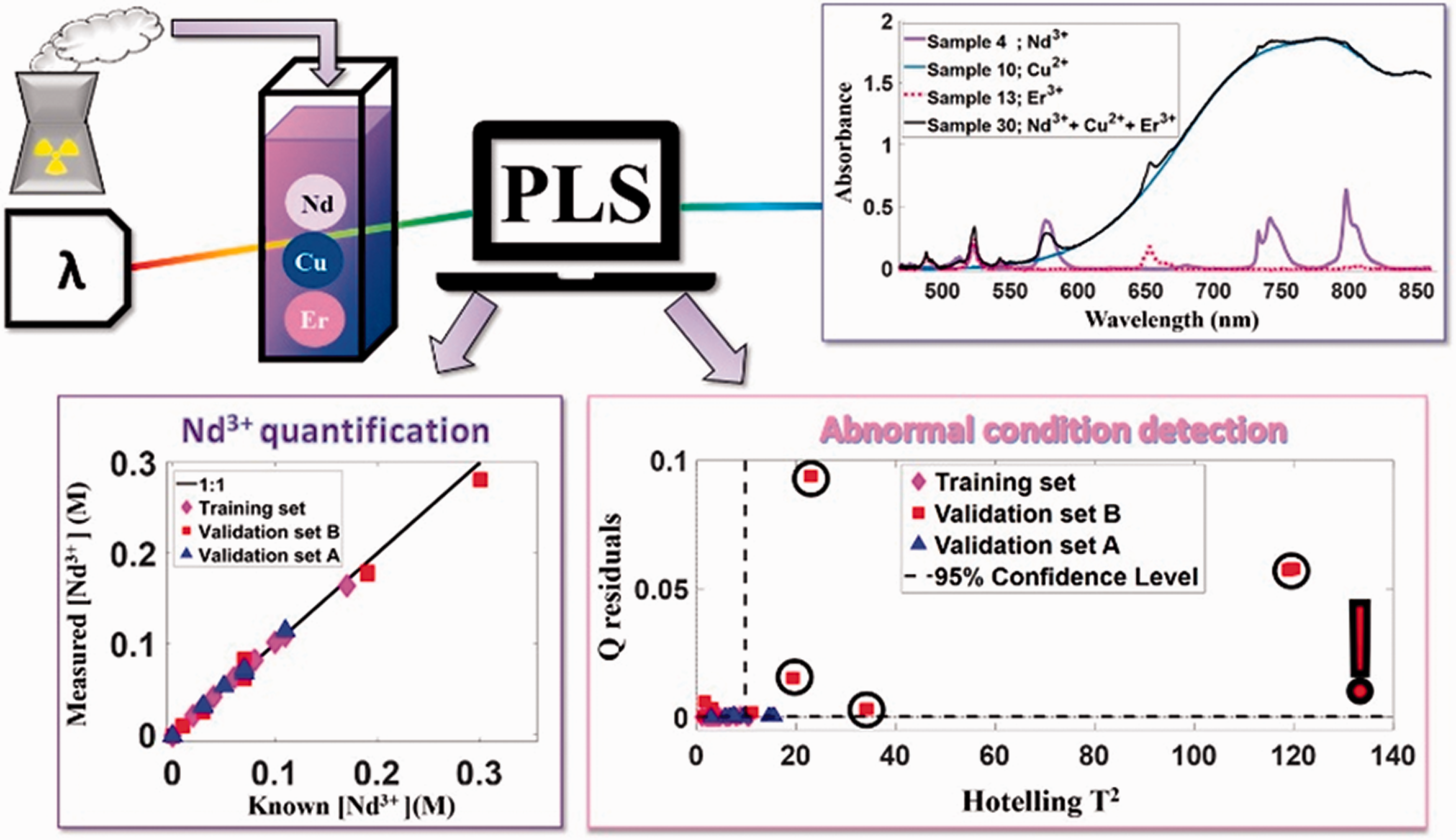
Optical spectroscopy is a powerful characterization tool with applications ranging from fundamental studies to real-time process monitoring. However, it can be difficult to apply to complex samples that contain interfering analytes which are common in processing streams. Multivariate (chemometric) analysis has been examined for providing selectivity and accuracy to the analysis of optical spectra and expanding its potential applications. Here we will discuss chemometric modeling with an in-depth comparison to more simplistic analysis approaches and outline how chemometric modeling works while exploring the limits on modeling accuracy. Understanding the limitations of the chemometric model can provide better analytical assessment regarding the accuracy and precision of the analytical result. This will be explored in the context of UV–Vis absorbance of neodymium (Nd3+) in the presence of interferents, erbium (Er3+) and copper (Cu2+) under conditions simulating the liquid–liquid extraction approach used to recycle plutonium (Pu) and uranium (U) in used nuclear fuel worldwide. The selected chemometric model, partial least squares regression, accurately quantifies Nd3+ with a low percentage error in the presence of interfering analytes and even under conditions that the training set does not describe.
Keywords
Get full access to this article
View all access options for this article.
References
Supplementary Material
Please find the following supplemental material available below.
For Open Access articles published under a Creative Commons License, all supplemental material carries the same license as the article it is associated with.
For non-Open Access articles published, all supplemental material carries a non-exclusive license, and permission requests for re-use of supplemental material or any part of supplemental material shall be sent directly to the copyright owner as specified in the copyright notice associated with the article.
