



Abstract
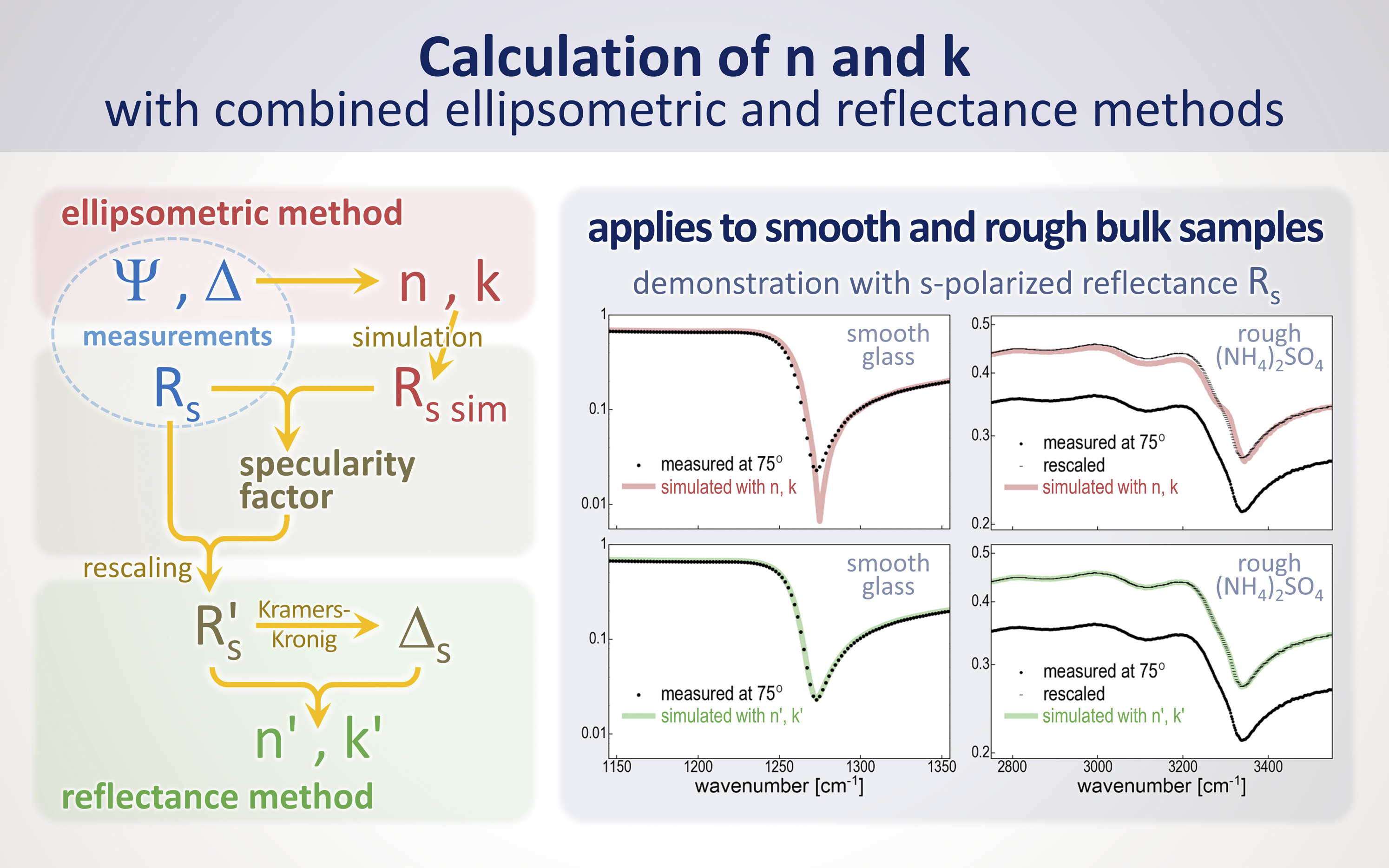
Spectra of the optical constants n and k of a substance are often deduced from spectroscopic measurements, performed on a thick and homogeneous sample, and from a model used to simulate these measurements. Spectra obtained for n and k using the ellipsometric method generally produce polarized reflectance simulations in strong agreement with the experimental measurements, but they sometimes introduce significant discrepancies over limited spectral ranges, whereas spectra of n and k obtained with the single-angle reflectance method require a perfectly smooth sample surface to be viable. This paper presents an alternative method to calculate n and k. The method exploits both ellipsometric measurements and s-polarized specular reflectance measurements, and compensates for potential surface scattering effects with the introduction of a specularity factor. It is applicable to bulk samples having either a smooth or a rough surface. It provides spectral optical constants that are consistent with s-polarized reflectance measurements. Demonstrations are performed in the infrared region using a glass slide (smooth surface) and a pellet of compressed ammonium sulfate powder (rough surface).
Keywords
Get full access to this article
View all access options for this article.
References
Supplementary Material
Please find the following supplemental material available below.
For Open Access articles published under a Creative Commons License, all supplemental material carries the same license as the article it is associated with.
For non-Open Access articles published, all supplemental material carries a non-exclusive license, and permission requests for re-use of supplemental material or any part of supplemental material shall be sent directly to the copyright owner as specified in the copyright notice associated with the article.
