



Abstract
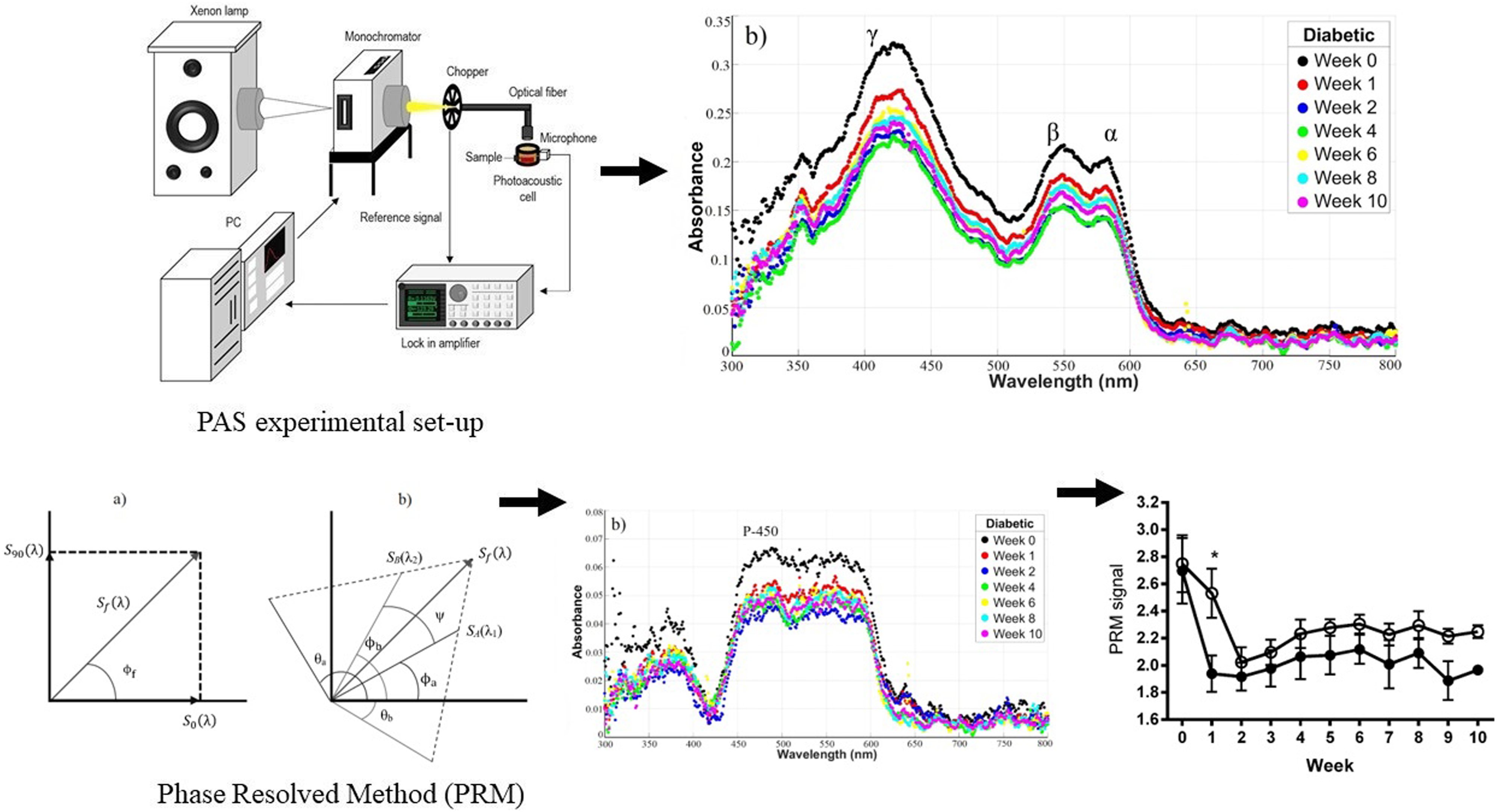
According to the World Health Organization, diabetes was the seventh leading cause of death in 2016. Long-term diabetes complications are associated with hyperglycemia. It is difficult to predict the beginning and evolution of those complications. The goal of the study was to evaluate the relationship between glycemia and blood spectroscopic variables in an experimental model of type 1 diabetes (streptozotocin model). Blood samples were taken weekly (10 weeks) from the tail of male Wistar rats with or without diabetes. Blood optical absorption spectra were obtained by means of photoacoustic spectroscopy. It was possible to estimate the time-course of blood characteristic peak ratios. The area under the curve of those peaks correlated with hyperglycemia. The evolution of the optical absorption at 450 nm, related to cytochrome p450, was obtained by using the phase-resolved method. The area under the curve of p450 correlated also with hyperglycemia. It is concluded that photoacoustic spectroscopy is a reliable technology to detect the effects of hyperglycemia on blood with possible applications in the study of long-term diabetes complications.
Get full access to this article
View all access options for this article.
References
Supplementary Material
Please find the following supplemental material available below.
For Open Access articles published under a Creative Commons License, all supplemental material carries the same license as the article it is associated with.
For non-Open Access articles published, all supplemental material carries a non-exclusive license, and permission requests for re-use of supplemental material or any part of supplemental material shall be sent directly to the copyright owner as specified in the copyright notice associated with the article.
