




Abstract
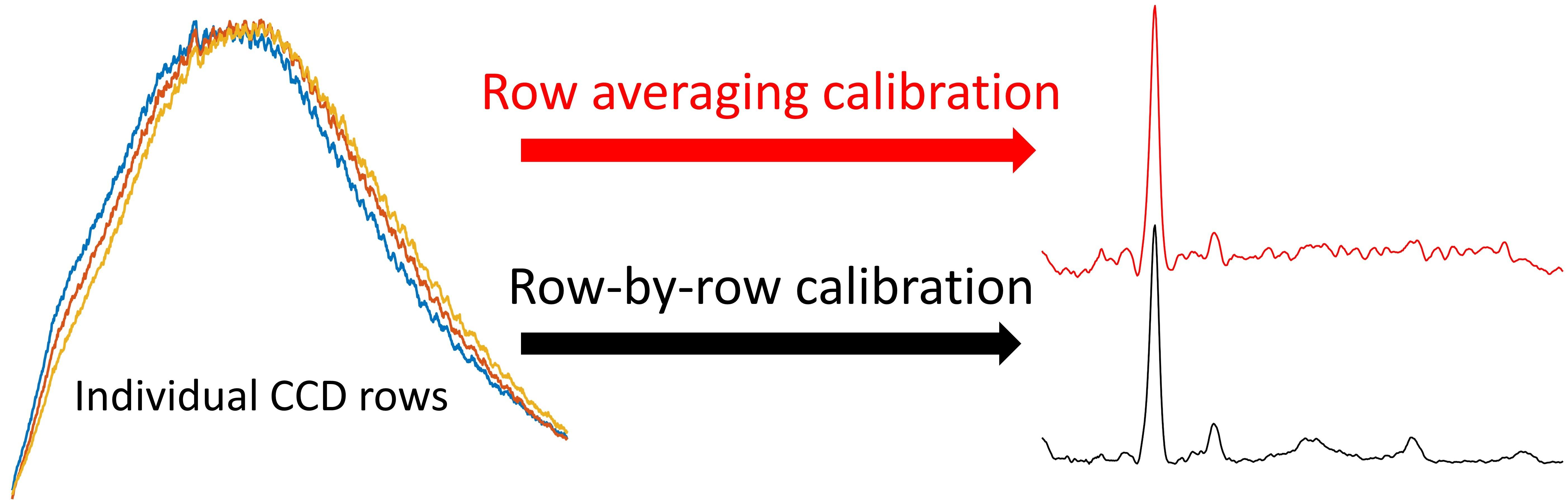
Back-illuminated charged-coupled device (BI-CCD) arrays increase quantum efficiency but also amplify etaloning, a multiplicative, wavelength-dependent fixed-pattern effect. When spectral data from hundreds of BI-CCD rows are combined, the averaged spectrum will generally appear etalon-free. This can mask substantial etaloning at the row level, even if the BI-CCD has been treated to suppress the effect. This paper compares two methods of etalon correction, one with simple averaging and one with row-by-row calibration using a fluorescence standard. Two BI-CCD arrays, both roughened by the supplier to reduce etaloning, were used to acquire Raman spectra of murine bone specimens. For one array, etaloning was the dominant source of noise under the exposure conditions chosen, even for the averaged spectrum across all rows; near-infrared-excited Raman peaks were noticeably affected. In this case, row-by-row calibration improved the spectral quality of the average spectrum. The other CCD’s performance was shot-noise limited and therefore received no benefit from the extra calibration. The different results highlight the importance of checking for and correcting row-level fixed pattern when measuring weak Raman signals in the presence of a large fluorescence background.
Get full access to this article
View all access options for this article.
References
Supplementary Material
Please find the following supplemental material available below.
For Open Access articles published under a Creative Commons License, all supplemental material carries the same license as the article it is associated with.
For non-Open Access articles published, all supplemental material carries a non-exclusive license, and permission requests for re-use of supplemental material or any part of supplemental material shall be sent directly to the copyright owner as specified in the copyright notice associated with the article.
