




Abstract
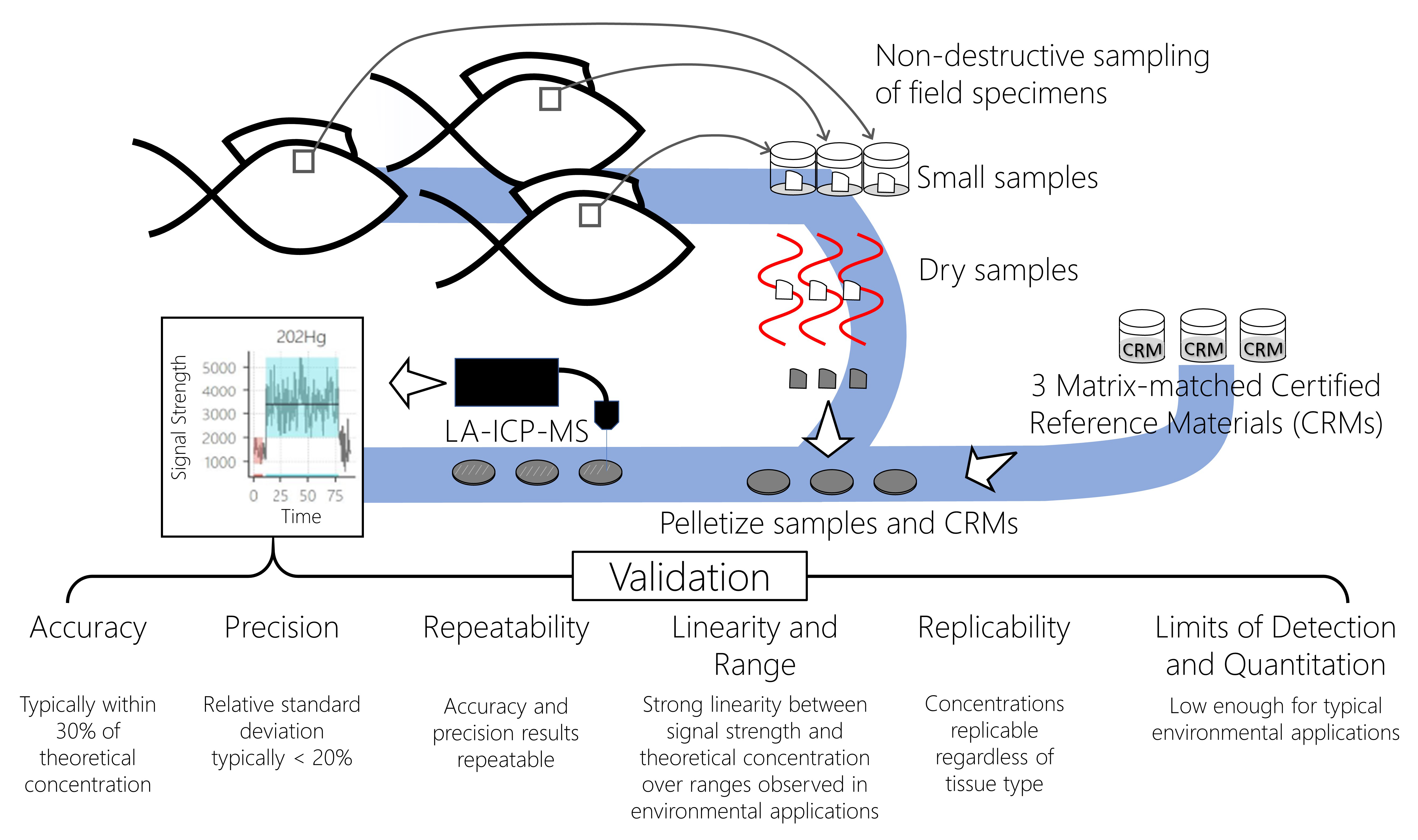
Determination of elemental concentrations in biological tissue is fundamental to many environmental studies. Analytical methods typically used to quantify concentrations in such studies have minimum sample volumes that necessitate lethal or impactful collection of tissues. Laser ablation inductively coupled mass spectrometry (LA-ICP-MS) has small sample volume requirements and offers environmental practitioners an opportunity to employ low-impact sample collection methods. Environmental applications of LA-ICP-MS are limited by the lack of validated methods, partly due to the need for dry samples and scarcity of matrix-matched certified reference materials (CRMs). This study validates an LA-ICP-MS method to determine concentrations of 30 elements in soft biological tissue (fish ovary and muscle). Tissue samples (median: 0.48 grams (g); inter-quartile range: 0.30 g to 0.56 g wet weight) were dehydrated, powdered, compressed into pellets (weighing approximately 0.03 g) and analyzed using LA-ICP-MS alongside three matrix-matched CRMs. The method yielded concentration determinations for CRM elements that were typically accurate to within 30% of theoretical concentrations, and precise (relative standard deviation <20%). These results were repeatable: accuracy rarely deviated from theoretical values by more than 20%, and precision rarely exceeded 33%. Determinations for biological samples were replicable irrespective of tissue (ovary or muscle). There was good linearity between analyte signal strength and theoretical concentration (median R2 ≥ 0.981 for all elements) across ranges typically encountered in environmental studies. Concentrations could not be consistently obtained (i.e., determined concentrations were typically below detection limits) for boron, vanadium, molybdenum, and cadmium in muscles, and arsenic in both ovaries and muscles; however, detection limits were sufficiently low for most environmental contexts. Further methodological refinement could include the incorporation of spiked standards to extend linear ranges, and fine-tuning instrument parameters to obtain smoother signal intensities for rare elements. The method presented promotes the use of low-impact sample collection methods while enabling high-quality determinations of elemental concentrations in biological tissues.
Keywords
Get full access to this article
View all access options for this article.
References
Supplementary Material
Please find the following supplemental material available below.
For Open Access articles published under a Creative Commons License, all supplemental material carries the same license as the article it is associated with.
For non-Open Access articles published, all supplemental material carries a non-exclusive license, and permission requests for re-use of supplemental material or any part of supplemental material shall be sent directly to the copyright owner as specified in the copyright notice associated with the article.
