




Abstract
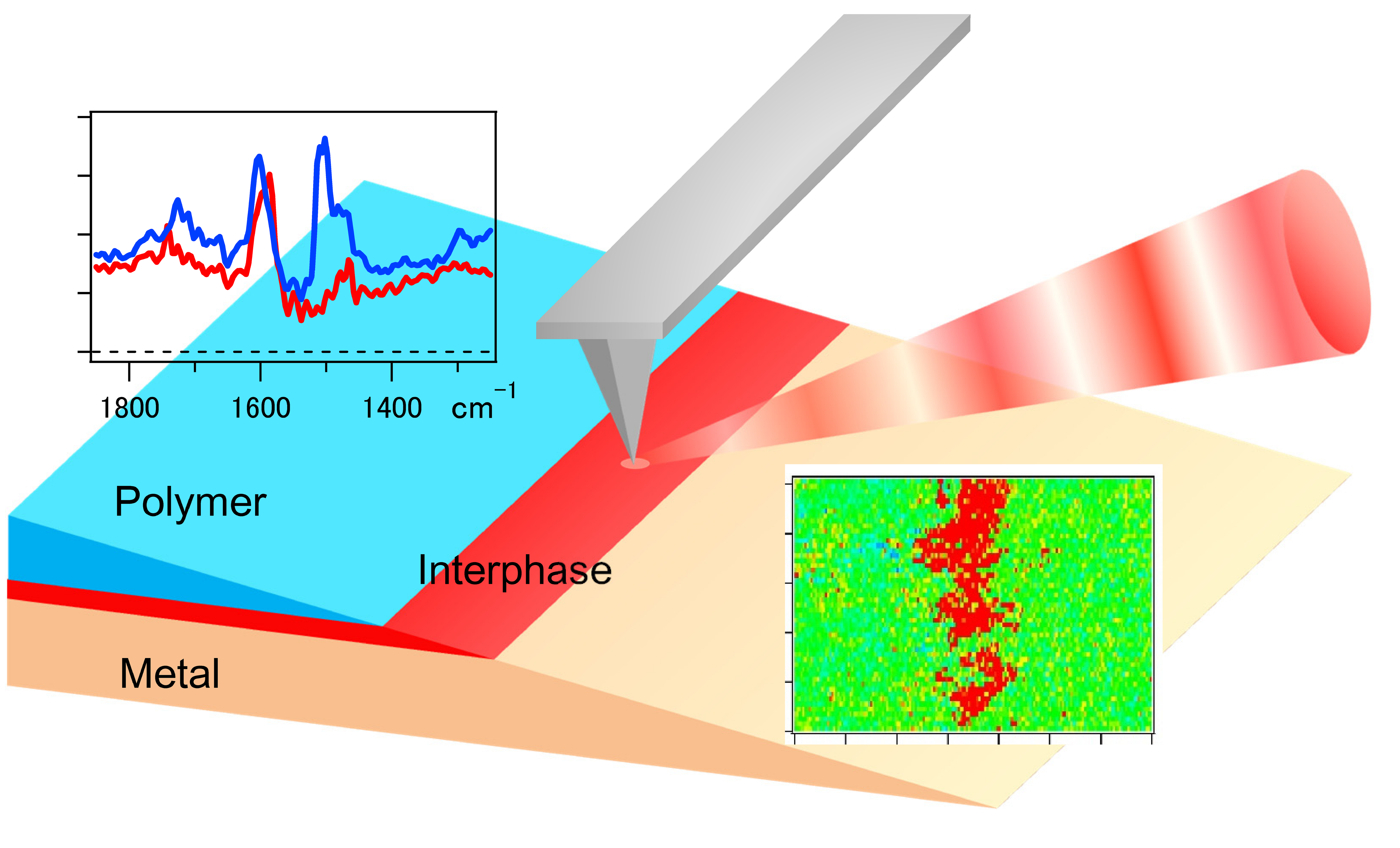
There is a great need for the analysis of the chemical composition, structure, functional groups, and interactions at polymer-metal interfaces in terms of adhesion, corrosion, and insulation. Although atomic force microscopy-based infrared (AFM-IR) spectroscopy can provide chemical analysis with nanoscale spatial resolution, it generally requires to thin a sample to be placed on a substrate that has low absorption of infrared light and high thermal conductivity, which is often difficult for samples that contain hard materials such as metals. This study demonstrates that the combination of AFM-IR with low-angle microtomy (LAM) sample preparation can analyze buried polymer-metal interfaces with higher spatial resolution than that with the conventional sample preparation of a thick vertical cross-section. In the LAM of a polymer layer on a metal substrate, the polymer layer is tapered to be thin in the vicinity of the interface, and thus, sample thinning is not required. An interface between an epoxyacrylate layer and copper wire in a flexible printed circuit cable was measured using this method. A carboxylate interphase layer with a thickness of ∼130 nm was clearly visualized at the interface, and its spectrum was obtained without any signal contamination from the neighboring epoxyacrylate, which was difficult to achieve on a thick vertical cross-section. The combination of AFM-IR with LAM is a simple and useful method for high-spatial-resolution chemical analysis of buried polymer-metal interfaces.
Keywords
Get full access to this article
View all access options for this article.
References
Supplementary Material
Please find the following supplemental material available below.
For Open Access articles published under a Creative Commons License, all supplemental material carries the same license as the article it is associated with.
For non-Open Access articles published, all supplemental material carries a non-exclusive license, and permission requests for re-use of supplemental material or any part of supplemental material shall be sent directly to the copyright owner as specified in the copyright notice associated with the article.
