




Abstract
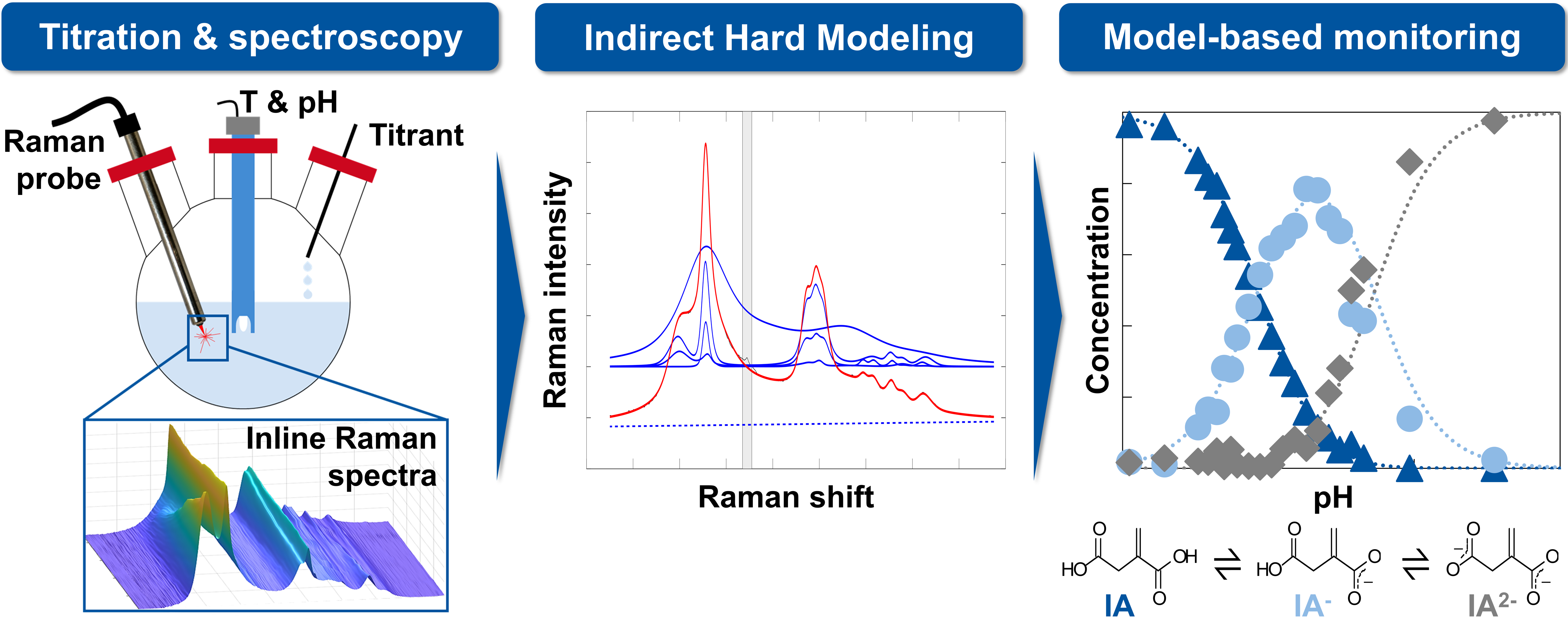
We propose an approach for monitoring the concentration of dissociated carboxylic acid species in dilute aqueous solution. The dissociated acid species are quantified employing inline Raman spectroscopy in combination with indirect hard modeling (IHM) and multivariate curve resolution (MCR). We introduce two different titration-based hard model (HM) calibration procedures for a single mono- or polyprotic acid in water with well-known (method A) or unknown (method B) acid dissociation constants pKa. In both methods, spectra of only one acid species in water are prepared for each acid species. These spectra are used for the construction of HMs. For method A, the HMs are calibrated with calculated ideal dissociation equilibria. For method B, we estimate pKa values by fitting ideal acid dissociation equilibria to acid peak areas that are obtained from a spectral HM. The HM in turn is constructed on the basis of MCR data. Thus, method B on the basis of IHM is independent of a priori known pK a values, but instead provides them as part of the calibration procedure. As a detailed example, we analyze itaconic acid in aqueous solution. For all acid species and water, we obtain low HM errors of < 2.87 × 10⁻⁴mol mol−1 in the cases of both methods A and B. With only four calibration samples, IHM yields more accurate results than partial least squares regression. Furthermore, we apply our approach to formic, acetic, and citric acid in water, thereby verifying its generalizability as a process analytical technology for quantitative monitoring of processes containing carboxylic acids.
Keywords
Get full access to this article
View all access options for this article.
References
Supplementary Material
Please find the following supplemental material available below.
For Open Access articles published under a Creative Commons License, all supplemental material carries the same license as the article it is associated with.
For non-Open Access articles published, all supplemental material carries a non-exclusive license, and permission requests for re-use of supplemental material or any part of supplemental material shall be sent directly to the copyright owner as specified in the copyright notice associated with the article.
