



Abstract
Claims of unfairness often arise when individuals’ expectations are violated. Evaluating such claims requires understanding the nature and basis of those expectations. This paper examines farmers’ fairness perceptions through two case studies: policy changes to water access rights and the use of dicamba in agricultural areas. We illustrate how expectations are rooted in identifiable bases, propose methods for uncovering those bases, and assess their presence in farmers’ statements. Our findings demonstrate the feasibility of identifying expectation bases, enabling more objective assessments of unfairness claims. This approach offers an alternative to normative fairness frameworks and has implications for antitrust and competition policy. In markets where concentration and power asymmetries are prevalent, fairness perceptions influence participation, trust, and regulatory legitimacy. Understanding expectation-based fairness claims can help policy-makers evaluate harms not captured by traditional metrics and design more responsive competition and contract policies.
I. Introduction
As U.S. agricultural markets become more concentrated, concerns about fairness have become increasingly central to both farmers and policymakers—especially in the context of antitrust and competition policy. These concerns reprise those expressed over a century ago that led to the Packers and Stockyards Act of 1921 (PSA), an important, if often dormant, piece of antitrust legislation. 1 Farmers then and now have voiced frustration not only with declining prices and limited market access, but also with what they perceive as unfair treatment by dominant firms and government institutions. For example, the National Farmers Union launched the “Fairness for Farmers” campaign in 2021 to advocate for competitive markets. 2 Farmers have long pressured the USDA for fairer prices 3 and established organizations like the Organization for Competitive Markets to focus on fairness and competition issues. 4 Fairness was a major concern at the USDA-DOJ antitrust hearings in 2010. 5 Black farmers and other marginalized groups have also voiced concerns about fair treatment in the marketplace and within the USDA. 6
Recognizing the importance of fairness is straightforward, but assessing unfairness claims in the context of market regulation is challenging. In antitrust discourse, fairness is often subordinated to efficiency metrics, yet it remains a persistent concern among market participants. For instance, the PSA reflected a commitment to fairness by prohibiting unfair, discriminatory, and monopolistic practices in livestock markets, 7 even though courts today tend to favor efficiency over fairness considerations. 8 Similarly, recent debates over contract grower protections in poultry markets highlight how producers perceive fairness in bargaining power and payment systems, even when these arrangements are defended on efficiency grounds. 9 In 2024 and early 2025, the USDA finalized three rules addressing unfairness, market integrity, and deception in livestock and poultry markets, while withdrawing a proposed rule that would have defined unfair practices under the PSA. 10
Previous efforts to evaluate fairness or respond to claims of unfairness frequently falter because they rely on predefined normative frameworks that may not reflect the lived experiences or expectations of those affected by market concentration or firm behavior. 11 For example, antitrust provisions operationalize fairness through prohibitions on “unfair methods of competition,” as in the Federal Trade Commission (FTC) Act or the PSA, framing fairness in terms of market integrity. 12 Principles of procedural and distributive justice emphasize fairness in processes and outcomes, respectively, and have been applied in studies of pricing 13 and resource allocation. 14 Philosophical theories such as John Rawls’s difference principle and Robert Nozick’s entitlement theory offer contrasting views—one prioritizing equity for the least advantaged, 15 the other emphasizing voluntary exchange and property rights. 16 Similarly, the ethics of care foregrounds relational responsibilities and has informed community-based resource governance. 17 While these frameworks provide normative guidance, adopting any one of them privileges certain claims over others, effectively determining winners and losers.
An alternative approach that does not rely on a predetermined definition or framework of fairness links fairness perceptions to expectations. 18 According to this literature, people perceive unfairness when their expectations are violated. Therefore, assessing the reasonableness of unfairness claims requires us to understand the basis of expectations that people form rather than to determine if the unfairness claim aligns with a preferred definition or framework. This paper examines the root basis of expectations, focusing on farmers and agrifood system participants. We ask: Can we identify the root basis of expectations from statements about fairness or unfairness? We analyze two case studies—statements by Idaho farmers about new water use restrictions 19 and farmer commentary about dicamba use—to determine the feasibility of identifying root bases of expectations. We find that the answer to our research question is often in the affirmative.
Understanding fairness perceptions is vital because it provides a bridge between individual experiences in agrifood markets and broader questions of market structure, regulation, and antitrust enforcement. In economic theory, competitive markets require not only efficiency but also legitimacy—participants must perceive the system as fair. When expectations of fairness are violated, market participation may decline, undermining price discovery, innovation, and supply chain resilience. For example, regulatory responses to market power and fairness issues can be too subjective or inconsistent. 20 Fairness concerns also justify value-based value chains and alternatives like Fair Trade. 21 By identifying the root bases of expectations, this paper offers a way to incorporate fairness more systematically into competition and contract policy.
Ultimately, this approach contributes to antitrust policy by offering a method to evaluate fairness claims without privileging one normative framework over another. Rather than relying on abstract definitions, it grounds fairness assessments in the expectations of market participants—expectations that can be traced, analyzed, and evaluated for reasonableness. This orientation may help regulators and courts better understand when claims of unfairness reflect genuine market failures or power imbalances, and when they do not.
II. Background on Expectations
An expectation is a strong belief or anticipation that something will happen. There are two different types of expectations. 22 Predictive expectations are beliefs about what people will do, and prescriptive expectations are beliefs about what people should do. 23 Scholars have sought to understand how, when, and why expectations form and how these relate to fairness perceptions and claims.
Equity Theory posits that fairness expectations arise from social comparisons—people evaluate their own inputs and outcomes relative to others. 24 When outcomes fall short of expectations, perceptions of unfairness intensify. Expectancy Violations Theory further refines this idea by distinguishing between positive and negative violations of expectations. 25 Positive surprises can sometimes be more satisfying than simply meeting expectations. Building on this, Jones and Skarlicki proposed a model of organizational justice that links fairness perceptions to evolving expectations. 26 They differentiate between fairness events (specific incidents) and fairness entities (ongoing assessments of a person or institution). When new events align with prior expectations, perceptions remain stable; when they do not, individuals reassess their broader judgments.
Other research highlights how power and prior commitment influence expectations. Power can foster a sense of entitlement, shaping reactions to perceived injustice, 27 while stronger prior commitments can amplify negative responses to unfair treatment. 28 Social structures also play a role—expectations are often shaped within networks like families, organizations, and communities. 29
Hendrickson and James developed a framework identifying sources of expectations and linking expectations to fairness, which is useful for assessing claims of unfairness. 30 They stated that assessing unfairness claims requires evaluating the reasonableness of expectations. Expectations are reasonable when the explanation for their basis is consistent with available evidence. An outside observer should be able to determine if the basis of an expectation is reasonable. For example, if a parent tells a child she will get one cookie for putting a toy away, the child will expect a cookie if she complies with the parent’s request. An observer would conclude that expecting one cookie is reasonable, while expecting five cookies is unreasonable, as the basis—a promise of five cookies—is inconsistent with the evidence—a promise of one cookie.
In summary, there is a robust literature linking expectations to fairness perceptions and claims. According to this literature, violations of expectations can lead to claims of unfairness. Because fairness claims can be tied to expectations, it is conceptually possible to assess the validity of unfairness claims if it is possible to identify the root basis of the expectations that a person believes have been violated. The idea is that if the root basis of a person’s expectations is reasonable—that is, if the root basis of the expectation is consistent with evidence—then the unfairness claim resulting from a perceived violation of that expectation could be considered reasonable as well. However, this process only works if it is possible to identify the root basis of a person’s expectations. It is this problem that this paper seeks to examine.
III. Conceptual Framework
Our conceptual framework for examining the nature or root basis of expectations draws on the work of scholars who posit that claims of unfairness can be linked to violations of expectations that people form, 31 as summarized in Figure 1. When a fairness event occurs, a person considers whether relevant expectations formed prior to the event are confirmed or violated. If the assessment shows that expectations were violated, then we can expect the person to respond by making an unfairness claim. 32
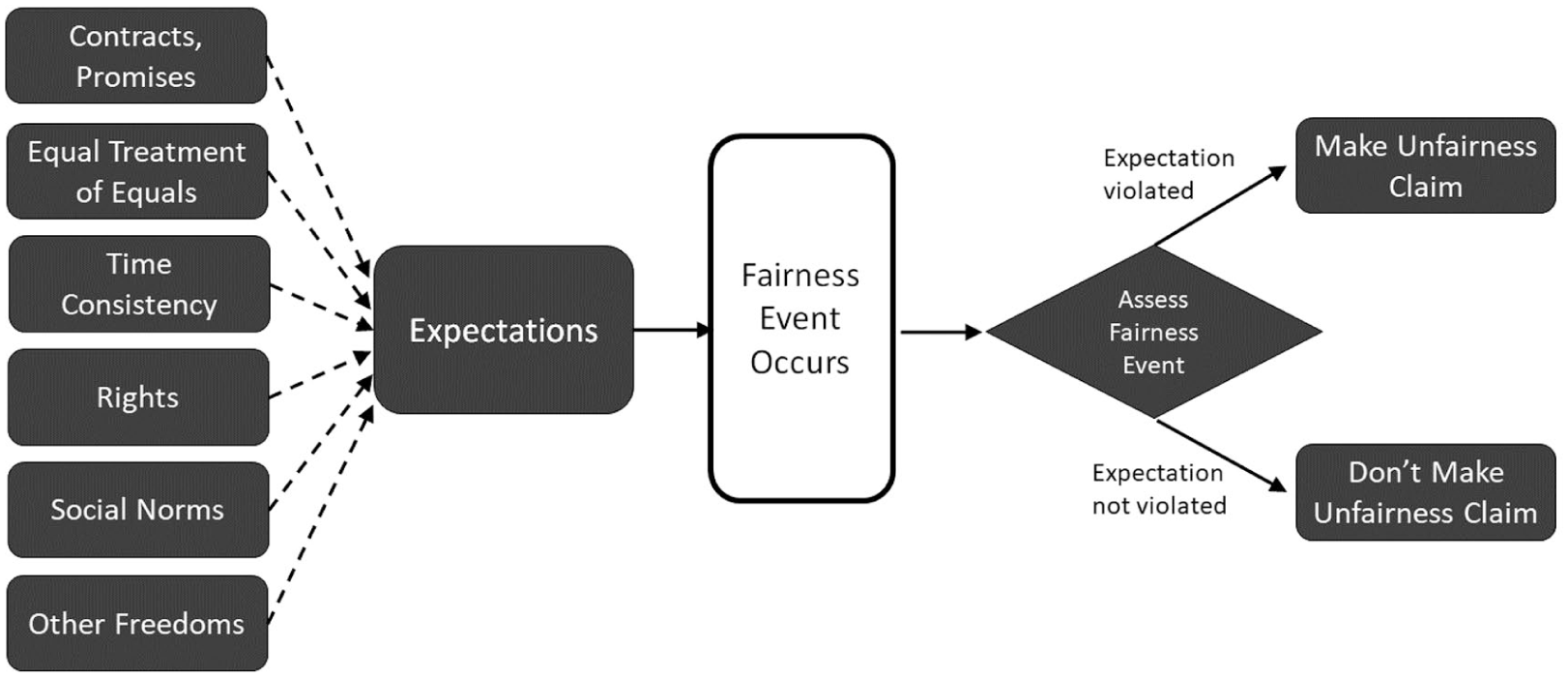
The relationship among root bases of expectation, expectations, and fairness claims.
However, our framework requires understanding the sources, context, or nature of the expectations that formed prior to the unfairness event—that is, the root basis for the person’s expectations. Fortunately, scholars have proposed many potential root bases for expectations. We summarize some of them here (see Figure 1). We acknowledge that ours is not an exhaustive list. Instead, we propose it as a reasonable approximation of some of the most common root bases of expectations. Furthermore, we recognize that not all root bases are responsible for specific expectations relevant to fairness events. Sometimes, only one root basis is needed to create an expectation. Other times, several root bases might apply. For this reason, we show the linkage of root bases to expectations in Figure 1 using dashed rather than solid lines.
Contracts and promises are among the most common means of creating expectations. 33 A contract or promise is a commitment, agreement, or assurance that one will do or receive a particular thing. Signed documents, oral agreements, handshakes, and even shared understandings can create expectations about what each party will or will not do. For example, if a beef packer signs a contract with a feedlot operator to purchase cattle before they have reached their finished market weight, it is reasonable for the feedlot operator to expect that the packer will complete the sale when the cattle are ready. Numerous scholars have argued or demonstrated that contracts and promises form the bases of expectations. For instance, Tess Wilkinson-Ryan explains how legal contracts create psychological expectations in parties, 34 and Kickul and Lester state that a breach of organizational promises creates a “sense of unmet expectations” among employees. 35
Equal treatment of equals is another common basis for the formation of expectations. The equal treatment principle states that individuals perceived as similar should be treated in a similar manner. 36 Numerous scholars have linked this principle to the formation of expectations. For example, Köppen and Trappe examine how gender equality—where men and women are perceived as equal—affects expectations of fairness in the division of household labor. 37 Hendrickson and James show how similar positions within a network can create expectations of similar treatment. 38 For instance, a poultry contractor may expect to receive the same payment per bird as a neighboring grower with the same experience, size of operation, and inputs. Jean-Paul Chavas’ argument that fairness considerations become more important among individuals belonging to the same social (or organizational) network offers further support. 39
Time consistency, another basis for fairness expectations, considers how beliefs about the future are shaped by what has happened in the past (e.g., “If I did it in the past and conditions have not changed, then I should be able to continue doing it in the future”). For example, farmers who consistently received a price discount for bulk purchases from a retailer during the last several years may expect to continue receiving price discounts when buying in bulk in the current year. Jones and Skarlicki’s model of organizational justice incorporates this idea when they show how people update the fairness “entity” or expectations based on the accumulation of past behaviors. 40
Rights are moral or legal entitlements to perform certain actions or receive certain benefits and, as such, serve as strong foundations for the formation of expectations. For instance, John Rawls’ principle of legitimate expectations posits that rights and obligations arise from the social and legal rules widely accepted in society. 41 In other words, because these rules create obligations for others, individuals develop “legitimate” expectations based on the rights they acknowledge from these obligations. As an example, Jeremy Waldron argues that a person’s expectation to use land, such as a farmer who wants to produce agricultural commodities, arises only when they have a right to the land or an entitlement to remain in control of it indefinitely. 42
Social norms consist of a shared understanding of what is culturally, collectively, or socially acceptable and thus relate to the expectations people have about attitudes, beliefs, or actions relative to reference groups. The expectations that social norms create operate in two ways. On the one hand, social norms within peer or reference groups create expectations about how others within the group ought to behave. On the other hand, these norms also shape individuals’ expectations about how they themselves ought to behave within the group. Hillenbrand and Miruka provide several instances where social norms influence the expectations of women in agriculture. 43 For instance, even when laws permit women to hold rights to land, gender norms within marriage relationships may require women “to renounce their inheritance claims to preserve alliances and secure support within the family.” 44
According to Hendrickson and James, there are other freedoms and liberties that can form the root bases for expectations. 45 These include beliefs about the ability to negotiate and dictate contract terms, to profit from exchange, to know and be informed, to be treated equally, and to make ethical decisions. For example, if a farmer believes he is free to negotiate over terms to a contract in order to ensure a reasonable chance of profiting from any resulting economic exchange, then the farmer might also have an expectation to negotiate and generate a profit.
In summary, there are many bases for the formation of expectations. Within our framework, claims of unfairness often arise when individuals perceive that an expectation has been violated. We propose that the reasonableness of an unfairness claim can be assessed by determining whether the expectations in question are reasonable. If the expectations are reasonable, then the associated unfairness claim is presumed reasonable. Conversely, if the expectations are not reasonable, then the unfairness claim can be considered unreasonable.
Reasonable expectations are based on good reasons or relevant evidence. Thus, if unfairness claims arise as depicted in Figure 1, assessing the reasonableness of the unfairness claim involves moving from the right to the left in Figure 1. Our question is whether it is possible to identify the likely root bases for expectations that people have based on their statements. Methodologically, this means isolating a person’s statement about what they expect or anticipate and then aligning the commentary with one or more root bases. Figure 2 summarizes this three-step approach: (1) review statements people make about unfairness and (2) identify words or phrases that (3) reflect or align with bases of expectations. For example, suppose a farmer claims she has been treated unfairly by a business and says, “That business paid me a lower price than what they had previously agreed to.” From this context, we can infer that the farmer’s expectation was likely based on a contract or promise, as the words “what they had previously agreed to” align most closely with the idea of a contract or promise, rather than any other root bases in Figure 1. To determine if the unfairness claim is supported, a fourth step assesses whether evidence is consistent with the identified basis of expectations. If it is, then we say the expectation is reasonable and a violation of that expectation is grounds for a claim of unfairness.
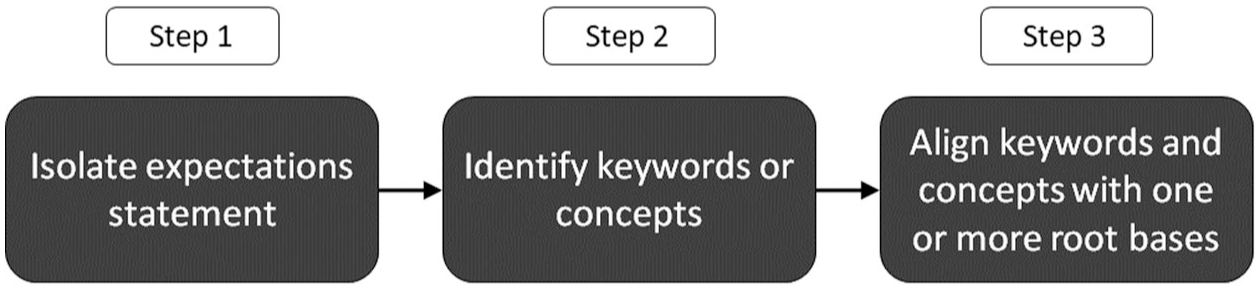
The methodological approach for identifying root bases of expectations.
In this paper, we examine two cases where statements are made about issues where fairness or unfairness claims are expected, and then we make judgments about the most likely root basis or bases that reflect those statements, as depicted in Figure 2. We do not take the additional step in determining whether there is evidence to support the expectation and fairness or unfairness claims. The first case is based in Idaho, examining the results of research from Running et al., 46 where farmers were impacted by a significant change in the policy environment regulating water that affects their continued participation in agrifood markets. The second case reviews commentary by farmers in an online agricultural forum discussing dicamba use following the introduction of dicamba-tolerant soybeans. In both cases, uncertainty and conflict over future participation in agrifood markets could spark claims of unfairness. This exercise demonstrates the feasibility of assessing the reasonableness of expectations and hence the ability to evaluate unfairness claims without the need for a specific fairness definition or framework.
IV. Study 1: The Case of Changes to Agricultural Water Use Policies
A. Introduction
The Eastern Snake Plain Aquifer (ESPA) is a crescent-shaped regional aquifer system that spans approximately 10,800 square miles in the southern portion of Idaho and the southeastern section of Oregon (in the United States). The aquifer is the primary source of irrigation water for agricultural production in the area. While some farmers in the ESPA region irrigate using surface water, others pump water from the aquifer. According to the Idaho Department of Water Resources, “The ESPA region produces approximately 21% of all goods and services within the State of Idaho—resulting in an estimated annual value of $10 billion. Water is the critical element for this productivity.” 47 The aquifer is fed through irrigation recharge and groundwater inflow from nearby streams and mountain ranges.
Like other states in the western region of the United States where water is relatively scarce, water rights to the ESPA are governed by the doctrine of “prior appropriation.” Also known as “first-in-time, first-in-right,” this doctrine states that water rights go to the person who first uses the water for beneficial purposes. Thus, seniority use is prioritized when usage rights are contested. 48 In contrast, water rights in the eastern portion of the United States, where water is relatively more abundant, are governed by the doctrine of “riparian rights.” According to this doctrine, anyone with land adjacent to or containing water may use the water as long as such use does not unreasonably restrict others with riparian rights from using the water.
Between 1915 and 1955, water levels within the ESPA increased because of efforts to divert water flow from the Snake River. However, growth in farming and development activities starting in the mid-1950s, as well as the adoption of more efficient irrigation systems by farmers that reduced irrigation recharge of the aquifer, caused water levels to decline over time.
49
Predictably, conflicts arose between surface water irrigators and groundwater irrigators. In response, the Idaho Department of Water Resources initiated new rules in 1994 and 1995 stating, in part, “that junior groundwater users would now be subject to delivery calls from senior surface water rights holders in cases where material injury could be shown under the rules of prior appropriation.”
50
This meant that in times of water scarcity, senior water right holders could force junior water right holders to stop accessing water. The result was numerous rounds of litigation over the next twenty years. In 2015, a temporary settlement was reached between surface water and groundwater users. Running et al. summarize the terms of the agreement:
Locally referred to as the 2015 water settlement agreement, its terms require groundwater irrigators to reduce total water consumption by an average of 13% annually. In return, as long as affected farmers agree to follow their district’s rules, they are protected from further lawsuits by senior water rights holders for the duration of the five-year agreement.
51
In addition, the settlement created a system of tiered reductions, where newer water users were expected to make larger cuts in water use than older water users.
Because the 2015 settlement created winners and losers, it provides an effective context for studying perceptions of fairness by farmers affected by the settlement.
B. Methods and Procedures
Running et al. interviewed 43 crop farmers from the ESPA region between 2017 and 2019 and also analyzed the responses of 265 mail surveys sent to farmers and other stakeholders in 2018 in order to determine farmer reactions and levels of support for the 2015 policy. 52 They found that “31% of respondents generally agreed, while 51% generally disagreed and 18% reported feeling neutral” toward the terms of the agreement. 53 In their study, the author coded and categorized statements of support or opposition to the settlement into themes, presenting representative statements as part of their report. We use the categorized themes and commentary by the study authors to identify the root basis or bases of farmer expectations.
C. Results
1. Root Bases of Expectations in Fairness Claims
The study authors identified two main themes in the comments by farmers who supported the settlement. The first theme was that water scarcity was a real problem and that the solution, while controversial, was justifiable. Thus, all farmers had to do their part, even if it was hard; “it was fair for everyone to sacrifice a little.” 54 The idea that “everyone should sacrifice a little” is, in our opinion, consistent with a social norm, especially if many farmers held the same view. According to the study authors, “there was . . . a common feeling” among farmers for this perspective, 55 which might be sufficient for farmers to create an expectation-based on a social norm. The second theme was that the old system of “first-in-time, first-in-right” should be respected, “because it is the game they have always had to play.” 56 If farmers hold the belief that it is fair to continue a practice that has existed in the past, then a likely root basis supporting that expectation, in our opinion, is time consistency.
2. Root Bases of Expectations in Unfairness Claims
The study authors report that there were several reasons why farmers did not think the settlement was fair. The most frequent reason offered is that
the agreement essentially changed the rules too much; for decades, farmers in Idaho had purchased water rights and made infrastructure decisions under one policy—prior appropriation—but now the game had changed and the burden is all on farmers to adjust.
57
The references to “changed the rules,” “for decades,” and “the game had changed” suggest that time consistency might be a reasonable root basis for expectations of farmers. Farmers played the game for decades under the old set of rules. It appears that many of them expected those rules would continue, consistent with the root basis of time consistency.
The study authors noted a comment by a stakeholder who said the settlement “makes all IGWA’s (Idaho Groundwater Appropriators) groundwater users equal,” 58 implying that prior to the settlement groundwater users were not equal. The root basis most closely reflecting this idea is equal treatment of equals, or its converse, unequal treatment of unequal persons. The speaker seems to imply that water users are different depending on when they acquired water rights; hence they should not be “made equal” by a change in the policy. Doing so forces equal treatment when unequal treatment is expected.
Another reason offered by farmers viewing the settlement as unfair is that it prevented farmers from being able to recoup investments made under the old system. The settlement required the calculation of a five-year water use average as the baseline for determining how much water a farmer had to cut. One farmer quoted by the study authors said this:
I think there was (sic) a lot of problems with the implementation. One of the biggest was the 5-year average. Because for me, when I bought the farm . . . about 15 years ago from my dad . . . there were no restrictions. I mean—there were water rights but nobody ever measured them. When I took over, I spent a lot of money, about $1,500,000, putting in variable drives, new high-efficiency pivots with low pressure nozzles. . . . I water monitor everything. And so this five-year average punished people like me that were already efficient.
59
This statement appears to be consistent with the root basis of freedom to profit from exchange. Because the farmer made an investment in efficiency and saw results from that investment, that action could create an expectation to profit from the investment.
A further reason given by farmers for believing the settlement was unfair was that they did not trust the government’s assessment of how serious the problem of water scarcity was. This concern was amplified by the observation of many farmers that water regulators were allowing new wells to be drilled. Thus, there seemed to be a disconnect between the words and actions of the government. Farmers felt that because the government encouraged development and the drilling of wells, they should take “responsibility in resolving the issue” rather than require changes in farmer behavior.
60
One farmer quoted by the researchers said:
The government was homesteading 160 acres and the deal was if you farmed it and built communities and made the desert blossom, that’s how they would give it to you. They didn’t give it to you to sit on and vest for 100 years. They wanted people to make it go. So now we’ve made it go and the government has their point man out there, taking our water from us. I don’t think it’s ethical. I don’t think it’s moral. I think it’s government run amok and bad science. I don’t think there’s any proof of damage down there. Unfair.
61
The expression “the deal was” in this quote is consistent with the idea of a contract or promise. Thus, the speaker is likely referring to an implied social contract between farmers and government.
A final reason for unfairness claims identified by the study authors is that the problem is less about water and more about power and money. As one farmer reportedly said, “It’s not about irrigation water! It’s about money and greed.” 62 According to the researchers, more than half of the farmers expressed this concern. Identifying the root basis for this expectation is trickier because it does not appear to fit cleanly one of the proposed bases presented in Figure 1. Is the statement reflecting an explicit or implicit contract, a social norm, a right, or something else? In this case, more information is needed to determine more clearly what root basis underlies the farmer’s expectation. This concern also speaks to how socio-economic structure shapes individual participation in markets, where power asymmetries are likely to arise. 63
V. Study 2: The Case of Dicamba
A. Introduction
While the herbicide dicamba has been used since the mid-1960s as a pre-plant treatment for weeds (mostly in corn), more recently it has been used in soybean production to control for weeds, 64 which have become resistant to other herbicides, such as glyphosate. 65 In 2015, Xtend soybeans were approved for the 2016 planting season but the accompanying new formulation of dicamba for use with them was not approved. By 2017, new formulations had been approved so farmers could plant dicamba-tolerant soybeans and legally use dicamba to control weeds in mid-summer. In the years since Monsanto’s seeds were approved, all of the large agrochemical-seed firms have introduced dicamba-tolerant seeds, including Syngenta (ChemChina), Corteva, BASF, and Bayer. 66 However, the use of these seeds stirred controversy because of the impacts on non-tolerant soybeans and other crops due to the volatility of dicamba formulations, causing it to drift. Many farmers protected themselves from neighboring farmers’ use of dicamba by planting dicamba-tolerant soybeans, also known as “defensive planting.”
Between 2015 and 2020, controversy over dicamba was especially intense in agriculture and rural circles. In 2016, a murder in the Arkansas-Missouri delta region was blamed on dicamba. 67 The agricultural news service DTN-Progressive Farmer documented extensive harm to rural businesses, alternative farmers (e.g., produce growers), and rural homeowners in 2018. 68 In 2020, a jury awarded Bader Farms, a southeastern Missouri peach orchard, $15 million in compensation for damages from off-target dicamba drift, 69 a decision affirmed on appeal in 2022. In 2021, Bayer agreed to a $400 million settlement for farmers impacted by dicamba drift between 2015 and 2020. 70 In 2020, and again in 2024, federal rulings directed the EPA to ban use of new formulations of dicamba on herbicide tolerant cotton and soybeans; 71 more recently, the EPA is again considering allowing over-the-top usage in herbicide tolerant crops. 72
Given the controversy regarding dicamba and the harm the herbicide causes, we anticipate that farmers will be vocal about unfairness from crop damage or other concerns relating to the use of dicamba. Such damage can directly impact the ability of these farmers to participate in agrifood markets. Thus, the case of dicamba usage among farmers in the Midwest creates an ideal environment for exploring the relationship between expectations and unfairness claims. Talking with farmers and reviewing comments by them about their experiences with dicamba and any related expectations can provide insights into which sources of expectations are important or relevant for issues relating to harm caused by dicamba.
B. Methods and Procedures
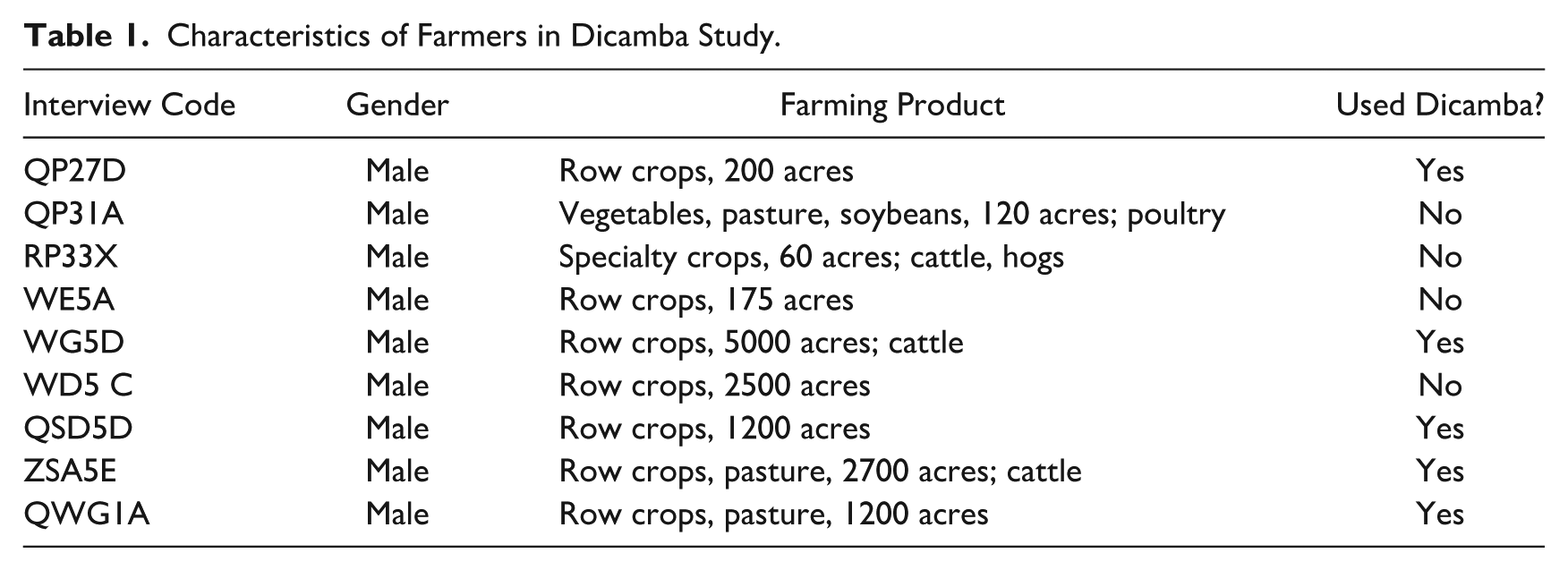
In the summer of 2019, we conducted exploratory interviews with 10 Missouri farmers about dicamba use. These farmers were recruited through snowball sampling, starting from contacts with the lead researchers, an appropriate method when conducting exploratory research. Farmers were recruited in heavy row-crop areas of northeastern and central Missouri. Seven interviews were conducted with row-crop farmers, and two were conducted with farmers raising vegetables and fruits for alternative markets. One interview was not included in the analysis since the participant was no longer an active farmer (see Table 1). All were men who ranged in age from mid-thirties to mid-seventies. Interviews were conducted and transcribed by graduate students hired by the lead authors. Using NVivo, two of the authors first coded the data using iterative open coding. 73 Coding was cross-checked for agreement. Thematic coding using the fairness framework was then conducted by one of the authors, with codes reviewed and discussed by the project team.
Characteristics of Farmers in Dicamba Study.
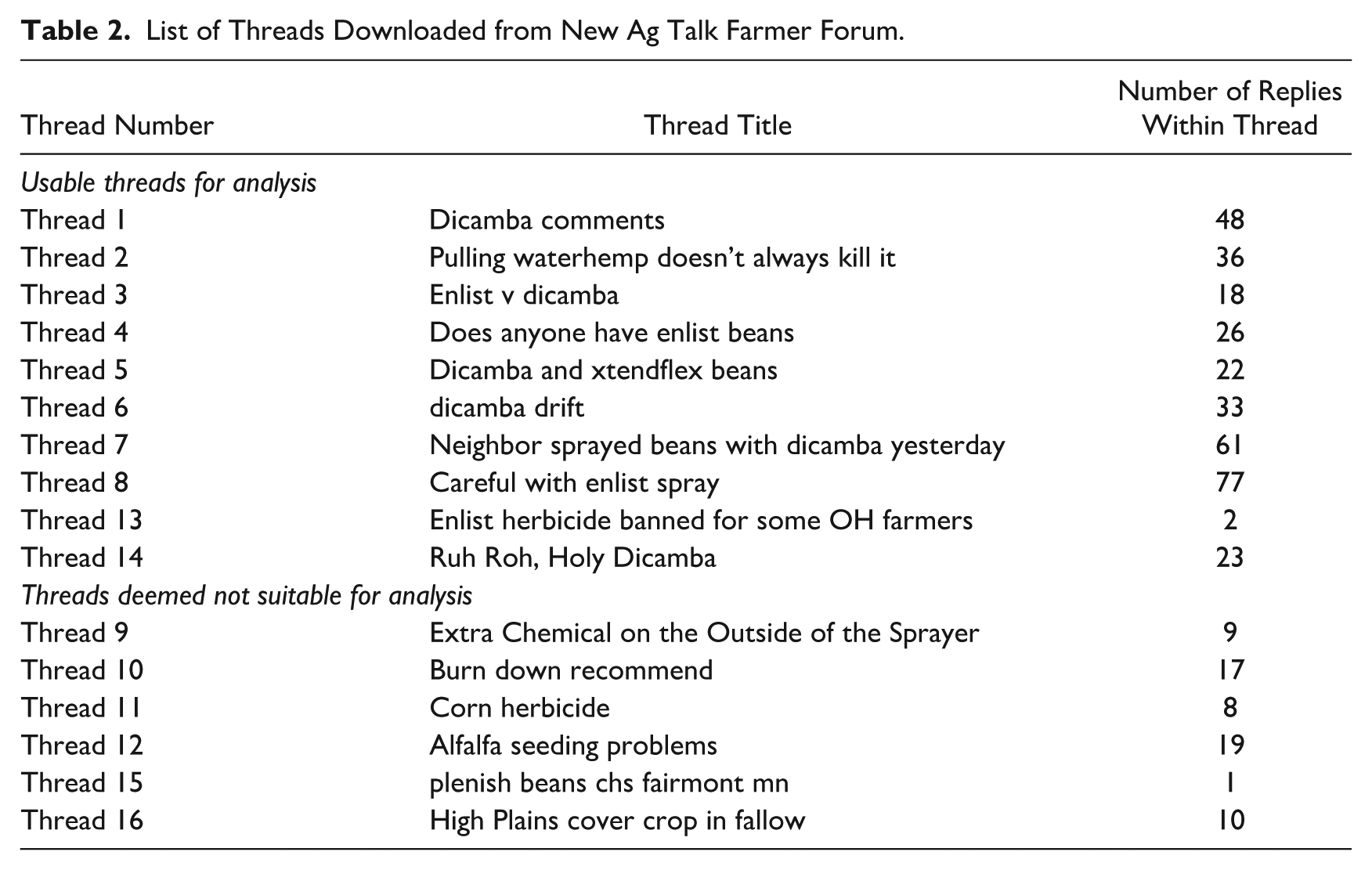
Given the dynamic nature of dicamba use in Midwestern cropping system and emerging regulatory action, the authors decided to reexamine some of the themes emerging from the interviews with more recent content analysis of an internet farmer forum. New Ag Talk offers threaded discussions on agricultural topics in nine different “forums.” 74 Using the site’s search function, the words “dicamba, fair” were keyed into the search of all posts in the “Crop Talk” forum on September 23, 2022. This brought up all posts made within the last year that contained the words dicamba and fair, sorted into sixteen threaded discussions. 75 Of these sixteen discussions, six were deemed unusable for our purposes, as they discussed technical issues related to seeds, inputs, weed management or equipment. The remaining ten threads, containing anywhere from two to seventy-seven posts in each thread, were coded in NVivo 12 to identify general themes. See Table 2 for a summary of the discussion threads.
List of Threads Downloaded from New Ag Talk Farmer Forum.
C. Results from Farmer Interviews
Only half of the respondents were current or former users of dicamba. However, all of the respondents expressed varying degrees of concern about its use. One reason is because of the actual or potential harm its use can cause them or others (e.g., “two of my neighbors have used it on their soybeans and it’s moved, picked up, moved over on mine. . . . it’s a bad deal” 76 ). Another reason is because users may not realize they are being harmed by its use (e.g., “People don’t even know that it’s affecting their garden” 77 ).
1. Claims of Unfairness
Are farmers in our sample making claims of unfairness? Interestingly, the answer is generally no. While most farmers expressed concerns about dicamba related crop injuries, only two farmers explicitly expressed concerns of unfairness. The other farmers did not raise claims of unfairness. For example, one farmer framed the use of dicamba as a moral or ethical issue, with a particular concern about doing the right thing:
With dicamba, you can do everything right and it can still move around and damage the neighbor’s orchard or the garden of the lady down the road. . . .. But, morally, can you spray a product that you have no control over once it leaves the boom tip and you have to rely on Mother Nature to keep it where it’s at and you damage someone else’s crop?
78
The basis for the farmer’s expectation appears to be the social norm of following rules and the desire to make ethical decisions. Farmers expect their neighbors and others to apply herbicides according to application instructions. When they “do everything right,” then while there might not be a basis for a claim of unfairness if something bad happens, there might still be a morally compelling reason not to engage in the activity, which this farmer articulated. We begin with this comment because it hints at the utility of our proposed framework for evaluating claims of unfairness. If unfairness claims arise when a person perceives their expectations have been violated, then when expectations are not violated, individuals might still have concerns about the ethics of an action, but not raise the matter to the level of an unfairness claim.
2. Root Bases of Expectations in Unfairness Claims
As noted, two farmers made statements about unfairness, and, furthermore, for similar reasons. For example, an organic vegetable grower in his mid-60s, asked:
why is it our responsibility to protect ourself (sic) from them? . . . Because their stuff is drifting over on us. . . . it affects our ability to farm the way we want to. So, you know, some of that to me, . . . if you get right down to it, yeah, it’s kind of unfair.
79
Similarly, a farmer who operated a large row-crop business said, “the fair thing would be to expect people to keep whatever it is that’s out there on our own darn place.” 80 From these quotes, we can discern that the root basis for their expectations is likely, in our opinion, the social norm of neighborly behavior—neighbors using dicamba should use buffers or other “common sense” practices to ensure that they do not interfere with the ability of other farmers to farm their properties.
3. Root Bases of Expectations for Non-Fairness Comments
Even though few issues of fairness were raised by farmers, they were still expressive about their feelings and expectations about dicamba use and related agricultural activities. In addition to the importance of social norms, two other root bases for expectations that we identified were those based within economic exchange: (1) making ethical decisions and (2) knowing and being informed. Farmers want to do the right thing, but dicamba drift is unpredictable:
I know, on part of it, at least half of it, the application it was applied right. And they followed all the guidelines. And in fact, my son was the one that applied it. . . . the other, I don’t know, I don’t personally know the other boy . . .but I’m sure he done (sic) what he was supposed to do too. It just that the product was supposed to be [stable]. . . wouldn’t move around like that and that’s not the case. . . . if you can make it stay put where its put, it’s a good product. I’ve seen where it’s been used and it works fine, but this year was a different story.
81
Farmers also want to know that if they are applying chemicals correctly, others would not be harmed:
. . . they had promised that the volatility would be greatly reduced. So we planted everything. But in that particular year, most of our soybean fields were not adjacent to other fields except in one or two. So we thought, well, it’d be a good year to try it. The weed control was excellent, burn down was excellent—we planted the field right away. But it was the post applications that got us in trouble. We had three incidents where it left our field, went on a neighbor’s field. Three different neighbors. That was highly unsatisfactory.
82
Another farmer said:
We tried to do everything as best we could and thought everything was okay. Then a couple of weeks later, then some symptoms started showing up on the Liberty, some cupped leaves. I don’t think there’s any detrimental damage to them, for yield anyway, but we won’t know that ‘til this fall.
83
There were other root bases for expectations that we discerned from the interviews. For example, this quote seems to reflect the concept of time consistency: “we’ve used Dicamba in corn for years, and we, we’ve always planted a lot of Monsanto-Bayer products. Uh, they’ve always performed well on our farm.”
84
In other words, because of previously positive experiences with the product, this farmer appears to expect that such results would continue. Another basis for expectations is having the freedom to negotiate, as illustrated by this statement:
There’s no negotiation. . . . I’m thankful that we have the ethanol plant for our outlet for corn or we would be in big trouble here. . . . [But] I’m not satisfied the fewer choices that we have, but it is what it is. . . . So yes, not always what it’s cracked up to be.
85
The relevance of equal treatment of equals was referenced by one of the two farmers who raised a concern about unfairness, although in this case, instead of arguing for similar treatment, he emphasized the need for dissimilar treatment. This farmer, in addition to highlighting the importance of neighborly behavior, also said that because his farming operating differed from his neighbor’s—his was an organic operation and he didn’t have cattle, but his neighbor had cattle—then he should not be held to the same fencing requirements.
You know, being an organic farmer, we have to leave a 25-foot buffer zone around our farms to protect us from the neighbors. Now we’re not the ones that are causing a problem with our crops. And it kind of reverts back to Missouri’s fencing law. I’ve got a neighbor that runs cattle next to me. I don’t have any cattle. So according to Missouri’s fencing law, I don’t have to worry about my fences. Normally, . . . they consider half the fence is . . . one side, half the fence is the other. . . . But, I don’t have to maintain my fences because I don’t have any livestock against it.
86
D. Results from Content Analysis of New Ag Talk Farmer Forum
Many of the posters to the online forum discussed their own land, fields, methods, or equipment, but because of our content analysis method, we observed an ongoing discussion rather than generated answers to questions. The ability to use newer formulations of dicamba (and 2,4-d) as well as the accompanying seed technology was clearly important to many of the posters, while others felt they could not maintain current farming practices or rely on neighbors because of its use (e.g. “Oh wait . . . forget about those that grow non gmo [sic] or specialty crops. Screw those guys.” 87 ). The use of dicamba still provoked controversy and discussion as this quote exemplifies: “it’s definitely a problem and one where some people don’t give a damn about a label, neighbors or the law. Sad very sad and these are the reasons that we’re going to see chemicals pulled from our toolbox.” 88
1. Claims of Unfairness
We saw only two references to fairness in the ten threads. One farmer observed:
So, where to go from here? Govt (sic) and big business seems (sic) disinterested in reworking the current formulations to be less risky. You, and I, we really no longer have enough control of the product to keep it safe for neighbors. Not much else left but to phase the product out of use at the least when temps and humidity starts rising. It’s unfortunate because I believe you that it works well on your crops. But is it fair to harm your neighbors?
89
In response to a post asking how to deal with a neighbor who allegedly sprayed dicamba in early July (past the cutoff date), one responder urged the original poster to talk with the neighbor to see if that’s in fact what he sprayed, and then document weather conditions and damage. The responder continued “We can be firm but fair. Right is right and wrong is wrong . . . . And July 13 is so wrong IF sprayed with Eugenia/xtendimax [it isn’t even] close to funny.” 90
2. Root Bases of Expectations
Overall, we were able to identify different bases for expectations, such as the ability to make ethical decisions and the ability to know and be informed. Time consistency and the freedom to be treated as equals also emerged as sources of expectations. We also note that the social norm of being a good neighbor was debated quite often in the threads we analyzed.
3. Ability to Make Ethical Decisions
Acting ethically can be inferred from many of the posts. There is strong concern that “bad actors” who misuse dicamba intentionally will end up prohibiting the use of a good tool (dicamba) in the future for those who want to act ethically. One poster complained “This is why we can’t have nice things. Off Label applications make us all look bad.”
91
Another said “We’re terrible at [controlling dicamba]. NOT ALL who apply it are terrible, but those that are terrible at, and don’t give a rip about anyone else, end up giving the rest of us [in ag] a bad reputation.”
92
The same poster confesses that though he’s used dicamba in the past, he’s not confident enough to do so now “because it’s inherently unstable for conditions at post spray beans. . . . so I hire [it done].” Another active poster likes dicamba and wants to continue using it as he has in the past (most likely with corn), but the
new uses of the new formulations that wreck other people’s crops should go away! . . . . Stop using mega dozes (sic) of a very volatile formulation in the heat of summer. That is what will get dicamba canceled. It’s not up to us, it’s up to those of you that use it, and new formulations and labels that allow it to harm other people.
93
Another poster believes that weather conditions are so conducive to dicamba moving that farmers need to be careful: “If he has an organic neighbor hopefully he doesn’t mind buying his beans for $39/bu and lost income for a couple years. This recklessness is what gives ag a bad name.” 94
4. Equal Treatment of Equals
In addition to these concerns about the ability to act ethically, we also saw interesting expressions of how the equal treatment of equals can shape expectations about using dicamba. For instance, one poster says: “This was brought on by those that can’t play by the rules, so everyone gets punished.”
95
Another poster complained that
it always seems the ones that get their hand slapped are the people who are trying to do everything right, while the habitual offenders are the ones who slip by. I’ve had landlords griping that their field wasn’t sprayed (because the wind was too high and we sat for days) while others sprayed in 28mph gusts.
96
In both these cases, the posters are implying that those who break rules should be punished because they are different than those who follow the rules.
5. Time Consistency
Since dicamba has only been used with herbicide tolerant crops for less than a decade, regulations and experiences had not had time to shape expectations when these threads were posted, so sentiments about how “the way things used to be” were common. For example, one poster said, “Before it was a bean chemical people either didn’t use it or used it with great care. The culture changed once it became a bean chemical. Like it or hate it you have to admit that.” 97 Similarly, another poster commented that “What little dicamba that was sprayed in my neighborhood this year, was sprayed very early in the growing season before most soybeans had emerged like dicamba is supposed to be sprayed. . .just like back in the good ole (sic) days.” 98 In addition, cropping patterns are now changing as well. In a discussion of fines leveled against Nutrien Ag for spraying after the cutoff date in Kansas, posters referenced the fact that soybeans are relatively new to western Kansas, where wheat and milo have longer histories. Dicamba has been used on wheat stubble to control weeds so “anybody that plants soybeans is smart enough to plant dicamba tolerant varieties.” 99
6. Social Norms
Related to time consistency is the fluctuating understanding of social norms, the written and unwritten rules of society that specify which behaviors are appropriate or inappropriate. Norms frequently arose in the discussion threads, particularly around the idea of being a good neighbor in a time when predictable crop management has been upended with the introduction of dicamba-tolerant crops. Essentially the norm is “many farmers are pretty good about letting people neighboring their fields [know] about chem applications.”
100
For instance, this poster expresses remorse about harming a neighbor:
I hate to see this [restrictions considered on dicamba] because . . . a few years ago when I sprayed Engenia was the only years I had really clean beans but I couldn’t take what I was seeing on my neighbor’s fields. The co-op had to handle things but I just didn’t want to use it.
101
This norm is being stressed, however, according to several posters.
I planted all Enlist soybeans this year after having to be so careful not to injure neighbors crops/gardens/trees etc. and had a neighbor spray his xtend flex beans with what looks to be a wind blowing directly on my farm. I totally can understand accidental things that happen on the farm, I’m not a bad neighbor but when it’s obvious that someone doesn’t care about anyone else . . . things have to change!
102
In fact, defensive planting has arisen because of the violation this norm: “Most of the difference between a ‘good’ applicator vs a ‘bad’ applicator is luck and whether or not all of your neighbors planted flex beans to protect themselves from cocky dicamba guys that think they’re ‘good’ applicators because they never injure the neighbors flex beans.” 103
VI. Discussion
We have demonstrated the feasibility of assessing the reasonableness of expectations and hence the ability to evaluate unfairness claims without the need for a specific fairness definition or framework. Building on this foundation, two issues merit closer attention. First, why can opposing parties in a regulatory dispute—such as the Idaho water case—each advance plausible claims of unfairness, and how can those claims be reconciled? Second, how can an expectation-based approach move beyond theory to inform antitrust enforcement, particularly under statutes like the Packers and Stockyards Act and the FTC Act?
A. Simultaneous Claims of Unfairness
Expectation‑based fairness helps explain why adversaries in regulatory conflicts can simultaneously hold credible claims of unfairness. Expectations often rest on different bases that are each reasonable within their own logic. Examples can include legal entitlements (e.g., seniority in prior appropriation), investment‑backed reliance (capital sunk under existing rules), custom and practice, harm‑avoidance/stewardship, and procedural assurances (voice, transparency, non‑retaliation). Reasonableness is based on an assessment of evidence. If evidence supports the expectations of opposing parties, then their respective fairness claims could be considered valid.
The Idaho water case illustrates this idea of cross-valid fairness claims. Some farmers accepted pumping reductions as necessary to sustain the aquifer, while others viewed the curtailments as unnecessary or even unlawful, citing distrust of modeling and perceived domination by outside interests. Senior surface‑water users (with legally senior rights) and junior groundwater users (with decades of investment tied to pumping) can each appeal to distinct, legitimate expectation bases, thus creating simultaneous or cross-valid claims. This helps explain Idaho’s movement toward negotiated mitigation arrangements reported in subsequent policy discussions.
While the question of how to reconcile cross-valid unfairness claims is important, it is beyond the scope of this paper. Nevertheless, there is legal precedent for dealing with situations like this. For example, courts in common law jurisdictions recognize that individuals can have reasonable expectations based on government representations or consistent practices, even if those expectations do not amount to formal legal rights. 104
Of course, the converse could also be true: opposing sides might espouse fairness views that have no basis in reasonable expectations. In this case, the focus would shift to other criteria, such as efficiency, legality, or competitive effects, because fairness-based reasoning would no longer be defensible.
B. Informing on Broader Antitrust Considerations
The Packers and Stockyards Act (PSA) prohibits “unfair, unjustly discriminatory, or deceptive” practices, but these terms have often been hard to apply. Recent USDA rules move toward an expectations-based approach. The Transparency in Poultry Grower Contracting and Tournaments rule requires integrators to disclose key contract terms—such as minimum placements and tournament adjustments—so growers know what to expect. 105 The Inclusive Competition and Market Integrity rule adds anti-retaliation and recordkeeping requirements, reinforcing expectations of fair process. 106 In 2025, the USDA went further by mandating a fixed base pay and limiting variability in tournament systems, aligning payment structures with growers’ reasonable expectations. 107
Why does this matter? Historically, PSA cases have struggled with whether plaintiffs must prove harm to competition. 108 An expectations framework will not change that legal debate, but it organizes evidence so regulators can show how violations—like undisclosed adjustments or retaliatory flock placements—frustrate reasonable expectations and deter participation. If competitive harm must be shown, expectation evidence links these violations to market effects such as grower exit or underinvestment.
The tournament system illustrates the point. Under the new rules, growers expect a fixed base pay, clear disclosure of performance comparisons, and truthful statements about capital upgrades. A violation occurs if integrators manipulate inputs, make undisclosed or unclear changes to inputs, scoring, or pay calculations, or retaliate against growers for speaking out. These predictable breaches undermine trust and create systemic disadvantages. By documenting expectation gaps—what was promised versus what occurred—regulators can show harm beyond price metrics, including reduced participation and chilled investment.
VII. Conclusion
Fairness concerns in agricultural markets are not peripheral—they are constitutive of market legitimacy and participation. We argue that assessing unfairness through expectations, rather than by privileging any single normative theory, yields practical, auditable criteria for evaluating claims. By identifying the root bases of expectations—and setting out auditable criteria that can be used to test their reasonableness—decision-makers can distinguish grievances grounded in evidence from those that are not, while also designing remedies (transition, disclosure, non-retaliation) that repair expectation gaps.
This approach strengthens antitrust analysis by addressing harms that traditional price or output metrics overlook but that still matter economically and socially. As Carstensen (2008) observes, responses to market power and fairness concerns often lack objective grounding. Rooting assessments in expectation-based evidence helps fill that gap. Understanding the root causes of expectations helps address stakeholder concerns in sectors where power asymmetries and vertical integration create relational and expectation-based harms that often arise outside the immediate transaction. 109 For instance, parallels between farmer vulnerabilities and those of consumers under the FTC Act show that conflicts of interest—such as when a packer also acts as a dealer or an agent doubles as a wholesale buyer—heighten vulnerability and have been managed under the PSA. 110 Initiatives such as value-based supply chains and Fair Trade programs underscore that fairness is not merely a moral ideal—it shapes market behavior and competitive dynamics. 111
Our analysis also resonates with insights from the behavioral antitrust literature, which emphasizes that market participants do not always act as perfectly rational agents and that perceptions, heuristics, and expectations play a critical role in shaping market behavior. 112 Behavioral antitrust scholarship challenges the narrow focus on price and output by incorporating psychological and sociological dimensions of harm, including fairness perceptions. Incorporating behavioral insights into antitrust analysis allows for a more realistic and inclusive understanding of how market power affects participants, especially in sectors like agriculture where trust, tradition, and relational expectations are central to market functioning. This perspective reinforces the value of assessing fairness claims through the expectations framework developed in this paper.
Ultimately, fairness perceptions are not just reflections of individual sentiment, they are indicators of systemic health. When expectations are routinely violated, it signals a breakdown in the implicit social contract that underpins competitive markets. Recognizing and evaluating these expectations are essential for crafting antitrust policies that are not only economically sound but also socially legitimate.
Footnotes
Acknowledgements
We appreciate the research assistance of Elizabeth Anderson and Rishabh Mahendra, as well as the comments from two anonymous referees.
Authors’ Note
A previous version of this paper was presented at the Yale University Virtual Conference, Big Ag & Antitrust: Competition Policy for a Sustainable and Humane Food System, January 2021.
Declaration of Conflicting Interests
The authors declared no potential conflicts of interest with respect to the research, authorship, and/or publication of this article.
Funding
The authors disclosed receipt of the following financial support for the research, authorship, and/or publication of this article: This project was supported by Hatch project number MO-AC011AC047 and USDA NIFA grant number 2021-67023-33824.
Informed Consent
All participants provided verbal informed consent to participate in this study, which included details about the study procedures, potential risks and benefits, and the confidentiality of their data. Identifying information was removed from all data prior to analysis. This study’s research protocols were approved by the University of Missouri Institutional Review Board.
1.
Christopher M. Bass, More than a Mirror: The Packers and Stockyards Act, Antitrust Laws, and the Injury to Competition Requirement, 12
2.
3.
Willaim Claiborne, Family Farmers Make Inroads in Fight Against Agribusiness Giants: Agriculture Department to Take Closer Look at Power of Livestock Industry,
4.
E. Palmer, Agribusiness Revolt Group Seeks Fairer Markets,
5.
6.
7.
Michael C. Stumo & Douglas J. O’Brien, Antitrust Unfairness vs. Equitable Unfairness in Farmer/Meat Packer Relationships, 8
8.
David J. Gerber, Competition Law, 50
9.
Douglas H. Constance & Anthony Rainey, The Real Game of Chicken: The Tournament, Broiler Contracts and Integrator Power, in
10.
11.
Francesco Ducci & Michael Trebilcock, The Revival of Fairness Discourse in Competition Policy, 64
12.
13.
Jodie L. Ferguson, Pam Scholder Ellen & William O. Bearden, Procedural and Distributive Fairness: Determinants of Overall Price Fairness, 121
14.
Patrick Emami, Wenjing Xu, H. Bjornlund & T. Johnston, A Framework for Assessing the Procedural Justice in Integrated Resource Planning Processes, in
15.
16.
Robert Nozick, Anarchy, State, and Utopia (Basic Books 1974).
17.
Barbara A. White, Economic Efficiency and the Parameters of Fairness: A Marriage of Marketplace Morals and the Ethic of Care, 15
18.
J. Stacy Adams, Inequity in Social Exchange, in
19.
Katrina Running, Morey Burnham & Margaret V. Du Bray, Perceptions of Fairness in Common-Pool Resource Access: Farmer Responses to New Agricultural Water Use Restrictions in Idaho, 5
20.
Peter C. Carstensen, Buyer Power, Competition Policy, and Antitrust: The Competitive Effects of Discrimination Among Suppliers, 53
21.
Mary M. Saulters, Mary K. Hendrickson & Fabio Chaddad, Fairness in Alternative Food Networks: An Exploration with Midwestern Social Entrepreneurs, 35
22.
Graham L. Staines & Pam L. Libby. Men and women in role relationships, In
23.
Marian L. Houser, Are We Violating Their Expectations? Instructor Communication Expectations of Traditional and Nontraditional Students, 53
24.
Adams, supra note 18.
25.
Judee K. Burgoon, A Communication Model of Personal Space Violations: Explication and an Initial Test, 4
26.
Jones and Skarliki, supra note 18.
27.
Sawaoka et al, supra note 18.
28.
Joel Brockner, Tom R. Tyler & Rochelle Cooper-Schneider, The Influence of Prior Commitment to an Institution on Reactions to Perceived Unfairness: The Higher They Are, the Harder They Fall, 37
29.
Jean-Paul Chavas, On Fairness, Efficiency and Social Structure, 71
30.
Mary K. Hendrickson & Harvey S. James, Jr., Power, Fairness and Constrained Choice in Agricultural Markets: A Synthesizing Framework, 29
31.
Adams, Supra note 18; Cherry, et al., Supra note 18; Finkel, Supra note 18; Hendrickson, et al., Supra note 18; Jones & Skarlicki, Supra note 18; Major & Townsend, supra note 18; Sawaoka, et al., supra note 18.
32.
In our framework, the reference point for ex post fairness assessments is one’s ex ante fairness expectations. Other frameworks, such as Fairness Heuristic Theory, suggest that relevant reference points are social comparisons with others (see, for instance, K. Van Den Bos, Fairness Heuristic Theory: Assessing the Information to Which People Are Reacting Has a Pivotal Role in Understanding Organizational Justice, in
33.
See, for instance, Eduardo Rivera-Lopez, Promises, Expectations, and Rights, 81
34.
Tess Wilkinson-Ryan, Legal Promise and Psychological Contract, 47
35.
Jill Kickul & Scott W. Lester, Broken Promises: Equity Sensitivity as a Moderator Between Psychological Contract Breach and Employee Attitudes and Behavior, 16
36.
37.
Katja Köppen & Heike Trappe, The Gendered Division of Labor and Its Perceived Fairness: Implications for Childbearing in Germany, 40
38.
Hendrickson and James, supra note 30; Hendrickson, et al., supra note 18.
39.
Chavas, supra note 29.
40.
Jones & Skarlicki, supra note 18.
41.
Rawls, supra note 15.
42.
Jeremy Waldron, The Right to Private Property (Oxford University Press 1990).
43.
Emily Hillenbrand & Maureen Miruka, Gender and Social Norms in Agriculture: A Review, in 2019
44.
Id. at 16.
45.
Hendrickson and James, supra note 30; Hendrickson, et al., supra note 18.
46.
Running, et al., supra note 19.
48.
Margaret V. Du Bray, Morey Burnham, Katrina Running & Vicken Hillis, Adaptive Groundwater Governance and the Challenges of Policy Implementation in Idaho’s Eastern Snake Plain Aquifer Region, 11
49.
Jae H. Ryu, Bryce Contor, Gary Johnson, Richard Allen & John Tracy, System Dynamics to Sustainable Water Resources Management in the Eastern Snake Plain Aquifer Under Water Supply Uncertainty, 48
50.
Du Bray, et al., supra note 51 at 538.
51.
Running, et al., supra note 19 at 405.
52.
Running, et al., supra note 19.
53.
Id. at 409.
54.
Id. at 410.
55.
Id. at 410.
56.
Id. at 410.
57.
Id. at 411.
58.
Id. at 411.
59.
Id. at 411.
60.
Id. at 412.
61.
Id. at 412.
62.
Id. at 413.
63.
Harvey S. James, Jr., Mary K. Hendrickson & Phillip Howard, Networks, Power and Dependency in the Agrifood Industry, in
64.
65.
Travis Harper & James Quinn, About Dicamba Problems and Opportunities with DriftWatch,  .
.
66.
67.
68.
69.
70.
71.
72.
73.
Sarah J Tracy, Qualitative research methods: Collecting evidence, crafting analysis, communicating impact (Wiley Blackwell 2020).
75.
Searching for both dicamba and fair means that an original post or a reply contained the words dicamba and fair. Thus, one might see different meanings of the word fair (e.g. “That’s why there is a fair bit of eye-rolling. . .” versus “But is it fair to harm your neighbors?”). We ignored threads where fair appeared in the former way only.
77.
WE5A
78.
QWG1A
79.
QP31A
80.
ZSA5E
81.
WD5C
82.
QWG1A
83.
QSDG5D
84.
WG5D
85.
ZSA5E
86.
QP31A
87.
88.
pwrcat posted on 7/13/22 in Thread 6
89.
paul the original posted on 9/14/22 in Thread 1 (emphasis in original)
90.
baby robin posted on 7/13/22 in Thread 7
91.
Hilltop Husker posted on 7/16/22 in Thread 5
92.
Oldbones posted on 9/15/22 in Thread 1
93.
paul the original posted on 9/14/22 in Thread 1
94.
TNelsECMN posted 7/16/22 in Thread 5
95.
‘oldbones’ posted on 9/13/22 in Thread 1
96.
Twraska posted on 7/14/22 in Thread 6
97.
Senodak posted on 9/12/22 in Thread 1. Note that being a bean chemical refers specifically to the dicamba-tolerant soybeans released in 2015; dicamba has a long history of use in corn production, but timing is quite different (early spring) which limits both drift and impact on other plants.
98.
CMN posted on 7/18/22 in Thread 4
99.
Nutlug posted on 11/20/21 in Thread 14
100.
Wnjr 8284 posted on 7/10/22 in Thread 8
101.
Poor Farmer posted on 9/12/22 in Thread 1
102.
Pwrcat posted on 7/13/22 in Thread 6
103.
9mm posted on 7/10/22 in Thread 8
104.
Bugalo Maripe, Substantive Legitimate Expectations: Reshaping the Boundaries of Judicial Reach in Public Law Remedies in Commonwealth Jurisdiction, 72
108.
Spencer J. Parts, Tyson and Leviathan: USDA Rulemaking and the PSA Harm to Competition Requirement, 1
109.
Mary K. Hendrickson, Philip H. Howard & Douglas H. Constance, Power, Food and Agriculture: Implications for Farmers, Consumers and Communities, in
110.
Herrine, supra note 1.
111.
Saulters, et al., supra note 21.
112.
Amanda P. Reeves & Maurice E. Stucke, Behavioral Antitrust, 86