




Abstract
The dynamic competition approach defines an improvement path for antitrust law. Interested in competitive realities more than political activities, the growing body of scholarship studying dynamic competition (i.e., competition through technology) wants to make antitrust diagnosis and analysis more accurate without sacrificing administrability. At a high level, the dynamic competition approach appears to some as a twenty-first-century equivalent of the Chicago school of antitrust. This article shows that the analogy is only partially correct. Unlike the Chicago school of antitrust law, the dynamic competition approach is innovation oriented, empirical, enforcement friendly, and interdisciplinary. To illustrate this distinction more concretely, the article reviews past cases through the lens of the dynamic competition approach. It concludes that the dynamic competition approach is the natural evolution for all systems of antitrust law that reassess doctrine in light of the progression of economic and technical understanding of competition.
I. Introduction
Dynamic competition (i.e., competition through technology broadly construed as a body of knowledge about techniques) 1 is intensifying across industries. The term dynamic denotes the idea that technology changes over time. For example, in the pharmaceutical industry, CRISPR, biopharmaceuticals, and mRNA vaccines, among others, all constitute changes in the level of technological knowledge leading to the creation of novel products, processes, and services that did not previously exist. The rate at which technology changes is an empirical variable. The value of that variable determines the intensity of dynamic competition.
Under a process of dynamic competition, technological change leads to firm selection through the entry or exit of incumbents and new firms. The firm selection effects associated with technological change depend on the activities carried by business participants, which themselves are a function of the “capabilities” embedded in each organization, that is, knowledge, experience, and skill. 2 Participants in dynamic competition are in a conflict for survival, which they seek to win by seizing, sensing, and transforming activities that enable intelligent adaptation to industry dynamics. 3
Dynamic competition is different from static competition as the latter is focused on maximizing welfare in the present and the former in the future. In static competition, firms compete for market share through pricing and output decisions in the short-term. Economists understand the short term as the period over which capacity is fixed, and in which all investments (purchases) are exhausted. In dynamic competition, firms compete for market disruption or creation through technological innovation in the mid-to-long term. The speed at which this process of dynamic competition changes market positions is an empirical variable. A relatively rapid pace will be on average every four to five years. A relatively slow pace will be on average seven to ten years. But at any rate, dynamic competition is not synonymous with long-term competition only. Dynamic competition can produce a daily source of competitive pressure on the business organization. In some industries where dynamic competition is high, firms develop continuous evolutionary survival strategies (also known as “exploration” strategies). 4 When firms follow a path dependent strategy, others can benefit from opportunities by exploring new strategies. 5
Antitrust and merger cases are increasingly referring to dynamic competition. 6 Admittedly, in some cases, the attention is mostly nominal. Yet, the increasing reference to dynamic competition in enforcement activities exerts a strong motivational effect on policymakers, lawyers, economists, and scholars. In 2023, for instance, the United Kingdom ‘(“UK”) Competition and Markets Authority (“CMA”) based its rejection of the merger between Facebook and GIPHY on the ground that the transaction would harm “dynamic competition” in display advertising. 7 The reasoning underpinning the CMA’s decision opened a rift between advocates of a theoretical but speculative understanding of dynamic competition in merger law and proponents of a more empirical but operationally costly engagement with dynamic competition. On appeals, the Competition Appeals Tribunal (“CAT”) devised a framework for dynamic competition analysis. 8
Despite the increasing interest in dynamic competition, courts and agencies lack a dedicated approach for addressing the associated legal challenges. While the distinction between static and dynamic competition has been recognized in antitrust literature since the 1990s, courts and agencies have lacked systematic methods to assess innovation effects beyond general assertions. Enforcement remains fragmented, with few tools available to assess firm-level innovation capacity, spillover dynamics, or long-run evolutionary effects in a structured way. As a result, U.S. agencies acknowledge innovation’s importance but remain primarily focused on static price and output effects. European Union (EU) enforcement shows even less systematic treatment of dynamic innovation considerations.
The lack of a specific antitrust method risks undermining the consistency of antitrust jurisprudence and hampers dynamic competition. The dynamic competition approach aims to bridge this gap between rapidly evolving market dynamics and the traditional antitrust framework. Building on the evidence that competition can be dynamic, the dynamic competition approach aims to create an antitrust framework that both safeguards and magnifies this dynamism.
We begin by establishing the distinctiveness of the dynamic competition approach. We identify the predicates that have made the Chicago school of antitrust distinct from other schools of thought and outline its core tenets (
Our focus shifts to the applicability of the dynamic competition approach. Rather than providing merely a separate perspective, the dynamic competition approach is grounded in a focus on firms and technological capabilities to equip agencies with a practical enforcement program. We show how this approach can strengthen competition enforcement through a review of past cases (
II. Situating the Chicago School of Antitrust
To see the convergences and differences between the dynamic competition approach and the Chicago school of antitrust, one must first ask, “what first principles did the Chicago school of antitrust stand for (
A. The Chicagoan Antitrust Predicates
It is important to start by acknowledging that the Chicago school of antitrust is a product of the broader Chicago school of economics emanating from the University of Chicago in the mid-twentieth century. We construct the following antitrust contextualization from the work by Robert Bork and Frank Easterbrook as well as contributions from Richard Posner as they form the operational blueprint for antitrust enforcement (or non-enforcement) based on the Chicago school of economics and the fundamental tenets of economic efficiency governed by price theory. 10
A general description of the Chicago school of antitrust would insist on four key economic ideas. First, the ultimate goal of antitrust law is to promote consumer welfare. 11 Second, approaching consumer welfare requires antitrust laws promoting enterprise efficiency. Third, efficiency performance is compromised when firms exercise market power: prices rise above long-term marginal cost. 12 Last, there is a misallocation of resources with monopoly pricing because consumers with a willingness to pay for the costs of production cannot transact. 13
That background leads the Chicago school of antitrust to read the broad statutory language of the Sherman Act as striking business conduct that increases market power by limiting rivalry. But, Chicagoans observe that business conduct can both increase market power and benefit consumers if weaker firms improve their efficiency or exit the economy. 14 In every antitrust or merger case the question is, therefore, whether firms take society down a path that leads to monopoly or more efficient performance. 15
For the Chicago school, the answer to that question can be determined by economics. A tenet of economics is that the degree of market power determines the welfare impact of business conduct. Ascertaining market power exists is thus necessary. This can be done by appraising whether business conduct has a “likelihood of creating output restriction.” 16
There is a snag though. Output “is exquisitely hard to measure.” 17 And fact finding has decreasing marginal returns. Attempts to “take account of ‘nature in all its fullness’” predispose courts and government institutions to “error” and “intellectual corruption.” 18 Thus, Chicagoans consider that identifying market power through direct measurement of output restriction is an “impossible task.” 19
The implication is clear: simple legal rules and standards work better for the purposes of market power analysis. 20 Clear guidance is given by price theory and the neoclassical economic model. Plain vanilla cartels and mergers to monopoly harm efficient performance. They deserve to be treated as per se violations and subject to aggressive prosecution. In all other cases where business conduct limits rivalry, antitrust laws will confront market power under uncertainty. “Ignorance” will be the “central problem.” 21 Bringing “complex” economic models to bear will not help. A “fancy” model can find that any business conduct increases market power. 22 And large data bases sharpen the tradeoff between “complexity and accuracy in implementation.” 23
For Chicagoans, study of business conduct under the rule of reason is the only method that can reduce the frequency of decisional error. 24 No thorough economic investigation of the facts on a case-by-case basis should, however, operate without “limits.” 25 Like other schools, Chicagoans have conceived many formulations of the rule of reason to rationalize antitrust analysis. 26
B. First Principles of the Chicago School
Compared with other schools, the main contribution of the Chicago school of Antitrust lies in the adherence to several distinctive principles intended to simplify the fact finding and analytical tasks required in antitrust cases. 27 They consist of descriptive and normative propositions about firms, markets and institutions. 28 Here are the key principles that characterize the Chicago school:
1. Economics
1. Economic concentration is an outcome, not a determinant of the conditions of competition 29 ;
2. Entry barriers are rare and short lived. Antitrust must concern itself with “artificial barriers” that stem from deliberate predation, Government regulation, or both in a case of “capture.” All other entry obstacles are “natural barriers” that reflect forms of efficiency 30 ;
3. Divisions of any surplus to the advantage of sellers arise when buyers face transactions and mobility/switching costs. 31 Inframarginal rents caused by market imperfections other than market power are beyond the reach of antitrust policy 32 ;
4. The pursuit of efficiency by business firms is the handmaiden of stronger competition and higher consumer welfare. Innovation is rarely featured explicitly and Chicagoans are not hostile to innovation but it is best modeled as an efficiency (in economic analysis).
2. Policy
5. Antitrust policy should protect competition, not competitors. When a business rival sues, it is safe to infer that the impugned practice benefits consumers 33 ;
6. The function of antitrust policy consists in improving allocative efficiency without impairing productive efficiency so greatly as to nullify or undermine consumer welfare 34 ;
7. Neither Congressional intent, nor economic wisdom support a model of antitrust law directed at the promotion of small business welfare, 35 or the protection of “small dealers” 36 ;
8. Antitrust policy should not prohibit durable and widespread business practice and transactions whose effects are uncertain. Survival and diffusion of “complex practices” indicate that they serve a socially beneficial function. 37 Neither should the absence of a justification for market behavior be looked at with inhospitality or suspicion. 38 Firms try dozens of practices. Most of them fail, and firms must try something else or disappear;
9. Merger policy should be permissive. Most mergers are efficient, unless the transaction involves large firms or leads to a monopoly 39 ;
10. Antitrust enforcement is for the marginal case. It is valuable because in some special situations it can achieve results more rapidly than market forces. 40 These circumstances are rare in judicialized systems, because on average the costs of type 1 errors that make institutions prohibit procompetitive conduct will exceed the costs of type 2 errors that exonerate anticompetitive conduct. 41 Type 1 errors are irreversible and reproduced on third parties through the effect of judicial precedent, while the latter are phased out by market processes. 42
3. Evidence
11. Observable market trends should not be ignored on the ground of idealized alternative states of the world. Clear price and output trends can be dispositive of the need for counterfactual evidence 43 ;
12. Price, and output, reveal the preferences of utility maximizing consumers. 44 For example, the concentration of output in one firm will say that consumers prefer its products. 45 Similarly, rising prices and output indicate that external events other than market power are at play;
13. No antitrust policy should prohibit above cost prices on suspicion of anticompetitive exclusion. 46
Implementation of the above postulates yields a limited antitrust law and policy. 47 That paradigm is fine for Chicagoans. They believe skepticism and humility about judicial or government intervention to be warranted. Judge Frank H. Easterbrook wrote that the “desire to make a buck” leads business to undermine market power in no time compared with judicial institutions. 48 And institutions do not have infinite capabilities when it comes to solving hard questions, or superior wisdom about what the right organization of a market may be. 49
III. Convergences with the Chicago School of Antitrust
The dynamic competition approach shares common ground with the Chicago school of antitrust on four key points: skepticism toward mainstream narratives (
A. Skepticism
The Chicago school of antitrust started from skepticism over the mainstream (at the time) understanding of the relationship between industry structure, firm behavior, and economic performance. Chicagoans exposed a mismatch. The Mason-Bain Structure-Conduct-Performance (SCP) paradigm’s prediction of higher prices in concentrated industries was out of touch with an economic reality of highly competitive firms, growing output, and changing industries in the United States. 50 That insight spurred empirical work. A little testing was sufficient to show that profits were not higher in concentrated industries, but only in the largest firms. 51 In turn, the correlation of profits and business size found a more plausible explanation in the possibility that large firms satisfy a higher share of consumers’ wants, for reasons of superior cost efficiency or management. 52 The proposition that competition by efficiency, not monopolization, skewed concentration of output into one firm laid the SCP paradigm to rest. The simple normative idea that atomistic competition is better than some blend of cooperation and competition also collapsed under the weight of the “demolition” of the SCP paradigm. 53
The dynamic competition approach also starts from skepticism about the new mainstream narrative of rising monopoly. Emerging works point to a resurgence of dominant firms, and of M&A deals involving them. 54 Some evidence also seems to indicate increasing concentration, 55 rising markups, 56 and declining business dynamism. 57 Antitrust reformists weave them together to tell a simple tale. The wretched “monopoloid species” of capitalism are back. 58 A suspicious view toward business emerges. Target all firms above a certain share or size with antitrust enforcement, economic regulation, or public ownership, or all of the above.
The facts, however, are not so supportive. Today’s mainstream narrative makes no sense in light of the visible reality of cut-throat competition and disruptive innovation in space travel, automation, and digital platforms, among others. Nor is it logical. The belief that bad cycles of monopoly concentration are bound to repeat themselves is a conjecture at best, a fallacy at worst. In an economy subject to strong technological change, growth of the service sector, and globalization, an equally appealing possibility exists that the size of established firms and the number of new firms will increase together. That observation should give pause to anyone interested in dealing with monopoly power. The dynamic competition approach advocates for such a pause and the urgent development of a research agenda focused on accurately describing long-term concentration trends and examining the welfare effects of large and potentially evolving oligopoly firms. 59
B. Economics
The Chicago school of antitrust claims grounding in economics. It says its prescriptions for antitrust law interpretation and policy formulation stem from economic foundations. 60 When the Chicago school of antitrust states to have economics on its side, it is not suggesting that it conforms with economic teachings. There is no such thing as an undisputed economic wisdom. 61 The supposed “teachings” of economics divide Chicagoans like many other schools. 62
What the Chicago school of antitrust means is that it adheres to mainstream microeconomic theory as a “method” for antitrust law adjudication and rulemaking. 63 The method involves seeing antitrust law as “instrumental” to a goal. 64 More will be said of antitrust law’s goal shortly. For now, let us focus on the first idea. The Chicago school refuses to take for granted broad propositions about what antitrust law does in general and in the particular case. Ideas such as “antitrust law serves the public interest,” “a market failure exists that justifies antitrust intervention,” and “legal processes dominate market self-correction” are predictions. The good news is skepticism can be overcome. Economics shows the way. Tests allow identification of circumstances under which predictions hold true, and which do not. Data and argument allow fact finders to check if the conditions are fulfilled. 65
The dynamic competition approach adheres to the economic approach, too. Understood as a means to an end, antitrust law must be concerned with outcomes. Predictions about the consequences of industry structure and business behavior cannot rest on claims, conjectures, or possibility theorems. Even experience is a false inferential friend. Antitrust law application must be grounded in demonstration and reexamination. Economics writ large is the necessary way to guide policy. Resemblances with the Chicago school, however, stop here.
C. Welfare
The Chicago school says that it is the function of antitrust law to improve material welfare. 66 That aspiration is reached when markets supply more of the products on which material life depends. 67 Judge Robert H. Bork defines welfare as “anything, whether products or services, that consumers are willing to pay for.” 68 Material welfare is reached under conditions of maximum production, abundance, or “prosperity.” 69
Chicagoans are true believers that competition is the best device to achieve material welfare. Competition does it by making it economically possible to fulfill both the “social desire” of consumers to pay as little as possible for as much output as possible, 70 with the rational profit maximization constraint of producers to keep “pick[ing] up . . . business” until it becomes unprofitable. 71 Technically, welfare is maximized at the point where the demand curve and the supply curve cross. There is no gap between marginal benefits and marginal costs (i.e., deadweight loss). As long as consumers are willing to compensate the costs of production, markets serve the requested output.
But, as Chicagoans point out, competition does not improve material welfare in the abstract. 72 Competition maximizes welfare relative to monopolized markets. A market with a monopoly firm has prices above marginal costs. Some consumers willing to pay a monopoly firm more than its costs of production will not get the goods and services. 73 There is a deadweight loss. Besides, in some cases, material welfare gains arise from cooperation that decreases the marginal production costs without raising prices.
Chicago’s embrace of wealth maximization entails repudiation of wealth distribution as antitrust’s goal. Bork’s Antitrust Paradox states,
antitrust . . . has nothing to say about the ways prosperity is distributed or used ; . . . Antitrust litigation is not a process for deciding who should be rich or poor, . . . [or] how much wealth should be expended to reduce pollution or . . . to mitigate the anguish of the cross country skier at the desecration wrought by snowmobiles.
74
Scholars at Chicago and elsewhere wrote libraries of literature to prove that fairness, social justice, or even equality deserved no place in antitrust teleology. 75 Chicagoans do not dispute that distribution of wealth between individuals is a major factor in welfare (which, in addition, may influence total product). 76 But income distribution is an issue for other laws. 77
Chicago’s adoption of a welfare criteria was a remarkable ethical achievement. Chicago is the first school that made explicit the normative justification behind the objectives of antitrust courts, government, and policy. Before it, the moral case for antitrust rested on abstractions like competition or subjectivities like fairness.
For the dynamic competition approach, the ethical requirement of specifying the function of the law justifies keeping antitrust law tethered to a welfare criterion. The case for a focus of antitrust law on material welfare is, in turn, easy. Statutory text does not convey the legislature’s intention. Study of legislative intent gives no clear prescription. And there is no empirical proof that other laws enjoy a comparative advantage over income distribution. How to best use antitrust law’s broad license must then be settled with logic. In liberal democracies, it is self-evident that absent an expression for a social preference in antitrust or another area of law, no court or agency is entitled to seize authority to cherry pick amongst the value choices that wealth distribution entails. 78
In that indeterminate context, judges and agencies serve society better by focusing on material welfare. As economist Edward Atkinson tells: “[i]t is of no use to preach to men with empty stomachs.” 79 Material welfare of consumers must be provided as a “condition precedent” to the development of moral welfare. 80
Besides, material welfare is not just the predicate to distribution. Material welfare also alleviates the problem of distribution, because abundance removes scarcity. Any parent with two (or more) kids knows why. Kids will fight over one toy car crying “unfair.” The point here is not to propose a single child policy. Rather, the idea is that if a parent had one more toy car to give, abundance would solve the distribution problem. More generally, rising welfare levels enable a softening of distributive conflicts (i.e., Kaldor-Hicks optimality). The current attention given to new welfare dimensions (intersectional harms) or beneficiaries speaks volumes to the success story of long-term growth.
Bottom line? Antitrust law requires the specification of a measurable goal, lest it becomes a legal instrument of political fiat. 81 Welfare, in the broad sense, is a suitable goal because it fits with the textual, purposive, and philosophical underpinnings of the antitrust statutes. The challenge for the dynamic competition approach is to develop empirical tools to measure the welfare gains stemming from the introduction of new products and services. Currently, antitrust law’s tools can measure improvements in productive efficiency. Long term innovation gains or losses, by contrast, are harder to predict and estimate. Antitrust law’s treatment of innovation efficiencies and harms thus falls back on an overstated conjecture that concentrated markets correlate with reduced innovation. The conjecture may narrowly hold in some industries with very structured and/or incremental innovation pipelines, like pharmaceuticals, 82 agro-chemicals, 83 communications servers, and so on. 84 But the conjecture is more challenging in industries with increasing returns on the supply and demand side, like digital goods and services. In addition, it may lead to ignoring the issue of innovation harms in cases that do not present clear harms to static competition. 85 More work is thus needed to measure innovation gains and losses directly, and discount the weight currently given to market structure in antitrust analysis.
D. Efficiency
The Chicago school does not reify competition. Some business conduct that weakens competition can increase material welfare. In many cases, more rivals are better, but foreclosure of one mom and pop store leads to no anticompetitive effect that requires antitrust intervention. 86 The absence of empirical regularity between limitations of competition by collusion or monopolization and material welfare requires an additional filter for antitrust intervention. 87 While statutory text demands a showing of harm to competition, it is not a sufficient condition for antitrust liability. A requirement of an adverse impact on efficient competition, not on competition as such, supplies a more economically rational policy for the law.
Moreover, focusing the law on efficiency conforms with the idea of protecting consumers from overcharges that prevailed around the adoption of antitrust laws in the United States and the European Union. 88 It is only when efficient competition among efficient firms is hampered that consumers suffer. Cartels are welfare reducing for a reason. They are welfare reducing because they prevent consumers from benefiting from competitive pricing. 89 Likewise, dominant firms’ predatory tactics are not unconditionally problematic. Antitrust law attacks single firm conduct that undermines consumers’ freedom to form improving coalitions with efficient rivals that keep incumbents under competitive pressure. 90
For the dynamic competition approach too, competition is a battle, a conflict, a war. 91 Exit may be the price that is paid. 92 Antitrust law is not about maintaining inefficient or non-innovating firms on life support, it is about survival of the fittest. The preservation of a competitive structure for its own sake or the preference for numerical thresholds of market concentration are the antithesis of the competitive process. A dynamic antitrust law accepts the cycle of corporate life and death. As Easterbrook wrote, “Antitrust law and bankruptcy law go hand in hand.” 93
The dynamic competition approach adheres to a broad understanding of efficiency. It encompasses, as Bork wrote, all “those contributions to consumer welfare which arise from the conception and introduction of new products, new services, and variations of products and services,” 94 and not just the economizing type of productive “cost cutting” efficiency that Oliver Williamson and much of conventional economics envisions. 95 For the dynamic competition approach, efficiency must be understood in the context of innovation, defined by competition for the future under uncertainty toward a better world that requires entrepreneurial effort and investment to be willed into existence.
IV. Differences with the Chicago School of Antitrust
Despite similarities, the dynamic competition approach differs markedly from the Chicago school of antitrust policy. It shares little of Chicago’s perspective on institutions (
A. Institutions
The Chicago school considers antitrust institutions impotent to deal with economic complexity. 96 Antitrust judges and juries “do not have perfect information, and the judicial process is both slow and costly.” 97 Ignorant and inefficient antitrust institutions require law enforcement to work with “simple presumptions that structure . . . inquiry,” 98 and to study under the rule of reason what is hard to understand. 99
Close study of the Chicago school of antitrust reveals ambivalence about the limits of institutional fact-findings. First, the Chicago school says reliance on economic analysis enables courts and agencies to protect consumers. 100 But it simultaneously lambasts economists for not being able to speak with one voice on problems of industrial organization. 101 Second, the Chicago school pretends that case experience and “study” under the rule of reason allows the discovery of facts that can inform the development of new legal rules or changes the allocation of burdens in antitrust cases. 102 At the same time, Chicago’s instruction to courts and agencies to focus on simple forms of conduct like cartels and mergers to monopoly creates an obvious selection problem: why ever bring costly rule of reason cases involving new practices before the courts? Third, the Chicago school drifts into doublespeak when Easterbrook says that “[n]o question should be answered without adequate data,” but then avers that one should be “skeptical of the ability of courts to make things better even with the best data.” 103 So what should we do: collect data, or ignore data? Bork gives an honest answer: “antitrust must avoid any standards that require direct measurement and quantification of either restriction of output or efficiency.” 104
The main normative disagreements between the Chicago school and the dynamic competition approach about institutions can be briefly stated. First, when Chicagoans pretend that the costs of drawing conclusions with the best information require to channel cases under the rule of reason, they have in mind an outcome of de facto immunity. 105 The dynamic competition approach sees opportunities for agencies and courts to study, learn, and remedy. It believes in the procedural possibility for administrative agencies to intervene in dynamic markets. 106 And even in judicial cases where the timeline of litigation makes forward looking remedies unavailable because innovation has already altered the field, there is a useful role for courts to define antitrust doctrine. 107
Second, Chicagoans counsel institutional deference toward immutable wisdoms like “practices that are long lived reflect efficiency,” “predatory pricing is rare,” “markets self-correct,” or “complaints from rivals denote inefficiency.” Dynamic competition scholars believe that technological change requires antitrust agencies and courts to put such dogmas to a test. For example, the idea that markets are self-correcting should be reexamined in digital markets. Increasing returns on the demand/utility side powered by non-ergodicity may lock users into incumbent digital platforms, for considerable periods of time. 108 Actual and potential competitors will tend to favor indirect entry strategies. No direct rivalry will strike monopoly power in markets that have tipped.
Third, Chicagoans argue that economic complexity counsels reliance on a simplistic tool: price theory. The dynamic competition approach believes that expert antitrust institutions should draw insights from interdisciplinarity through a process of reasoned heterodoxy. The challenge of reasoned heterodoxy is that antitrust institutions are not universities or forums for endless debate. Rather, enforcement of the law is their primary function. There is an opportunity cost to non-prescriptive antitrust analysis. The development of a research agenda focused on practical antitrust issues is thus required so that administrative institutions can assist the formation of new learning, and its transfer to other antitrust institutions including courts. Despite the Chicago school’s assumptions about the cognitive limitations of antitrust institutions, experience shows that courts are willing to adapt their findings to advances in the economic literature. 109 In addition, administrative institutions can help by supplying expert advice when new theories and ideas emerge in the policy conversation or through antitrust litigation. Agencies also have the power to subpoena and obtain forward looking information that competitors themselves do not know.
Currently, a slow process of reasoned heterodoxy is occurring before the courts in relation to ecosystem economics. 110 In digital markets, economic relations that involve partial integration and transaction are the norm between platforms and their complementors. They create new challenges for the evaluation of market power or of business conduct. For example, strategies of ecosystem leadership in relation to innovation trajectories, quality or privacy management, or cybersecurity carried out by digital platforms may entail exclusionary effects on ecosystem partners that clash with the spirit and letter of antitrust law. An abundant amount of literature exists that may allow antitrust fact finders to draw some lines between lawful, and unlawful, exclusion. 111
More generally, the dynamic competition approach considers that the main Chicagoan flaw lies in overstating institutions’ inability to grasp complexity. The Chicagoan view assumes away the role of expert administrative institutions in antitrust enforcement. It also often assumes away the ability to penetrate markets through comprehensive discovery and through subpoenas and information requests. With expertise that operates outside the courts discounted, Chicagoans easily got away with the claim that lay judges and juries should not do more than enforcing the law against “plain vanilla cartels and mergers to monopoly.” 112 Now, bring specialist agencies back into the picture. The case against tasking administrative bodies with inquiries involving economic complexity is much flimsier. If one leaves aside the (antitrust unspecific) problem of regulatory capture, the Chicagoan literature presents very little empirical evidence that administrative institutions’ have cognitive limitations and procedural costs similar to judicial ones. 113
B. Rivalry
The Chicago school refused to consider any possibility of enforcing antitrust law to protect less-efficient rivalry. 114 In the second edition of his textbook Judge Richard A. Posner restricted appropriate antitrust intervention under Section 2 to conduct that is “likely in the circumstances to exclude from the defendant’s market an equally or more efficient competitor.” 115
The dynamic competition approach does not want to apply antitrust law as strictly. True, corporate life and death are the engine of the competitive process. But so is evolution too. Firms and industries change. Less-efficient rivals today can improve their competitiveness by internal growth, improvements in management, acquisitions, or collaboration. The Chicagoan guideline of efficiency may deserve relaxation in some particular cases.
The problem, however, is that influenced by the Chicago school, antitrust doctrine enforces unconditionally the “mechanism that rewards efficient firms and penalizes inefficient ones.” 116 Business acts that impede less-efficient rivals from achieving greater competitiveness in the future are outside the reach of the Sherman Act. But, the dynamic competition approach asks, “what if “not-as-efficient” firms today improve their efficiency and capabilities tomorrow?”
A model of socially costly exclusion of a dynamically efficient rival—a dynamically-as-efficient-competitor test—can be constructed. 117 This is different from a model in which the new entrant is assisted to achieve scale and operating efficiencies comparable to the incumbent firms. The common case involves a rival leveraging modern technologies to reach lower average and marginal costs than an incumbent. Entry or expansion threats prompt the incumbent to use pricing and non-pricing devices to deny the rival the scale needed to undercut its own costs. We see this when licensed cabs attempt to drive out ride sharing from transport markets. A more speculative case involves a rival leveraging modern technologies to supply higher long-term marginal benefits to consumers. The rival need not have lower average or marginal costs than the incumbent. We see this when established digital platforms take out firms with higher network effects or that sell inferior technology for products that are still valuable for consumers. 118 In both cases, the welfare justification for judicial or government intervention is that society will be better off if the rival serves a higher share of total output. 119 Techniques with lower costs or higher benefits are used more widely. 120 Note that the model is more narrow than the usual antitrust claim that a business practice or merger prevents a rival from reaching the minimum efficient scale.
Both scenarios entail administrable antitrust theories of harm provided information can be obtained on whether the rival’s average or marginal cost is lower than the incumbent above a given share of output (Figure 1) or if the slope of the demand curve faced by the rival flattens above a given share of output (Figure 2: Flattening Demand Curve at Specific Output Shares).
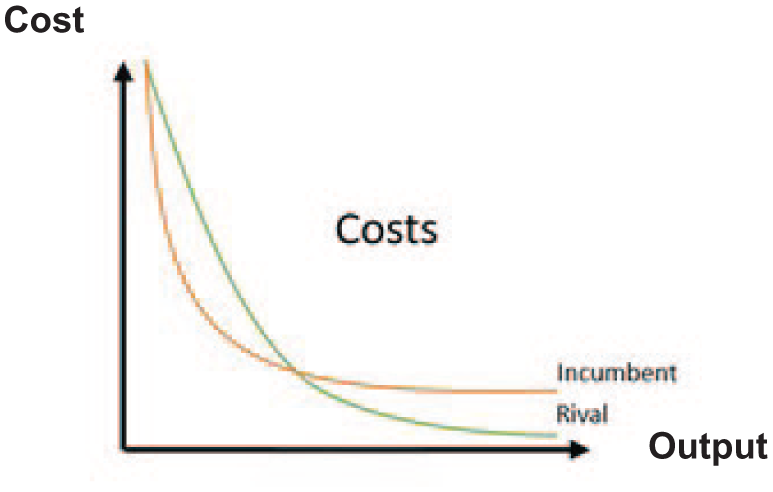
Rival’s cost comparison at specific output shares.
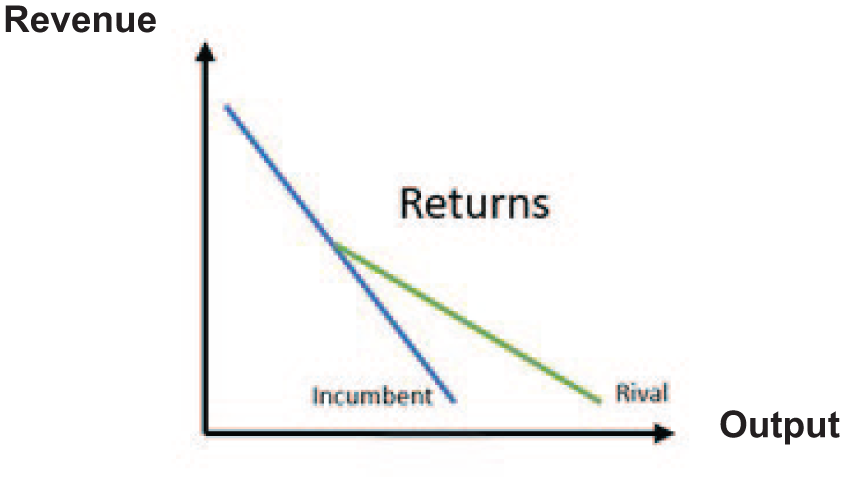
Flattening demand curve at specific output shares.
Chicagoans would object to the protection of dynamically efficient rivals on several grounds. First, in a traditional model of antitrust law enforcement, no “simple” rule can be conceived to protect a dynamically efficient rival. The root of the problem is that an incumbent with no access to a rival’s cost cannot know if competing for share harms dynamic efficiency. Should the incumbent consult rivals to know their costs? Chicagoans say no: incentivizing discussions between competitors “may facilitate the supreme evil of antitrust: collusion.” 121 Should the incumbent be ordered to reduce its output at any rate? Chicagoans say no again: aggressive responses from incumbents to competition are often highly beneficial to consumers. 122 If antitrust cannot give clear instructions to incumbents, caution is warranted.
The dynamic competition approach says, not so fast. 123 A traditional model of antitrust law enforcement does not necessarily entail simple rules. Section 2 liability can arise without an incumbent being always able to establish in advance the lawfulness of its commercial conduct. 124 Several examples drive the point home. Antitrust doctrine entitles courts and agencies to determine that commercial conduct had an unlawful purpose in spite of a business organization’s demonstrated willingness to compete on the merits. Similarly, antitrust doctrine also sanctions incumbents’ monopolization conduct that restricts market output below the level that would prevail without the monopoly. Clearly, a firm may know in advance how individual output will change if its monopolizing strategy is successful. However, that same firm will struggle to know in advance whether total output will fall below that of a competitive market. 125
Standards that only enable findings of antitrust liability after a thorough inquiry of past market events belong to traditional models of antitrust law enforcement. The issue lies in keeping the process administrable. This brings us to the second Chicagoan objection: elaborate econometric measures and computational economics are beyond the capabilities of most judicial institutions; determining a rival’s long-term costs or estimating rivals’ demand functions is too difficult. The objection, however, loses credence in antitrust regimes with administrative institutions. Agency economists know how to estimate demand elasticity and cost savings using rival data. 126 Data and computer scientists know how to make sense of (sometimes) billions of data entries. 127 And administrative institutions are empowered to order firms to disclose information for empirical purposes. 128 The question is, “what to ask for, and what to calculate?”
The agency will need information on the minimum efficient scale (MES) of incumbents (i) and rivals (r). 129 It will need to know the minimum average or marginal cost point (C) of incumbents and rivals at the MES. And the agency will need to calculate the following inequalities to test for harm to dynamic competition. Business conduct or mergers will harm dynamic competition if both MES(r) > MES(i) and C(r) < C(i). 130 That is not enough, though. Business conduct or transaction will only injure dynamic competition if it leaves a contestable share of output that is inferior to MES(r). These refinements are needed to avoid the costs of a broad and hard to apply antitrust rule against “raising rivals costs” which protects all rivals deprived of MES including dynamically inefficient ones. 131 The point, indeed, is not to help any rival reach its MES, only more efficient ones.
Judges and agencies need not fear that getting a rough sense of the relative MES of market participants requires sophisticated data analysis. 132 Take predatory pricing cases. In most of them, the complainant is an excluded rival that brings claims based on its own measures of price, costs, and output. Hence, much of the data needed to preliminarily evaluate the MES of market participants will be available to the agency or courts. But that is not all. In many cases, a qualitative appraisal of the MES needed to enter or compete will bring the case a long way. 133 Moreover, courts have demonstrated the ability to estimate MES in past antitrust and merger cases. 134
One final point. Assisting high MES rivals means increased concentration, not less. Costs (of the rivals) may be lower. Output may be higher. 135 But the supply side will have fewer firms. Chicagoans have no qualms with this. As antitrust law scholar Herbert Hovenkamp says, the school views bigness as an “unmixed blessing.” 136 Like Chicago, the dynamic competition approach takes no issue, but not because it finds big is beautiful. 137 Admittedly, a large and increasing MES as a result of technological change or buyer consolidation means higher barriers to entry. 138 But movements of the MES frontier incentivize bigger firms to compete for growth. 139 In this case, increased concentration will correlate with increased competition.
C. Regulation
The nature of antitrust law confuses Chicagoan scholars. Some Chicagoans view the Sherman Act as a tort law. 140 Others describe antitrust as a law enforcement. 141 Many treat the Sherman Act as a common law statute. 142 Strikingly, Easterbrook even called antitrust a regulation. 143 The common ground is to envision antitrust laws as “rules of the game.” Courts and agencies serve the role of a referee.
What does this mean? Chicagoans recognize two clear fouls in market competition: cartels and mergers to monopoly. All the rest is a free fight. Anticompetitive practices are seldom tried, rarely successful. Calling a foul against other business practices risks condemning practices that “increase economic efficiency and render markets more, rather than less, competitive.” 144 Plus, anticompetitive conduct—assuming it exists—does not lead to durable advantage. New firms will enter to take out the bad player.
The dynamic competition approach envisions antitrust laws as rules of a more complex game. The game’s fouls evolve, as in football. As the game is played, experience grows, and knowledge develops. Some new moves like the “running knee lock” in soccer are banned from competition. Antitrust courts’ function to evolve the law entails a power to call out new fouls. The dynamic competition approach suggests usage of judicial rule making power against business conduct that takes away an efficiency advantage from a rival to constitute, conserve, or consolidate market power.
The dynamic competition approach also acknowledges that many nations’ antitrust laws empower administrative agencies with a “managerial” role over the game—economist and complexity scientist W. Brian Arthur describes this market management function metaphorically as that of a “park ranger.” 145 The management style of agencies differs across the world. Industrial policy minded agencies are like the coach of a team. Others act like a sports association protecting a level playing field. An agency’s management policy is a function of more or less explicit judgments about institutions, markets, and technology’s relative ability to improve competition in a context of uncertainty.
The dynamic competition approach considers that market management by agencies can achieve something useful. Agencies can leverage substantive and procedural antitrust rules when market imperfections prevent new entrants from taking down monopoly rents. Data should show cases in which monopoly profits fail to induce competitive entry. Capital markets, for example, may not have the patience to fund a more efficient rival’s growth to MES. Similarly, increasing returns to technology may lock in users in inferior technologies. 146 Last, regulation may limit market access to foreign competition or to inferior inventions with competitive potential in the long run. Chicagoans inadvertently point toward the same target when they write that antitrust’s “central purpose” is to “speed up the arrival of the long run.” 147
How, concretely, can this translate into a practical antitrust program? The answer is that in every case, agencies shall apply the law with the following additional questions in mind. 148
Section 1: Is the agreement preventing a firm from growing into a more efficient or innovative firm in the future to serve a larger share of output today?
Section 2: Is the business practice suspected of unlawful monopolization preventing a firm from growing into a more efficient or innovative rival in the future to achieve a higher level of output today?
Merger review: would the merging firms grow more independently or in combination with others without the transaction, bringing under them a higher share of output?
As can be seen from the questions, a dynamic competition approach entails initiating a detailed economic study of actual firms, their production costs, their R&D activities, organization, and capabilities. The costs of painstaking study, collection of hard to obtain evidence, and analytical complexity would horrify a Chicagoan scholar. Yet, the benefits of the rigor of empirical proof avert the peril of converting antitrust agencies into “handicappers general” as Chicagoans railed. 149
A further question for the dynamic competition approach is whether antitrust law should develop a doctrine of provisional intervention. By this, we mean enabling agencies to issue reversible remedies on the basis of temporary injunctions, which companies can subsequently challenge in court. 150 A doctrine of provisional intervention would allow agencies to surgically attempt to improve competition by application of restricted duties to deal, narrowly tailored infrastructure sharing mandates, targeted lines of business restriction, temporary and experimental price ceilings, and so on. If the remedy has succeeded in correcting a baleful practice at the expiry of the injunction period, a full determination of liability on the merits will be needed to change behavior permanently. If the agency has erred by correcting a beneficial practice, losses to private firms and society will be contained and compensated.
A doctrine of provisional intervention comes closer to systems of “prediction and control” than to “rules of the game.” 151 Prediction and control systems like market studies, interim measures, and sector inquiries envision antitrust enforcement as a learning process. By contrast, a doctrine of provisional liability differs from a “no fault” antitrust. Statutory language subjects antitrust mobilization to a market event, generally a merger, a contract, or a change in trading conditions. And judicial precedent subordinates antitrust liability to a showing of harm to competition. 152
D. Innovation
Few Chicagoan works discuss innovation as a determinant of industry performance, business conduct, market structure, or competition. Given the school’s infatuation with efficiency (in particular productive efficiency), it is hard to understand why they attach little importance to incremental or even radical innovation. A plausible hypothesis is that Chicagoans followed the mainstream economic view of the time. Until the 1980s, neoclassical theory considered technological change to fall on the economy as “manna from heaven.” 153 Economic modeling required assuming knowledge transfers at trivial cost and irrelevant impacts of firms and individuals on technological change. Innovation, in a word, was “exogenous.” 154 Moreover, it was messy, and tended to stand in the way of simple rules for antitrust intervention.
Chicagoans never believed innovation was exogenous. Many Chicago school writers stress that inputs to innovation matter. Hence their proverbial obsession with the protection of inventors’ ex ante incentives. 155 But Chicagoans had two issues with innovation. First, recall the red line: reject economic theories that raise problems too complex for antitrust practice. 156 With this in mind, the idea of endogenous innovation—in short that innovation stems from capital accumulation including human capital 157 —may come close to what Chicagoans would look at as a “useless truth” to everyday antitrust. 158 The “quantification of the productive efficiency factor” arising from innovation is beyond the capacities of the law. 159 Second, Chicagoans held doubts as to whether innovation was an unconditionally good thing. To them, it is not clear how much quantity of technological progress is socially desirable, 160 or what features make some innovations “desirable” or “undesirable.” 161
Bottom line for antitrust? Bork argued that there is no way to “give weight to” innovation gains as an efficiency defense in the law. 162 And Easterbrook supplied the other side of the argument arguing against unlawful predation by innovation (i.e., predatory innovation). 163 These views seem to reflect common sense: allocative losses from business conduct and transactions are the price to pay for innovation outputs. 164 However, they feigned to ignore service to the more elaborate idea that some levels of allocative losses from business conduct might go beyond what is needed to overcompensate incentives to innovate. Antitrust courts drank from the Chicagoan hose. Coordinated conduct cases like Amex, 165 single firm conduct cases like Trinko 166 and merger cases like FTC v Great Lakes 167 exemplify a Chicagoan approach to innovation. In all three cases, the courts stated that the protection of ex ante incentives to innovate implied broad toleration toward horizontal or vertical restraints on competition. 168 As a matter of fact, Chicagoans advised antitrust institutions to treat innovation as exogenous.
The dynamic competition approach takes innovation very seriously. Unlike prior theoretical treatments of innovation in antitrust, we provide concrete, administrable methods for agencies and courts to assess innovation effects. This operational focus is essential because no amount of Chicagoan skepticism is warranted about the welfare gains from innovation. It is universally accepted that technological innovation improves welfare in many ways other than by increasing allocative efficiency and that the welfare benefits of innovation are in aggregate much greater than those from increasing allocative efficiency. 169 The social returns to innovation also far exceed private returns, providing an additional and powerful reason to favor dynamic competition over static competition. 170 Where the Chicago School centered its analysis on static efficiency and consumer welfare in the short run, the dynamic competition approach redirects attention toward innovation trajectories, system-wide spillovers, and evolutionary advantage as central to market performance and enforcement.
Innovation is not so hard to operationalize. By Easterbrook’s definition, innovation is
a way of either producing a higher quality good or reducing the marginal cost of producing the same final good . . . Even the invention of a previously nonexistent good can be thought of as a reduction from an infinite price to some lower price for that good.
171
All three dimensions correspond to the umbrella term of “efficiency.” 172 Innovation can then be easily depicted using the stylized supply and demand curves so common in antitrust analysis. 173 If innovation increases marginal benefits on the demand side and decreases marginal costs on the supply side, then a figure would depict the effects of innovation as outward movements of the demand and supply curves (Figure 3). If innovation creates a new product, a graph with a distinct demand and supply curve must be drawn (Figure 4).
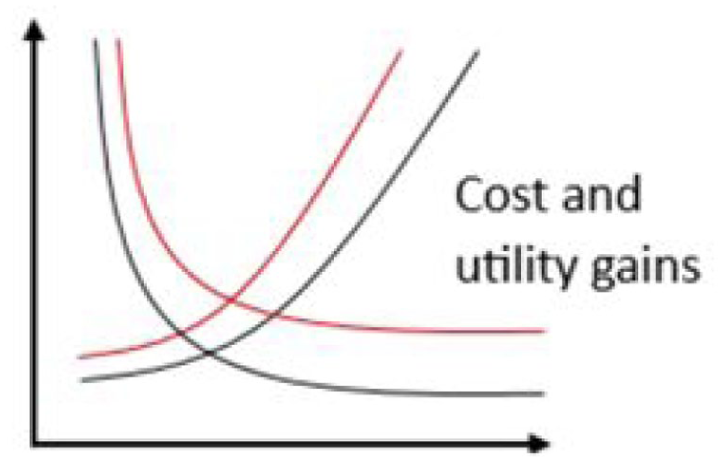
Efficiency from lower cost and higher utility.
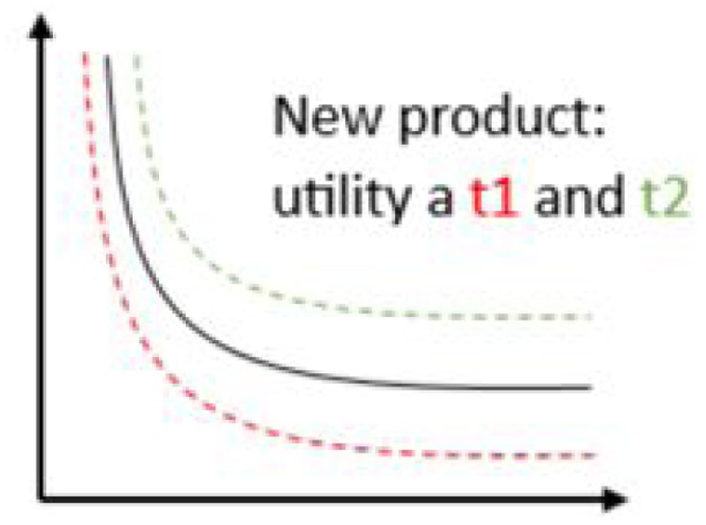
Efficiency from new product & services.
Note that Easterbrook’s abstract definition of efficiency covers two different types of innovation. The first is incremental innovation that raises the marginal utility or lowers the marginal costs of an existing product. The second is radical innovation that adds to the economy a new product or service that lowers the marginal utility or raises the supply costs of existing products. Firms may pursue one or the other, and less frequently both at the same time. 174 A focus on incremental innovation will entail cost-cutting, logistical optimization, or quality improvements. A focus on radical innovation will entail “competing against non-consumption” by addressing the unserved demand of existing customers or entirely new customers. 175 Both types of innovation are the two ends of a spectrum: the jury is out on whether Southwest, MCI, Uber, Airbnb, OpenAI or SpaceX have introduced one or the other. Dynamic competition scholars tend to refer to both types of innovation respectively as efficiency and innovation. This contrasts with modern economists who refer to both types of innovation respectively as productive efficiency and dynamic efficiency 176 —Chicago talked of “productive efficiency” for both. 177 Disciplinary semantic differences should not obscure the key role of innovation in economic competition.
Now, it is one thing to say that innovation (both incremental and radical) or efficiency (both productive and dynamic) belong in antitrust. It is another one to ask if we have the (economical) means of estimation that Chicago deemed missing. The answer is yes, subject to one setting realistic expectations. It is extraordinarily hard to measure innovation. But no such thing is required for the application of antitrust law, or law in general. Approaching, not discovering, the truth about innovation is what antitrust law should concern itself with. Enforcement of antitrust law always occurs under uncertainty. The question in the particular case is, “has our ignorance about innovation been reduced to a tolerable level?”
With that in mind, we can now approach the question of innovation estimation. We can make innovation assessments in antitrust cases, but one must look to other fields of economics (including heterodox approaches), business and management literature for guidance, and not simply neoclassical economic theories. Despite Alfred Marshall’s early interest in the subject, 178 conventional microeconomics never developed analytical tools to study the endogenous impact on productive or dynamic efficiency of the internal workings of organizations and the groups and individuals inside them. 179 Harvey Leibenstein, who advocated for a micro-micro approach, and Kenneth Arrow, who emphasized the study “technical managers,” were not followed by many. 180
Scholars in business and management science have since peered into the firm “black box.” George B. Richardson, David J. Teece, Constance E. Helfat, Margaret A. Peteraf, Amy Shuen, Gary Pisano, and others have written on firms’ dynamic “capabilities.” 181 Capabilities are “knowledge, experience and skills.” 182 Capabilities become dynamic when productive and dynamic efficiency opportunities are “sensed,” “seized,” and achieved by “reconfiguration.” 183 Dynamic capabilities enable firms to adapt, integrate, and reorganize internal and external capabilities in response to rapidly changing environments (for example, in contexts of increasing returns). 184 In brief, dynamic capabilities are necessary for firms to generate innovation and capture value from it.
The dynamic capabilities literature does not “disassembl[e]” the black box fully. 185 It does not say exact things about “intrafirm behavior and relations or with the interaction of persons within the firm and their influences on firm behavior.” 186 But it provides operational tools to estimate productive and dynamic efficiency. Management scholars Johann Murmann and Fabian Vogt, for example, have developed a framework that allows for some prediction and comparison of the future competitiveness of various types of firms (incumbents, new ventures, and diversifying entrants) in the automobile industry by looking at their capabilities—observe, as a side note, that we’re one inch close to Bork and economist George J. Stigler’s concepts of relative efficiency 187 or competitive effectiveness. 188 Reviewing twenty-six relevant capabilities in the automobile industry, they predict that automobile incumbents have the strongest capabilities to bring into market electrical vehicles at scale. 189
Capabilities scholarship does not supply a “complete” model for endogenous innovation applicable in all cases. 190 Capabilities frameworks depend strongly on the particular industry. 191 That said, the costs of developing industry-specific capabilities frameworks should not scare antitrust analysts. Capability frameworks require information that is not costly to acquire and process. They are based on in-depth case studies. 192 That is the bread and butter of antitrust analysis. In addition, capabilities frameworks are an appealing method of asking relevant questions about the impact of business conduct and transactions on innovation. For example, capability assessments, ratings, and rankings allow us to answer simple questions about the innovation impacts of business conduct and transactions: is a proposed merger a strong or a weak capability combination? Are alternative forms of business organization (for example, a joint venture or vertical integration) leading to higher capability scores? Or are there alternative combinations of firms with a higher capability ranking? Should these alternatives inform merger decision-making?
Of course, capabilities frameworks cannot supply all the answers. They are and will remain limited considering that the departure of a few key employees could significantly diminish the company’s dynamic capabilities. But like Williamson believed fifty years ago, the dynamic competition approach trusts that a strong commitment toward endogenous innovation, or dynamic efficiency, in antitrust, will create an incentive to improve techniques. 193 Perhaps, this is an overoptimistic mindset. Institutions are conservative. But that is much less true for antitrust courts and agencies. A remarkable regularity of antitrust history has indeed been a commitment to updating the law in line with developments in economics. 194
V. The Dynamic Competition Approach in Practice
Now that we have situated the theoretical framework of the dynamic competition approach within the doctrine, how does it function in practice? Current implementation reveals significant gaps: while U.S. agencies increasingly reference innovation in their decisions, systematic assessment remains elusive. EU competition agencies lag further behind, with innovation considerations often limited to analyzing barriers to entry. We use a merger review context to illustrate how our framework fills these gaps across jurisdictions.
Protecting dynamic competition means a concern against the adverse impacts of mergers on long term competition. Under current law, merger agencies remedy harms within a period of two years. 195 In practice, the time horizon may occasionally be extended. 196 Chicagoans would view a general extension of the time dimension as an insurmountable challenge. No intelligence—even a computational one—can forecast the long-term strategic price effects of mergers or the change in parties’ ability and incentives to foreclose. 197 Prediction and control in a timeframe of ten to fifteen years is a fool’s errand.
A dynamic competition approach of mergers requires, however, to pose a different question: can the relevant firms grow equally absent the merger? If the answer is no, the merger should be allowed. If the answer is yes, the merger should be challenged. All merger laws are based on a preference for organic growth rather than growth by amalgamation.
That basic question is amenable to resolution by administrative or judicial processes. A focus on capabilities can tell if the merging firms enjoy alone (or in combination with others) the technological, managerial, and financial capabilities required for organic growth. In the past, the agencies got it (probably) right. In 2020, Visa, the debit card company, sought to acquire plaid, a fintech startup. The Department of Justice challenged the transaction on the ground that Plaid was uniquely positioned to offer a pay-by-bank debit service that would compete with Visa’s online debit services. 198 Little in the U.S. Department of Justice’s (DOJ) complaint focused on Plaid’s technological, managerial, and financial capabilities. Yet, within a few years, it became clear that Plaid had the capabilities to grow independently. Weeks after the DOJ successful challenge, Plaid announced having raised $425 hundred million for a $13.4 billion valuation. 199
The challenge for a dynamic competition approach is to identify objective indicators and data points for capabilities evaluations. 200 The business and management literature is becoming familiar with capabilities ratings, rankings, and scores. All provide useful methods to answer the complementary question posed by a dynamic competition perspective. In addition, the impugned firms’ own documents about industry and technology peers constitute information that can be made available to regulators in line with the requirement for “information light” policies. 201
There is further evidence that capabilities evaluations are within the acceptable range of fact-finding activities imposed on antitrust courts and agencies. In the past, antitrust institutions have occasionally examined firms’ capabilities. In Weyerhauser, the Court dismissed claims of unlawful predatory bidding against a new entrant in hardwood lumber mills. While not dispositive in the case, the Court noted that the defendant employed “state-of-the-art technology” that allowed high recovery of lumber from every log. 202 By contrast, the plaintiff had “engaged in little efficiency-enhancing investment.” 203 In a dynamic competition approach, the opinion can be reasoned as suggesting that the protection of antitrust law against predatory bidding in the short term was unnecessary, given the weak capabilities of the plaintiff for long term competitive survival.
In FTC v. H.J. Heinz, the District Court and the Court of Appeals disagreed over whether efficiencies achieved by the integration of the Heinz and Beech Nut would increase competition against Gerber, the leader in the baby food business. The District Court considered that the merger would combine the best of both parties’ capabilities, in particular the advanced automated Pittsburgh plant of Heinz with the better recipes and deeper equity of beechnut. 204 The Court of Appeals refused to accept that the transaction was likely, and necessary, to turn the merged entity into a “more efficient competitor.” 205 The Court considered the protection of short term competition between Heinz and Beech Nut more important than a capabilities combination that would fuel long term competition “against giants.” 206 The Court observed that Heinz could have developed better recipes by investing more money in product development and promotion, rather than by usage of a merger. The argument is supported by the business and management literature that stresses that absorption of capabilities is harder when the merging firms are established ones.
The cases suggest a degree of (unconscious) familiarity of antitrust courts and agencies with capabilities evaluation. What is missing from antitrust practice is the formulation of explicit questions about capabilities that enforcers can ask in every case to evaluate the impact of mergers and business conduct on long term competition.
There is a wide variety of additional capability questions that merger agencies may ask themselves, and the choice of issues to address will depend on legal and policy preferences. Broadly, the main possible questions for mergers could be the following: is the merger leaving in the industry a population of firms with capabilities sufficient to support long term competition by innovation? Is the merger a good capability combination relative to other transactions or no transaction? 207 And can the capability combination be achieved by a contract that is less harmful, because reversible, to long term competition by innovation?
Admittedly, these questions are a bit abstract. But they supply a better framework to decide merger cases than current generalizations derived from Chicago school economics. In FTC v. Great Lakes, for example, the District Court was so impressed by the acquirer’s intense R&D efforts that it inferred from them a likely “revitalization” of the target’s declining R&D facility following the transaction. The District Court rejected the Federal Trade Commission’s challenge, believing the merger would increase competition. 208 A more convincing approach toward the evidence would have consisted in searching in the parties’ internal documents the trace of a commitment of the acquirer to close its capability gap with the target.
VI. Conclusion
A new approach focused on the economic study of dynamic competition and its protection by legal and policy implementation is emerging. This approach is “new” not in recognizing innovation’s importance—that insight dates to the 1990s—but in providing operational tools grounded in recent advances in organizational economics and management science. We move from asking whether innovation matters to showing how to measure and compare innovation capabilities in antitrust analysis.
The dynamic competition approach is new, but familiar. It shares common blood with what the Chicago school of antitrust sought to achieve in the second half of the twentieth century. The dynamic competition approach does not take for granted mainstream descriptions of the economy, ascribes a welfare function to antitrust law, adopts economics as a method, and uses efficiency as a guideline. The dynamic competition approach also differs substantially from the Chicago school of antitrust. It is more confident in the ability of antitrust intervention to deliver welfare-increasing impacts, and less naive about the self-correcting properties of markets in the economy.
The main point of departure from Chicago consists in developing a research agenda that makes innovation effectively central in antitrust analysis. To that end, the dynamic competition approach wants to leverage untapped operational insights from diverse fields of economics and business and management science to improve existing antitrust regimes. The right question to ask today is not what lies “beyond” dynamic competition, 209 but how to deepen our understanding of dynamic competition. In the short term, looking at firms’ capabilities in merger cases can be a first step toward operationalizing the dynamic competition approach in antitrust practice. In the long term, the dynamic competition approach will promote interdisciplinary knowledge transfers into antitrust law and policy through a process of reasoned heterodoxy.
Footnotes
Declaration of Conflicting Interests
The authors declared no potential conflicts of interest with respect to the research, authorship, and/or publication of this article.
Funding
The authors received no financial support for the research, authorship, and/or publication of this article.
1.
2.
See, for example, George B. Richardson, The Organisation of Industry, 82
3.
David J. Teece et al., Dynamic Capabilities and Strategic Management, 18
4.
James G. March, Exploration and Exploitation in Organizational Learning, 2
5.
W. Brian Arthur, Foundations of Complexity Economics, 3(2)
6.
See, for example, Competition & Mkts. Auth., Completed Acquisition by Facebook, Inc (now Meta Platforms, Inc) of Giphy, Inc. Final Report, 13, 174–79, 228–31 (Nov. 30, 2021), https://assets.publishing.service.gov.uk/media/61a64a618fa8f5037d67b7b5/Facebook__Meta__GIPHY_-_Final_Report_1221_.pdf; Case M.9409—Aurubis/Metallo Group Holding, Comm’n Decision, ¶¶ 721, 722–29, 770 (May 4, 2020) (summary: 2020 O.J. (C 224) 10),  . Note that mentions of dynamic competition have appeared in U.S. and EU competition law instruments in the past. See Eur. Comm’n, Guidelines on the Assessment of Horizontal Mergers under the Council Regulation on the Control of Concentrations between Undertakings, 2004 O.J. (C 31) 5, ¶ 76.
7.
Mike Walker, The UK Facebook/Giphy Case: Taking Dynamic Competition Seriously,
8.
Gabriele Corbetta & Joe Perkins, Frameworks for Dynamic Competition,
9.
There is nothing uniquely Chicagoan in the idea that antitrust must be guided by “basic economic analysis”. See
10.
Melvin W. Reder, Chicago Economics: Permanence and Change,
11.
12.
Frank H. Easterbrook, When Is It Worthwhile to Use Courts to Search for Exclusionary Conduct? 2003
14.
Easterbrook, supra note 12.
15.
All firms presumably enjoy some market power, that is all firms are able to price above costs. Otherwise, there would be no business activity.
16.
17.
Frank H. Easterbrook, Workable Antitrust Policy, 84 M
18.
Id. at 1710. See also
19.
20.
True, “[d]ifficulty is not an adequate reason for abandoning a problem”. George Stigler, Introduction to “Business Concentration and Price Policy”, in
21.
Easterbrook, supra note 17, at1712.
22.
Id. at 1708, 1712 (asking whether these models “explain anything better”).
23.
Id. at 1709.
24.
See Frank H. Easterbrook, Limits of Antitrust, 63
25.
Id at 9, 11.
26.
By rational, Chicagoans means a process that limits decisional errors while minimizing decisional costs. See Easterbrook, supra note 17, at 1711.
27.
28.
We do not discuss other economic principles which are not distinctive, that is that are also adhered by other schools, like for example the skepticism about processes like market definition. Proponents of the Harvard school like Kaplow have, for example, also challenged the usefulness of market definition. See, for example, Louis Kaplow, Market Definition: Impossible and Counterproductive, 79
29.
Chad Syverson, Macroeconomics and Market Power: Context, Implications, and Open Questions,
30.
31.
Direct and indirect network effects are relevant circumstances.
32.
Like information asymmetries, incomplete contracts, risk aversion, transaction costs, or asset-specific investments. See Benjamin Klein et al., Vertical Integration, Appropriable Rents, and the Competitive Contracting Process, 21
33.
Easterbrook, supra note 24, at 18.
34.
35.
36.
Easterbrook, supra note 17, at 1702.
37.
Id. at 1701.
38.
Easterbrook, supra note 24, at 5.
39.
40.
Id. at 311.
41.
Easterbrook, supra note 17, at 1711. Note that Bork also made explicitly the point that in a tie breaker case of 50/50 odds of type 1 and 2 errors, the type 1 option should be avoided because antitrust enforcement is a costly process.
42.
43.
Frank H. Easterbrook, Predatory Strategies and Counterstrategies, 48
44.
The system “permits consumers to define their own welfare by their purchases”.
45.
Frank H. Easterbrook, The Inevitability of Law and Economics,
46.
Easterbrook, supra note 43, at 297–304.
47.
We acknowledge here that some of the above postulates might be inconsistent with each other, or even inconsistent as a whole. For example, the idea that data is needed to decide cases is key in Easterbrook’s work, but at the same time, Easterbrook wants to keep complex datasets out of antitrust litigation. Easterbrook, supra note 45, at 10–11; Easterbrook, supra note 17, at 1707, 1709–10. Similarly, Chicagoans suggest that empirics matter, but the above postulates were never really reexamined in light of empirical changes in the economy. Last, the above propositions pay lip service to important nuances and disagreements amongst Chicagoan scholars. For example, Posner considers that persistence of business behavior can be a problem, like for example in case of tacit collusion. Richard A. Posner, Oligopoly and the Antitrust Laws: A Suggested Approach, 21
48.
Easterbrook, supra note 17, at1701.
49.
Id. at 1700, 1709.
50.
M. T. Panhans, , The Rise, Fall and Legacy of the Structure-Conduct-Performance Paradigm,
51.
Easterbrook, supra note 17.
52.
Id.
53.
Id.
54.
55.
56.
Simcha Barkai, Declining Labor and Capital Shares, 75
57.
58.
See
59.
60.
61.
Plus, previous schools of antitrust also sprung from economics works. Herbert J. Hovenkamp, The Rationalization of Antitrust, 116
62.
Easterbrook, supra note 17, at, 1699, n. 7 (observing that “[i]f you examine the opinions written by people often associated with an efficiency-oriented approach to antitrust, you will see differences in emphasis but agreement on the sort of questions that should be asked and the sort of data that are important to the answers”).
63.
64.
Easterbrook, supra note 45, at 4.
65.
Id. at 22.
66.
67.
We use the words of Edward Atkinson, The Basis of the Science of Political Economy, 33
68.
69.
Id. at 90.
70.
Id. at 97.
71.
Id. at 94.
72.
Id. at 98–101.
73.
Padilla, supra note 13 at 2.
74.
75.
Bork sought to anchor the welfare goal in congressional intent and developed the unconvincing originalist argument whereby “[t]he Sherman Act was clearly presented and debated as a consumer welfare prescription”.
76.
That point is made in Jan Tinbergen, Welfare Economics and Income Distribution, 47
77.
In the words of Anthony B. Atkinson, there is “an assumed division of labor, with economists taking responsibility for the identification of the possibility frontier and leaving to others the criteria for choosing from that menu”. Anthony B. Atkinson, The Restoration of Welfare Economics, 101 A
78.
See Frank Easterbrook’s argument in a context other than antitrust: “I would argue vigorously that the Court must discover and carry out the design of any given provision; that cost-benefit and moral concerns play no legitimate role in the process (unless the drafters instructed the Court to incorporate them)”. Frank H. Easterbrook, Ways of Criticizing the Court, 95
79.
Atkinson, supra note 77, at 216.
80.
Id.
81.
82.
See EU Commission, Case COMP M.7275 Novartis/Glaxo Smith Kline’s Oncology Business.
83.
See EU Commission, Case COMP M.7932 – Dow/DuPont.
84.
See EU Commission, Case COMP/M.2609 - HP / COMPAQ.
85.
See EU Commission, Case COMP/M.2256 - PHILIPS / AGILENT HEALTH CARE SOLUTIONS.
86.
We thank Doug Melamed for suggesting that idea, and the formulation, to us.
87.
This point is also shared by the Harvard and Post Chicagoan schools, though it places less emphasis on protecting efficient rivalry, and more on rivalry per se. See Phillip Areeda & Donald F. Turner, Predatory Pricing and Related Practices under Section 2 of the Sherman Act, 88
88.
Thomas J. DiLorenzo & Jack C. High, Antitrust and Competition, Historically Considered, 26
89.
Or they limit cartel participants’ incentives to increase their competitiveness, because they cannot then cut prices to attract demand. For example, price fixing is problematic because it keeps participants’ share of output equal in spite of cost differentials. Note that in addition to this, the bad effects of cartels are diverse, and widely documented.
90.
91.
Dynamic competition takes literally the Supreme Court’s holding that competition is a “conflict for advantage”. See United States v. American Linseed Oil Co., 262 U.S. 371, 388 (1923).
92.
Dynamic competition is a “gale of creative destruction”.
93.
Frank H. Easterbrook, The Chicago school and Exclusionary Conduct, 31
94.
95.
96.
Easterbrook, supra note 24, at39 (observing that “neither judges nor juries are particularly good at handling complex economic arguments”).
97.
Id. at 29.
98.
Id. at 14.
99.
Id. at 10 (arguing that “[w]e cannot condemn so quickly anymore. What we do not condemn, we must study. The approved method of study is the Rule of Reason”).
100.
Easterbrook, supra note 17, at 1703. Note also that in Workable Antitrust Policy Easterbrook suggested that, despite some diversity of opinions, there is general agreement in the economics profession on “the sort of questions that should be asked and the sort of data that are important to the answers”. Easterbrook, supra note 17, at 1698–99.
101.
Easterbrook, supra note 24, at 11 (arguing that “[t]he welfare implications of most forms of business conduct are beyond our ken. If we assembled twelve economists and gave them all the available data about a business practice, plus an unlimited computer budget, we would not get agreement about whether the practice promoted consumers’ welfare or economic efficiency more broadly defined”).
102.
Id at 10.
103.
Easterbrook, supra note 17, at 1701.
104.
105.
This is recognized by Chicagoans. See Frank H. Easterbrook, Monopolization: Past, Present, Future, 61
106.
See FTC v. Staples, Inc., 970 F. Supp. 1066, 1093 (D.D.C. 1997) (commending “counsel on both sides for their excellent performances in this matter and the tremendous efforts made on both sides. Though this was an extremely complex matter, the issues were clearly presented to the Court by counsel possessing superior advocacy skills. Counsel also exhibited a high degree of professionalism in their ability to resolve peripheral matters so that the Court could focus on the important issues presented by this action”).
107.
See, for an expression of a somewhat similar idea, U.S. v. Microsoft Corp., 253 F.3rd 34, 49 (D.C. Cir. 2001) (remarking that “[e]ven in those cases where forward-looking remedies appear limited, the Government will continue to have an interest in defining the contours of the antitrust laws so that law-abiding firms will have a clear sense of what is permissible and what is not”).
108.
W. Brian Arthur, Some Background to Complexity Economics,
109.
In the United States, cases like Aspen Skiing, Kodak or Amex illustrate the integration of the economics of incomplete contracts, behavioral economics, and multi sided markets. See Aspen Skiing Co. v. Aspen Highlands Skiing Corp., 472 U.S. 585, 606–609 (1985); Eastman Kodak Co. v. Image Technical Servs., Inc., 504 U.S. 451, 465, 470–77 (1992); Ohio v. American Express Co., 138 S.Ct. 2274, 2285–89 (2018). The EU courts have, for example, progressively weighted down the relevance of market shares in the evaluation of monopoly power, in line with economics literature. Case 85/76, Hoffmann-La Roche & Co. AG v. Comm’n, E.C.R. 461, ¶ 41 (stating that “very large shares are in themselves, and save in exceptional circumstances, evidence of the existence of a dominant position”); Case T‑79/12, Cisco Systems, Inc. & Messagenet SpA v. Comm’n, ECLI:EU:T:2013:635, ¶ 69 (GC December 11, 2013), curia.europa.eu/juris/liste.jsf?num=T-79/12&language=IT (observing that “the consumer communications sector is a recent and fast‑growing sector which is characterized by short innovation cycles in which large market shares may turn out to be ephemeral. In such a dynamic context, high market shares are not necessarily indicative of market power”).
110.
Case T‑604/18, Google LLC & Alphabet, Inc. v. Comm’n, ECLI:EU:T:2022:541, ¶¶ 116–119, 268–73, 877–80, 889–91 (GC September 14, 2022), curia.europa.eu/juris/liste.jsf?num=T-604/18; European Commission, European Commission, M.10615, Booking Holdings / Etraveli Group.; J. Gregory Sidak & David J. Teece, Dynamic Competition in Antitrust Law, 5 J.
111.
See, for example, Organisation for Economic Co-operation and Development, Executive Summary of the Hearing on Competition Economics of Digital Ecosystems, Annex to the Summary Record of the 134th Meeting of Competition Committee Held on 1-3 December 2020 (2021), ; Sergey Yevgenievich Barykin et al., Economics of Digital Ecosystems,
112.
Easterbrook, supra note 17, at 1701.
113.
For example, Herbert J. Hovenkamp, Rhetoric and Skepticism in Antitrust Argument, 84
114.
Chicagoans considers that the low point of antitrust doctrine is Justice Pechkam’s opinion, which held that “[t]rade or commerce under those circumstances may nevertheless be badly and unfortunately restrained by driving out of business the small dealers and worthy men whose lives have been spent therein, and who might be unable to readjust themselves to their altered surrounding”. U.S. v. Trans-Missouri Freight Ass’n, 166 U.S. 290, 343 (1897). See Easterbrook, supra note 12 (arguing that “it is appropriate to step back and ask what antitrust is for, because the question used to have an easy answer when Justice Peckham could write so easily about small dealers and worthy men, as if we were out to protect the welfare of producers”).
115.
116.
Rudolph J. Peritz, A Counter-History of Antitrust Law, 1990
117.
This is different from a model in which the new entrant is assisted to achieve scale and operating efficiencies comparable to the incumbent firms.
118.
There is a recurrent complaint that the pharmaceutical industry undersupplies breakthrough innovation: Bernard H. Munos & William W. Chin, How to Revive Breakthrough Innovation in the Pharmaceutical Industry,
119.
See Richard S. Markovits, Fixed Input (Investment) Competition and the Variability of Fixed Inputs (Investment): Their Nature, Determinants, and Significance, 24
120.
In another context, discussing the example of the barbed wire industry, Easterbrook wrote that “it is socially desirable that the low-cost process should be applied to the largest possible share of the barbed wire production”. See Easterbrook, supra note 43, at 300. The argument works for the economy more generally.
121.
Verizon Commc’ns, Inc. v. Law Offices of Curtis V. Trinko, LLP (Trinko), 540 U.S. 398, 406 (2004). Similarly, the point was made by non-Chicagoans too. See Philip Elman, The Robinson-Patman Act and Antitrust Policy: A Time for Reappraisal, 42
122.
Frank H. Easterbrook, On Identifying Exclusionary Conduct, 61
123.
In other words, the dynamic competition approach endorses the Chicago school’s general idea that consumers suffer only when efficient competition is impeded, but it extends the time frame for evaluating efficiency.
124.
Chicagoans know this perfectly. They ask us to “think of market behavior as random” and say that “[f]irms try dozens of practices” and that “[t]he firms that selected the practices may or may not know what is special about them”. Easterbrook, supra note 24, at 5. In that context, the judicial dicta requiring “willful acquisition or maintenance” of monopoly power is a bit odd. See United States v Grinnell Corp. 384 U.S. 563, 570–71 (1966).
125.
Hovenkamp, supra note 87, at 257.
126.
For example, Gregory J. Werden, Demand Elasticities in Antitrust Analysis, 66 A
127.
Thibault Schrepel, Computational Antitrust: An Introduction and Research Agenda, 1
128.
15 U.S.C. § 46(b).
129.
Joseph Farrell & Carl Shapiro, Scale Economies and Synergies in Horizontal Merger Analysis, 68
130.
S(r) < S(i) does not guarantee that the rival has smaller costs, just that it needs less scale to minimize its costs. If the rival has smaller costs at the MES, and S(r) < S(i), it is probable that the rival is already as efficient as, or not far from being as efficient as the incumbent.
131.
See Thomas G. Krattenmaker & Steven C. Salop, Anticompetitive Exclusion: Raising Rivals’ Costs to Achieve Power Over Price, 96
132.
See United States v. American Cyanamid Co., 719 F.2d 558, 566–67 (2d Cir. 1983) (suggesting the Court could have decided differently, had it had “the benefit of an analysis of record data regarding such factors as the level of concentration, barriers to entry, scale economies, minimum efficient scale, or collusion”. Instead, the Court was given theory).
133.
The assessment of MES does not constrain agencies (and courts) to a purely quantitative analysis. For examples, see Craftsmen Limousine v. Ford Motor Company, 491 F.3d 380, 392–93 (8th Cir. 2007) (suggesting a small MES is needed to enter into the coachbuilding industry); Tenneco, Inc. v. FTC, Respondent, 689 F.2d 346, 354 (2d Cir. 1982) (suggesting that a high MES would be needed to enter, disincentivizing entry, because of low profitability for several years); United States v. Waste Mgmt. of Ga., Inc., No. CV496–35, 1996 WL 426830, at *1, *7, *8 (S.D. Ga. May 20, 1996) (finding liability, and noting that “[a] new entrant or small incumbent hauler must be able to achieve minimum efficient scale to be competitive. First, it must be able to generate enough revenues to cover significant fixed costs and overhead” and that “[d]efendants’ use and enforcement of the contracts has reduced the likelihood that the customers will switch to a Defendant’s competitor. Given Defendants’ market power, this has made it more difficult for competitors to achieve efficient scale”).
134.
United States v. Alcoa, Inc., No. CIV. A. 2000–954, 2001 WL 1335698, at *12 (D.D.C. June 21, 2001) (observing that a post-merger price increase would not be defeated by increases in competitors’ output because “A minimum efficient scale greenfield refinery could cost $1 billion and take four years or longer from planning to operation. Reynolds’ expansion of its Worsley refinery is costing $700 million and was scheduled to take thirty-two months.”). Cf. International Air Industries, Inc. v. American Excelsior Co., 517 F.2d 714, 724 (5th Cir.1975) (stating that “all of the relevant data, including a low minimum efficient scale of operation, significant ability to attract customers of other manufacturers, availability of raw materials, etc., suggest a very low barrier entry in the cooler pad market”).
135.
We will see a difference in output under the existing monopoly with the hypothetical output that would occur without when the rival serves more output. Hovenkamp, supra note 87, at 257.
136.
As Herbert Hovenkamp said, Chicago considered product differentiation and economies of scale an unmixed blessing, in all but extremely concentrated market. And “the welfare of the small business in such markets should be ignored”. Hovenkamp, supra note 87, at 225. The problems of high concentration and large firm size are “the outgrowth of natural industrial evolution”, as did the early twentieth-century economists believed. Herbert J. Hovenkamp, The Invention of Antitrust, 96
137.
Moreover, even if the MES of rivals is higher, the fact that the rival long-term cost-minimizing level is lower will often mean that economies as big as today’s under the incumbent model can be achieved tomorrow with lower economic concentration.
138.
Technology may decrease MES. In the meantime, capital markets and regulation may come in the way to maintain MES at a stable level.
139.
Farrell & Shapiro, supra note 129, 688–89 (2001).
140.
See Baxter, supra note 75 at 663 (arguing that the flexible nature of the Sherman Act allowed “a common-law refinement of antitrust law through an evolution guided by only the most general statutory directions”).
141.
Easterbrook, supra note 17, at 1702.
142.
Easterbrook explained that the Sherman Act transformed a common law rule of non-enforceability in a rule of liability. Frank H. Easterbrook, Vertical Arrangements and the Rule of Reason, 53
143.
Easterbrook, supra note 17, at 1702.
144.
United States v. United States Gypsum Co., 438 U.S. 422, 441 n. 16 (1978); Broadcast Music, Inc. v. CBS, Inc., 441 U.S. 1, 20 (1979).
145.
Arthur, supra note 108.
146.
W. Brian Arthur, Competing Technologies, Increasing Returns, and Lock-In by Historical Events,
147.
Recall the Chicagoan belief that new entrants will undercut monopoly profits. Chicagoans dismissed any role for legal processes in that process. Markets always beat legal processes to the punch when it comes to taking down monopoly rents. See Easterbrook, supra note 24, at 24–25.
148.
To be clear, we are not saying that these questions should drive the entire analysis. We are saying that they should be asked in addition to more traditional questions, for example, is the agreement causing a rise in prices, etc.
149.
Easterbrook, supra note 17, at 1703.
150.
This comes very close to systems of “interim measures” used in some jurisdictions. It is different because it is more conceived as a learning experiment.
151.
One way to say this is that the Chicago school wants a proscriptive law that removes anticompetitive conduct. Dynamic competition is more open minded towards interventions intended to improve noncompetitive situations. A requirement of a finding of liability remains required in the long term to make the remedy permanent, however.
152.
In practice, antitrust scholars have reasoned that the law catches “bad conduct” involving the establishment or exercise of “market power”. See Nicolas Petit, Understanding Market Power 25–28 (Robert Schuman Ctr.for Advanced Stud., Working Paper No. RSC 2022/14, 2022).
153.
This used to be the dominant assumption, until the works of Paul Romer. See Paul M. Romer, Endogenous Technological Change, 98
154.
See Paul Davenport, Embodied Technical Change: A New Approach, 16
155.
Easterbrook, supra note 43, at 300. Some Chicagoan works recognize that innovation cannot happen without inventors, and an appropriate legal structure that promotes incentives to invest. See, for example, Frank H. Easterbrook, Intellectual Property Is Still Property, 13
156.
Easterbrook, supra note 17, at 1711; Easterbrook, Easterbrook, supra note 43, at 313.
157.
Gene M. Grossman & Elhanan Helpman, Endogenous Innovation in the Theory of Growth,
158.
Easterbrook, supra note 17, at 1704.
159.
160.
Id. at 132. Note, however, that Easterbrook appeared to embrace innovation as an unquestionable good: “New and better products and methods of making them are the principal source of economic betterment. The gains they produce swamp all other forms of wealth—even one percent per year compounded over a long period yields fabulous returns”. Easterbrook, supra note 154
161.
Easterbrook, supra note 43, at, 265.
162.
163.
Easterbrook, supra note 43, at, 304–12.
164.
Id. at 313.
165.
Ohio v. American Express Co. (Amex), 138 S.Ct. 2274, 2282–83, 2289 (2018).
166.
Verizon Commc’ns, Inc. v. Law Offices of Curtis V. Trinko, LLP, 540 U.S. 398, 406–408 (2004).
167.
FTC v. Great Lakes Chemical Corp., 528 F. Supp. 84, 91 (N.D. Ill. 1981).
168.
Amex, 138 S.Ct. 2274, 2282–83 (observing that Amex’s business model, which earns “most of its revenue from merchant fees” and “has stimulated competitive innovations in the credit-card market”, “sometimes causes friction with merchants”. To avoid higher fees, merchants sometimes attempt to dissuade cardholders from using Amex cards at the point of sale— a practice known as “steering.” Amex places antisteering provisions in its contracts with merchants to combat this).
169.
For example, Robert M. Solow, Technical Change and the Aggregate Production Function, 39
170.
For a brief survey of the private and social returns to innovation literature, see David J. Teece, The ‘Tragedy of the Anticommons’ Fallacy: A Law and Economics Analysis of Patent Thickets and FRAND Licensing, 32
171.
Easterbrook, supra note 43, at 304.
172.
As reduction of costs, improvement of quality, or “offering anything. . . that consumers are willing to pay for”.
173.
A. Douglas Melamed & Nicolas Petit, The Misguided Assault on the Consumer Welfare Standard in the Age of Platform Markets, 54
174.
See
175.
See Clayton M. Christensen & Michael Raynor, The Innovator’s Solution: Creating and Sustaining Successful Growth (2013); Clayton M. Christensen et al., Foundations for Growth: How to Identify and Build Disruptive New Businesses,
176.
See, for example, David Havyatt, The Components of Efficiency, Network, March 2017, at 1, 1.
177.
See
178.
179.
Harvey Leibenstein & Schlomo Maital, Empirical Estimation and Partitioning of X-Inefficiency: A Data-Envelopment Approach, 82
180.
Some works on agent-based modeling were developed by complexity economics. But that scholarship does not focus on the question of endogenous innovation. W. Brian Arthur, Some Background to Complexity Economics, Network L. Rev., July 25, 202; Alan Kirman & Giovanni Dosi, Markets and their Organization, in The Foundations of Complex Evolving Economies, at 443, 450 (Giovanni Dosi, 2023) (warning that “in reducing our models to a minimum to be able to solve them analytically, for example to characterize their equilibria, we may actually purify away the phenomena we are interested in”).
181.
See, for example, Richardson, supra note 2; Constance E. Helfat & Margaret A. Peteraf, Understanding Dynamic Capabilities: Progress Along a Developmental Path, 7
182.
Richardson, supra note 2.
183.
See David J. Teece, Explicating Dynamic Capabilities: The Nature and Microfoundations of (Sustainable) Enterprise Performance, 28
184.
Teece et al., Teece et al., supra note 3, at . 509, 515.
185.
Harvey Liebenstein, A Branch of Economics Is Missing: Micro-Micro Theory, 17
186.
Harvey Liebenstein, A Branch of Economics Is Missing: Micro-Micro Theory, 17
187.
Easterbrook, supra note 17, at 1703.
188.
See generally George J. Stigler, Perfect Competition, Historically Contemplated, 65
189.
Johann P. Murmann & Fabian Vogt, A Capabilities Framework for Dynamic Competition: Assessing the Relative Chances of Incumbents, Start-Ups, and Diversifying Entrants, 19
190.
Easterbrook, supra note 17, at 1706.
191.
192.
For example, Paul Feiler & David Teece, Case Study, Dynamic Capabilities and Upstream Strategy: Supermajor EXP, 3
193.
194.
Note that populist voices today suggest breaking with tradition by taking economics out of antitrust. The goal is to simplify antitrust to unlock enforcement. See, for example, Joe Biden, President of the United States, Remarks at Signing of an Executive Order Promoting Competition in the American Economy, (stating that “[f]orty years ago, we chose the wrong path, in my view, following the misguided philosophy of people like Robert Bork, and pulled back on enforcing laws to promote competition. We’re now 40 years into the experiment of letting giant corporations accumulate more and more power . . . I believe the experiment failed. We have to get back to an economy that grows from the bottom up and the middle out”). By contrast, dynamic competition has a different ambition. It wants to make antitrust more rational to improve enforcement.
195.
196.
See Pierre Régibeau, Competition Policy Enforcement in a Dynamic World,
197.
The same difficulty exists even if the issue is, as the EC explained in Dow/Dupont, about assessing “immediate effect of the Transaction on the Parties’ behavior, and not only in a timeframe of 10 to 15 years”. Case M.7932—Dow/Dupont, Comm’n Decision, ¶ 2034 (Mar. 27, 2017) (summary: 2017 O.J. (C 353) 9), https://competition-cases.ec.europa.eu/search?clear=1&policy_area_id=2.
198.
Complaint, United States v. Visa Inc., No. 3:20-cv-07810, 3 (N.D. Cal. Nov. 5, 2020).
199.
200.
Capabilities evaluation covers managers, technology, business model, and a variety of other factors. See, for example, David J. Teece, The Foundations of Enterprise Performance: Dynamic and Ordinary Capabilities in an (Economic) Theory of Firms, 28
201.
Jean Tirole, Market Failures and Public Policy, 105
202.
Weyerhaeuser Co. v. Ross-Simmons Hardwood Lumber Co., 549 U.S. 312, 316 (2007).
203.
Id.
204.
FTC v. H.J. Heinz Co., 116 F. Supp. 2d 190,198, 199 (D.D.C. 2000).
205.
FTC v. H.J. Heinz Co., 246 F.3d 708, 721, 722 (D.C. Cir. 2001).
206.
The expression was used by the District Court. See H.J. Heinz Co., 116 F. Supp. 2d, at 198.
207.
Similar questions arose a few years ago when the U.S. administration sought to organize the forced acquisition of the U.S. assets of TikTok by an American company.
208.
FTC v. Great Lakes Chemical Corp., 528 F. Supp. 84, 91 (N.D. Ill. 1981).
209.
GW, Inaugural Conference ‘Beyond Dynamic Competition’, Apr. 25, 2024.