




Abstract
This article critically examines the historical and institutional development of competition law enforcement in the Republic of Slovenia, highlighting persistent inefficiencies and challenges from its independence to the present day. Emphasizing Slovenia’s unique economic context within the European Union framework, the paper addresses how historical attitudes, ideological commitments to national economic interest, and institutional shortcomings have impeded the effectiveness of competition law. The analysis focuses on two primary institutional actors—the national competition authority and the judiciary—and their roles in enforcing competition law. Empirical data from judicial decisions between 2004 and 2024 underscore the courts’ limited application of fundamental economic and antitrust concepts, illustrating a critical gap in judicial competence and conceptual clarity. The paper concludes by stressing the necessity of sustained institutional reforms and enhanced judicial training to realize the full potential of Slovenia’s competition law framework, thereby fostering a more robust and competitive market environment
Keywords
I. Introduction
This article explores the historical and institutional context of competition law enforcement in the Republic of Slovenia, with a particular focus on the challenges and inefficiencies that have marked its evolution from independence to the present day. Given the small scale and economic integration of Slovenia within broader European markets, competition law and policy are not merely regulatory necessities but vital instruments to ensure market efficiency and economic development. However, historical attitudes, deeply entrenched political ideologies prioritizing national economic interests, and institutional inadequacies have significantly hindered the effective implementation and perception of competition law. By tracing the development of Slovenian competition law, from its inception in the post-Yugoslav period to the present-day institutional structure, this paper critically examines the persistent factors undermining competition enforcement, notably institutional inefficiencies of both the competition authority and judiciary.
II. Historical Context and Development of Slovenian Competition Law
In researching this article, I proceeded from the premise that in small economies embedded in systems of deep economic integration, 1 like the Republic of Slovenia, competition law (and competition policy) plays a crucial role in their development and efficient operation. While such a premise may at first glance appear a sine qua non, it is essential to recognize that ideas permeating Slovenia in the fifteen years following its independence—rooted in the idealization of the so-called national economic interest, 2 which purportedly justified restrictions on economic freedom (including limits on the entry of foreign competitors into the Slovenian market)—had an extremely negative impact on the perception, reach, and effectiveness of competition law. For a considerable time, law on prevention of restriction of competition was viewed as an obstacle to the successful development of the domestic economy, as a Trojan horse imposed by the European Union (EU), and as an unnecessary and insignificant legal field unworthy of serious academic research. 3
In addition, competition law’s advancement (or rather, its successful development and application) was further hindered by the fact that the post-independence legal elite (the term is used deliberately to encompass practitioners—judges, lawyers, representatives of administrative authorities, and academics) was almost universally trained during the 1970s and early 1980s. This background often meant their intellectual approach to legal issues and their mental value codes were not aligned with the fundamental ideas of a market economy, including concepts of competition, competition policy, and competition law. Although competition law found some footing even in the era of socialist planned economic systems, the existing legislation likely served merely to meet criteria, such as those for membership in agreements like General Agreement on Tariffs and Trade (GATT), without constituting a regulatory framework genuinely aimed at promoting vigorous economic competition among market players within the former Yugoslavia or Slovenia as a republic within it. The 1974 Yugoslav framework of the Law on prevention of unfair competition and illegal monopolies 4 “floated” uneasily above the reality of the managed/agreement economy, which underwent an additional twist with the formal establishment of so-called self-management as the new political-economic paradigm of the Socialist Federal Republic of Yugoslavia (SFRY). 5
The processes of privatization, denationalization, and structural reform in Slovenia have been significantly delayed, primarily due to persistent political discord regarding their execution. 6 For decades, the Slovenian economy has remained heavily burdened by extensive state control. In periods marked by political and economic instability, a substantial portion of both the political elite and the broader public have expressed a preference for maintaining state ownership—particularly over strategically important, albeit frequently inefficient, enterprises—often invoking the afore mentioned concept of the “national interest 7 ” to justify such retention.
Slovenia’s accession to the EU in 2004 and the subsequent adoption of the euro in 2007, alongside efforts to enhance the business environment through regulatory reforms, facilitated the formal opening of the domestic market and encouraged increased foreign participation. 8 However, these developments have not fully realized their anticipated outcomes. The continued presence of high taxation, onerous administrative procedures, politicization of the civil service, an inefficient judiciary, 9 and a rigid labor market—when coupled with the inherent limitations of Slovenia’s small economic scale—have collectively acted as deterrents to sustained foreign investment. 10
The onset of the global financial crisis in late 2008 further exacerbated Slovenia’s economic vulnerabilities. Recession ensued, triggered by declining domestic consumption, fiscal austerity, and the persistent inability to implement comprehensive economic reforms. The construction sector, which had expanded precipitously in the pre-crisis period due to a surge in infrastructure spending, experienced a dramatic collapse by 2010–2011, resulting in widespread unemployment and numerous unfinished projects. 11
Moreover, the period has been marred by widespread corporate insolvency and acute payment indiscipline. Allegations of corrupt practices—including controversial management buyouts and the extension of unsecured, politically motivated bank loans—have become increasingly prevalent and remain a focal point of public discourse. These developments have significantly undermined public confidence in the integrity and functionality of state institutions. 12
The origins of the present institutional malaise—manifested in elevated levels of corruption, the persistent inefficacy of the rule of law, and a correspondingly ambivalent, if not dismissive, societal attitude toward competition law and policy—can be traced to a protracted historical continuum encompassing both the pre- and post-independence periods of the Republic of Slovenia. This trajectory has been shaped by the entrenchment of a largely unfounded narrative: that Slovenia, whether as a constituent republic within the former SFRY or as a sovereign state following its secession, has functioned as a stable democracy, operated a market-oriented economy, and fostered a civic value system congruent with those of states characterized by long-standing traditions of constitutionalism and the rule of law. This self-perception, often uncritically accepted, has hindered critical engagement with the structural deficiencies of Slovenia’s legal and economic systems and contributed to the marginalization of regulatory disciplines—such as competition law—that are foundational to the integrity of liberal democratic governance and market economies.
A particularly salient aspect profoundly affecting the perception, status, and operational efficacy of competition law in the Republic of Slovenia throughout the preceding quarter-century has undeniably been institutional inadequacy. From a methodological vantage point, institutional efficacy in the domain of competition law bifurcates into two principal areas of concern: first, the manifest inefficiency of the central regulatory authority—initially the Slovenian Competition Protection Office (CPO) 13 and subsequently succeeded by the Slovenian Competition Protection Agency (CPA) 14 ; and second, the pervasive inefficiency inherent within the judiciary, an institution ostensibly designed to function as a corrective counterbalance against potentially erroneous decisions of the CPA.
III. Institutional Challenges and Inefficiencies
In addressing the institutional deficiencies of the national competition authority in all of its emanations, particular emphasis must be placed on the chronological inception of this Slovenian authority, which astonishingly dates to 1994—a full three years subsequent to the nation’s attainment of independence. The statutory underpinning facilitating the establishment and operational commencement of the CPO was embodied in the Competition Protection Act of 1993 (PCA), 15 an enactment historically significant as Slovenia’s inaugural legislative framework addressing competition restrictions. The immediate post-independence epoch was distinguished by extensive legislative dynamism. Notably, preliminary drafts of the CPA emerged contemporaneously with Slovenia’s status as a constituent republic of the SFRY. The initial legislative initiatives, subjected to meticulous amendments and enhancements over the subsequent two years, first materialized as proposal on July 25, 1991, while the finalized statute ultimately attained official promulgation within the Official Gazette of the Republic of Slovenia on April 9, 1993. It was enacted on the basis of the Slovenian Constitution of 1991 16 that prohibits unfair competition practices and practices which restrict competition in a manner contrary to the law. 17 In the meantime, the 1974 Yugoslav act still applied.
Article 22 of the PCA, this landmark legislative instrument, exclusively designated the responsibility for enforcement actions in competition protection to a then non-existent specialized administrative entity—the CPO. Regrettably, the legislative authority refrained from explicitly defining the legal status and precise institutional characterization of this body, engendering substantial ambiguity concerning its autonomy, ministerial subordination, or resemblance to an agency structure. Preliminary documentation had envisioned the establishment of this regulatory body within the aegis of the Ministry of Trade; however, such provisions conspicuously disappeared from the finalized statutory text. Consequently, the prevailing institutional ambiguity significantly compromised the CPO credibility and functional efficacy following its eventual inception.
The transitional and concluding provisions of the PCA explicitly mandated a definitive deadline (no later than September 30, 1993) by which the CPO was required to be constituted and sufficiently empowered to embark upon active enforcement duties. Regrettably, the CPO establishment transpired belatedly, constituting an illegality that indelibly tarnished the landscape of Slovenian competition law enforcement. The CPO was eventually established on October 21, 1994 as a public body organized within the Ministry for Economic Relations and Development. 18
A change in the sphere of administrative oversight and enforcement practices was expected to materialize with the adoption of a wholly revamped legislative framework in 1998, that is, the Prevention of Restriction of Competition Act (PRCA). 19 This reformative enactment not only introduced a modernized, comprehensive, and exclusive regulatory approach to antitrust affairs and merger control but also represented an indispensable legislative intervention within Slovenia’s strategic convergence toward EU standards and norms. 20 Furthermore, this statute decisively reshaped the institutional architecture underpinning the enforcement of competition law in Slovenia.
The enactment of the new legislation introduced critical amendments required to enhance the efficacy and robustness of Slovenian competition law. Importantly, these legislative adjustments were obligatory for Slovenia, serving as direct compliance measures necessitated by the EU accession negotiations. On July 16, 1997, the European Commission rendered its assessment regarding candidate states’ readiness for EU membership, as detailed in Agenda 2000. Owing to Slovenia’s favorable evaluation, the country was subsequently included, in December 1997, among the initial cohort of states scheduled to commence accession negotiations, which officially started on March 31, 1998. 21
A particularly significant institutional reform was encapsulated in Articles 4 and 14 of the PRCA, which—despite its persistent omission to explicitly clarify the office’s position within the hierarchy of the state administration—introduced a statutory requirement mandating that the office operate autonomously and independently. 22 Nevertheless, the precise rationale behind such statutory language remains opaque, with interpretative possibilities ranging from a purely instructive nature to an intention toward substantive institutional independence. Factually, from the outset of implementing the PRCA, the office continued its operations as an entity integrated within the ministerial administrative structure. 23 Consequently, the supervising minister retained explicit authority to issue obligatory directives to the office’s director, with the office’s funding secured indirectly through ministerial allocations rather than direct appropriations from the national budget. Thus, without the foundational element of financial autonomy and considering the continued possibility of ministerial directives, genuine institutional autonomy and independence were severely compromised.
Both the legislative drafters and academicians explicitly noted, within both the travaux préparatoires and subsequent post-enactment scholarly commentaries, 24 the lex specialis nature of Article 14, underscoring its intended precedence over general administrative regulations permitting ministerial oversight and intervention. Regrettably, these scholarly arguments and legal interpretations were mostly overlooked. Therefore, it is reasonable to conclude, from a legal-scientific perspective, that from 1994 until its reconstitution into an independent agency in 2014, the office operated under conditions of compromised autonomy, subjected to significant dependency upon successive ministers and the Government—arguably constituting a clear and sufficiently serious breach of legislation. 25
An additional argument supporting this interpretation can be found in the wording of Article 4 of the PRCA, which—prima facie ambiguously—requires the Government of the Republic of Slovenia to establish a CPO, even though an authority bearing this name had already been established under the previously applicable law (PCA) in 1994 and was operational at the time the PRCA was adopted. Such a provision clearly conveys two points: first, that the existing authority did not meet the criteria prescribed by the newly enacted law for its functioning; and second, that only through abolishing the old authority and establishing a new independent CPO could independence and autonomy be ensured, thereby implying that the new CPO should be an institution entirely distinct from other governmental administrative offices. 26
One of the most prominent examples illustrating the apparent lack of autonomy and independence of the national competition authority can be identified in the decision rendered in the merger control proceedings concerning the two largest Slovenian breweries, namely Pivovarna Laško and Pivovarna Union. In this decision, the then-existing CPO authorized, without imposing specific conditions or reservations, a concentration which – at its outset - resulted in the creation of an undertaking controlling nearly 90 percent of Slovenia’s beer market. A thorough legal and economic analysis carried out by experts from the Faculty of Law of the University of Ljubljana on behalf of Pivovarna Union 27 using established methodological tools (SLC test, SSNIP test, dominance test, unilateral effects test, loyalty rebate test, and price elasticity test), resulted in the following conclusions:
The acquisition of Pivovarna Union by Pivovarna Laško, that is, the concentration of Union and Laško breweries, is not compliant with applicable competition law;
This concentration facilitates potential abuses of a dominant market position, significantly reducing or eliminating effective competition in the relevant market by increasing the market power of the combined entity.
Calculations based on the Herfindahl-Hirschman Index (HHI) indicated that, assuming the execution of concentration of Union and Laško breweries, the HHI value in the market of Beer in the Republic of Slovenia would increase from 4,790 to 9,234, signifying an increment of 4,444 points.
Although never conclusively established, governmental influence in the handling of this matter was consistently presumed, primarily because the merger of Union and Laško breweries (and further “consolidation” of Slovenia’s corporate crown jewels) stood prominently among the political-economic objectives pursued by then ruling coalition. This transaction exemplified the concept of safeguarding the so-called “national interest,” which has been outlined above.
In addition to the significantly constrained authority due to its lack of institutional independence, operating as an administrative body within a ministry, the CPO also faced severe staffing limitations, initially comprising only the Director, a few assistants, and a secretary, with a notable absence of specialized professional personnel. 28 These structural limitations rendered the CPO largely passive in its role. 29
The PRCA of 1999 notably expanded the scope of the CPO’s competences compared to the earlier PCA of 1993. Beyond merely prosecutorial functions, the CPO was entrusted with proactive responsibilities, including supervision of the PRCA enforcement, market monitoring and analysis, and the issuance of advisory opinions to the Parliament and Government on general competition matters. 30
Persistent domestic and international advocacy for enhanced institutional autonomy, supported also by the Organisation for Economic Co-operation and Development (OECD), eventually culminated in the structural reorganization of the CPO into an autonomous agency during 2012/2013. This transformation elevated the Slovenian Competition Protection Authority (CPA), to the status of an independent public agency founded by the Republic of Slovenia. The amendments to the newly adopted Prevention of Restriction of Competition Act (PRCA-1) 31 in 2011 and 2012 comprehensively established and regulated the new CPA, succeeding the former CPO.
The PRCA-1 emphasized that, when handling individual cases, the CPA operates independently, unbound by directives or instructions from governmental or other entities. Only general guidelines, excluding influence on specific cases, were to be provided by the Slovenian Government and Parliament. Furthermore, the supervisory oversight performed by the responsible ministry under the Public Agencies Act explicitly excluded access to details concerning individual cases. The CPA was to independently determine its staffing levels within the constraints of its annual financial plan.
These changes alleviated the institutional deficit to a certain extent. Nevertheless, one cannot overlook the persistent issue of significant staffing shortages affecting the Slovenian competition authority, even in its current form as an agency. A comparative analysis between the CPA, serving as a general market regulator in the Republic of Slovenia, and the Agency for Communication Networks and Services of the Republic of Slovenia (AKOS), 32 responsible specifically for regulating the electronic communications market, reveals that AKOS consistently employs nearly three times as many staff members as AVK—a disparity that has persisted for almost two decades. Currently, the AVK carries out its broad mandate related to market operations in Slovenia with only twenty-seven employees, 33 a figure which has remained virtually unchanged since Slovenia’s accession to the EU. Such limited staffing, further exacerbated by the unattractiveness of employment due to low remuneration and a rigid career progression system, inevitably results in institutional inefficiency. This inefficiency is most clearly evidenced by the agency’s performance record, which is notably unsatisfactory.
To further contextualize the historical institutional shortcomings of the Slovenian competition authority, it is noteworthy that directors appointed throughout its various institutional incarnations consistently lacked professional backgrounds in competition law and policy. Arguably, this circumstance has contributed, at least in part, to the absence of a coherent and articulated competition policy—including clearly defined priorities and objectives tailored to Slovenia’s relatively limited market size—and consequently to the overall inefficiency of the country’s principal market regulator, as previously outlined.
Another immense hurdle in attaining efficient proceedings before the CPO/CPA that existed up until the enactment of the new Prevention of Restriction of Competition Act (PRCA-2) in 2022, 34 was that two separate, administrative and misdemeanor proceeding had to take place before the competition authority in order to establish the breach of competition law and to sanction the infringers. Under this regime that was in place from January 2005 when the CPO was eventually vested with the power to set fines for breaches of competition law, 35 two separate sets of proceedings with regard to the same restrictive practice, typically performed one after another, had to take place with the CPO/CPA: first, administrative proceedings for determining the infringement of competition law were performed, and afterwards, separate misdemeanor proceedings for determining the misdemeanor and setting of fines for this offense upon undertakings and their responsible natural persons took place also before the competition authority. Administrative decisions finding competition law infringements were reviewed by the Administrative Court and the Supreme Court in administrative dispute proceedings, while misdemeanor decisions finding the offenses were reviewed by one of the Slovenian local courts in misdemeanor judicial proceedings. 36 As often the statute of limitation for setting the fine had already lapsed before the misdemeanor decision setting the fine became final, the two-tier system also minimized the deterrent effect of the public enforcement proceedings. This effect is close to nil also due to very low sanctions imposed by the competition authority and in particular the courts in review proceedings who typically lower the sanction if the proceedings imposing sanctions are at all brought to an end. 37
What is also rather shocking is that the proceedings (both before the competition authority and the review courts) often take a long time before cases are finally resolved. 38 The lengthy “ping-pong” process from the authority to the courts and back is clearly inefficient and offers neither sufficient legal certainty nor deterrent effect. Apart from the proceedings that are terminated because of the expiry of the time period for imposing sanctions, some are in recent years being terminated stating that the infringements took place such a long time ago that the competition authority is not able to assess them efficiently or purposefully. 39
III. Judicial Enforcement and Application of Competition Law
The second dimension of the presented institutional inefficiency relates to the functioning of Slovenian courts. In this segment of the analysis, I first delineate the role and status of Slovenian courts within the broader framework of competition law enforcement. Subsequently, I specifically examine the problematic absence—or notably low intensity—of judicial application of fundamental principles of competition law and antitrust economics, particularly regarding oversight of restrictive practices characterized by abuses of dominant market positions.
The question of the (intensity of) application of fundamental economic concepts by courts is a highly contentious issue in the field of competition law. Over time, perspectives have ranged from entirely negative views—arguing that judges should only make legal determinations and leave economic analysis to experts, utilizing only the final results of their findings, thereby partially “filling” legal standards with economic responses 40 —to those advocating for a significant role of courts in competition law matters, including interpreting and even developing economic concepts and, consequently, competition policy itself. This dichotomy largely aligns with the near-hostile division between proponents of the “generalist” approach and those favoring a “specialist” antitrust bench. 41 Both extremes are likely too removed from reality, suggesting that the optimal approach lies in a balanced solution. This balance must account for legal-historical, legal-cultural, institutional, and economic contexts—particularly relevant in the transitional and post-transitional states of Central and Eastern Europe. Competition law (comprising antitrust and merger review, omitting the fields of unfair competition and consumer protection) is economic law in its nature as it regulates the market and the behavior of the market players. Its basic concepts 42 stem out of theory of microeconomics, its goals are mostly economic goals, 43 the enforcement decisions have an economic content. 44 There is hence no clear separation between law and legal on one side and economy and economic on the other side in competition law. Standards of analysis applied by courts to evaluate the (il)legality of certain type of market behavior are undoubtedly an integral (and probably most important) part of a legal process. To define them as purely legal, however, would be incorrect because of their economic content and nature. They are legal “tools,” but their proper application demands an acute understanding of the basic (economic) tenets, as those form the underlying basis of all competition legislation. For example, it is nearly impossible to correctly ascertain whether an undertaking is enjoying a position of dominance without a prior proper understanding of the theory of monopoly and other deviations from perfect competition. 45 In the realm of competition law, the judiciary’s primary responsibilities encompass reviewing the actions of regulatory authorities against established legal objectives, assessing the relevance and market impact of those decisions, and ensuring that imposed sanctions are proportionate to the economic costs of the practices under scrutiny. 46 These functions underscore the imperative for the judiciary to possess a nuanced understanding of foundational economic principles underpinning antitrust analysis.
In Slovenia, the role of courts in competition law enforcement is twofold. Primarily, by exercising the prerogative of (administrative) judicial review, the administrative court acts as the first line of defense against the false positive or false negative decisions adopted by the competition authority, 47 while an extremely minute portion of the civil courts’ docket is aimed at entertaining damages claims in the area of private antitrust enforcement. The importance of judicial review in competition law is paramount; here—as elsewhere in the society—the courts take on the role of an immune system, offering protection against potentially erroneous decisions of the competition authority, in addition, through their judgments, the reviewing courts have the power to partly complement the content of the normative regime. This enables and empowers them to (more or less) coherently contribute to the creation of competition policy, which has an extremely intense and widespread impact and affects both the position of market participants and—more importantly—the very relationship between capital, on the one hand, and the individual, on the other. 48 The general role and importance of the (administrative) judicial review are well recognized. Both its aims and procedure are no different in the realm of competition law, save for the fact that the judges face much more complex issues, must therefore be acquainted with the basic tenets of economics (of antitrust) and have a basic grasp of the potential consequences of their actions or omissions. In Slovenia, judicial review is primarily intended to provide a procedural framework where the controversy regarding a certain administrative act is to be solved and therefore its legality or illegality be established. 49 It is thus an instrument for the protection of rights of individuals and legal persons when interacting with administrative institutions (the subjective concept of judicial review) and is aimed also at guaranteeing the legality of functioning of the public administration (the objective concept of judicial review). 50
The analysis of courts’ (proper) application, understanding and (potentially) interpretation of basic tenets and concepts of antitrust economics is consciously limited to judgments rendered in judicial review proceedings, with an additional filter of analyzing solely cases stemming from breaches of Slovenian and European legislation prohibiting the abuse of dominance. The decision to delimit the research to abuse of dominance cases was adopted based on two compelling reasons—first, the field of (abuse of) unilateral market power is inseparably linked to the basic concepts of competition law economics, especially regarding the potentially negative effects on consumer welfare, and second, because of the recognition that Slovenian courts reviewed the competition authority’s abuse of dominance decisions in only eighteen cases since Slovenia has joined the EU. Looking for reasons behind a number of cases that is extremely low in relative and absolute terms exceeds the scope and goals of this paper. One should only reiterate that the level of activity of courts in the field of judicial review depends on (1) the professional aptitude, sensibilization, and capability of the competition authority to investigate restrictive business practices and issue decisions, 51 and (2) the will and capability of the parties involved to react to such competition authority’s decisions in the form of an appeal. It should also be clear that a strategic preference to prosecute cartels is unsurprising as abuses of dominance are generally much more difficult to prove
Generally, the position and potential of the judiciary to become a true defining institutional factor in the development process of the competition system was initially marred by multiple alterations of jurisdictional competence, a situation wholly unsuitable for developing coherent and robust jurisprudence. 52 Setting this issue aside, irrespective of the judicial tier involved, a predominantly legalistic approach to adjudication can initially be identified. Education initiatives provided by the national Judicial Training Center, coupled with training activities organized by the Institute for Comparative Law at the Faculty of Law in Ljubljana in collaboration with the European Commission, have undeniably contributed to improving judicial familiarity with European competition law. Indeed, judgments rendered since 2015 generally reflect a substantially enhanced level of understanding. Nevertheless, a simple frequency analysis of the occurrence of fundamental antitrust concepts within the text of judicial decisions regrettably reveals that Slovenian courts generally remain hesitant to explicitly employ these concepts. These are widely recognized theories, concepts, standards, and principles whose application is virtually indispensable in competition law cases. Failure to explicitly apply such analytical standards, for example, the consumer welfare criterion, carries a substantial risk of leading the judiciary toward conceptually flawed decisions. The data presented in this article constitute only a small segment of a significantly broader and notably more complex ongoing research project examining judicial practice concerning the abuse of a dominant position in the Republic of Slovenia. The complete findings of this research would be excessively detailed for the scope and purpose of this paper.
The statistical analysis presented herein is based on a set of judicial decisions issued over a twenty-year period following the Republic of Slovenia’s accession to the EU, specifically from 2004 to 2024. The scope is strictly limited to judgments arising from judicial review proceedings against decisions issued by the national competition authority concerning alleged abuses of a dominant position, as defined under Article 9 of the PRCA.
Within the aforementioned set of judicial decisions, we conducted an analysis of the frequency with which specific terms, indicative of the application of fundamental economic and antitrust concepts, appeared. The following table represents the frequency of those specific terms appearing in the selected eighteen judgments:
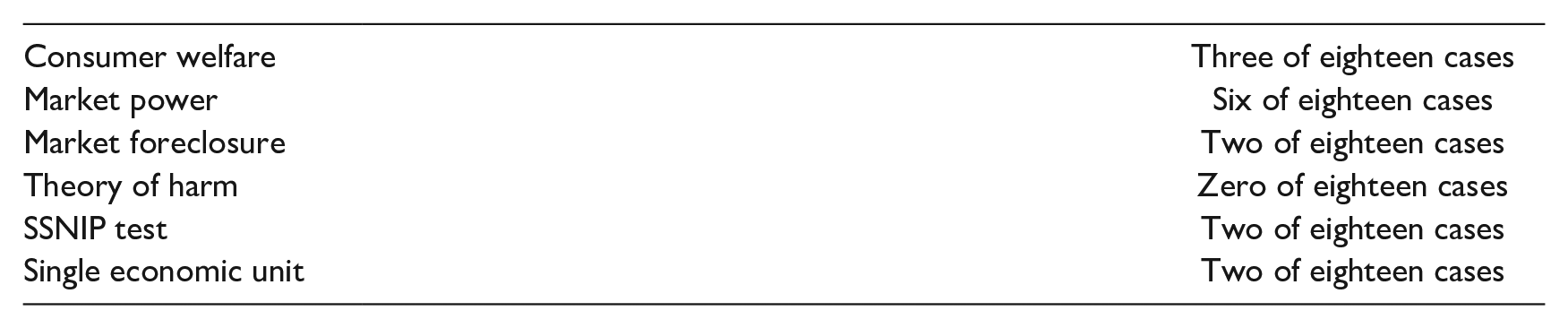
The statistical sample comprised eighteen judicial cases related to abuses of a dominant market position (infringements of Article 9 PRCA and/or Article 102 TFEU). The presented data clearly indicate that the application of fundamental antitrust law and economic concepts remains markedly limited, and that Slovenian courts continue to demonstrate a notable reluctance toward explicitly employing concepts that are theoretically well-established and whose application undoubtedly contributes to enhanced accuracy and appropriateness in judicial decision-making. The reasons behind this limited use of the specified concepts and standards are undoubtedly complex and multifaceted, extending beyond the scope of the present contribution. Nevertheless, these findings unequivocally highlight a significant deficiency that must be addressed in the ongoing development of a more mature and effective competition law system
IV. Conclusion
The historical trajectory of competition law enforcement in Slovenia has been characterized by profound institutional challenges and persistent inadequacies. The competition authority, initially established under conditions of ambiguity and dependency, faced structural impediments including limited staffing and insufficient autonomy. Although the institutional framework has been progressively refined—particularly with the transformation of the competition authority into an independent agency—the enduring constraints related to staffing, resources, and expertise continue to significantly undermine its efficiency and effectiveness. Simultaneously, the judiciary's role, intended as a corrective balance to administrative decision-making, has been constrained by a historically legalistic approach, frequent jurisdictional shifts, and hesitancy to robustly engage with foundational economic principles underpinning competition law. Despite noticeable improvements post-2015, considerable room remains for enhancing judicial capacity and practice.
This article has also provided a simplified statistical and qualitative analysis of judicial decisions specifically concerning the abuse of dominant market position. However, the insights presented herein represent only a fraction of a larger, ongoing research initiative aimed at comprehensively evaluating the effectiveness and application of competition law by Slovenian courts. Further analysis and policy reforms are necessary to overcome historical and institutional obstacles and to ensure that Slovenia's competition law system can fulfill its intended role of safeguarding economic freedom, promoting competitive markets, and thereby supporting sustainable economic growth and development.
Footnotes
Declaration of Conflicting Interests
The author(s) declared no potential conflicts of interest with respect to the research, authorship, and/or publication of this article.
Funding
The author(s) received no financial support for the research, authorship, and/or publication of this article.
Ethical considerations
Not applicable.
Consent to participate
Not applicable.
Consent for publication
Not applicable.
Academic commitment
University of Ljubljana Faculty of Law, Comparative Law Institute at University of Ljubljana Faculty of Law
Political Commitments
None.
National Commitments
None.
Commercial Commitments
Acted as out-house consultant for an American corporation (authored a legal opinion in the field of copyright law)
Financial Interests
None.
Non-financial interests
None.

1.
D. Trubek, “Social Justice ‘After’ Globalization: The Case of Social Europe,” Paper presented at European University Institute, Italy (Nov. 1996), University of Wisconsin Global Studies Program Working Paper (Dec. 1996).
2.
B. Šušteršič & M. Rojec, Nacionalni interes kot omejevanje ekonomske svobode, Naše gospodarstvo, Year 56, nr. ¾, 2010.
3.
It is noteworthy that only two doctoral thesis in the field of competition law exist in the three decades from 1970 to 2000 at the Faculty of Law in Ljubljana.
4.
Sl. Zakon o zatiranju nelojalne konkurence in monopolnih sporazumov, Official Gazette SFRJ, Nos. 24/74 and 72/86.
5.
Fatur, supra note 5, at 28.
6.
A. Brezigar Masten et al., Power Struggle: Cooperation or Competition? Post-Privatization Ownership Changes in Slovenian Corporations. In: Papers from 22nd Annual Conference of European Association for Law and Economics, Sept. 15–17, 2005, Ljubljana, Slovenia, Pravna fakulteta: = Facultas Iuridica, 23.
7.
D. Možina & M. Kovač,
8.
Fatur, supra note 5, at 21.
9.
A. Gregorič et al., ‘Agents’ Response to Inefficient Judiciary: Social Norms and the Law in Transition,
10.
Fatur, supra note 5, at 21.
11.
Id. at 22.
12.
Id.
13.
Sl. Urad za varstvo konkurence (UVK).
14.
Sl. Javna agencija Republike Slovenije za varstvo konkurence (AVK).
15.
Sl. Zakon o varstvu konkurence (ZVK), Official Gazette RS, No. 18/93, entered into force on Apr. 24, 1993.
16.
Official Gazette RS, No. 33/91-I ff, entered into force in Dec. 1991.
17.
Article 74/3 of the Constitution.
18.
J. Barlič et al., Zakon o varstvu konkurence s komentarjem, Zakon o trgovini s komentarjem (Ljubljana: Gospodarski vestnik 1993), 120–27.
19.
Sl. Zakon o preprečevanju omejevanja konkurence (ZPOmK), Official Gazette RS, No. 64/07 ff.; entered into force on July 14, 1999.
20.
See Fatur, supra note 5, at 29.
21.
Id. at 29–30.
22.
Art. 14 of the PRCA.
23.
“Organ v sestavi” in Slovene.
24.
See P. Grilc, Zakon o preprečevanju omejevanje konkurence s komentarjem (Ljubljana: GV 2000), 135, 136.
25.
A critical issue emerging in this context concerns the legal validity and enforceability of all decisions adopted by the NCA throughout the period described above.
26.
Cf. Grilc, supra note 24, 47, 48.
27.
P. Grilc & K. Podobnik, Skladnost koncentracije na trgu piva s pravili o preprečevanju omejevanja konkurence (Ljubljana 2002).
28.
Fatur, supra note 5, at 77.
29.
K. Podobnik, Framing a New Competition Law for Slovenia,
30.
Fatur, supra note 5, at 77–78.
31.
Sl. Zakon o preprečevanju omejevanja konkurence (ZPOmK-1), Official Gazette RS, No. 36/08, with amendments; entered into force on Apr. 26, 2008.
32.
Sl. Agencija za komunikacijska omrežja in storitve Republike Slovenije.
34.
Sl. Zakon o preprečevanju omejevanja konkurence (ZPOmK-2), Official Journal of the RS, No. 130/22 of 11 October 2022
35.
Before 2005, the CPO had to file a request with the court for the sanctionig of the undertakings.
36.
For details, see A. Vlahek, Slovenia Report. In: Judicial Review of Competition Law Enforcement in the EU member states and the UK (B. Rodger, ed., Alphen aan den Rijn: Kluwer Law International B.V., cop. 2024), 807–815; Rihtar Smiljanić, Institutional Design, Efficiency and Due Process in Competition Enforcement: Lessons from Slovenia and Serbia, 13(22) YARS 70, 72–77, 80 (2020); A. Krašek, V varstvo konkurence prihaja enotni postopek sankcioniranja, 27(3)
37.
Vlahek, supra note 36 at 842.
38.
Id. at 842–43.
39.
Id. at 843.
40.
For an excellent presentation of diverging views, see e.g. B. Hawk, Antitrust Law & Policy: Fordham Corporate Law 1998, Antitrust and the courts (roundtable), 369.
41.
See D. P. Wood, Generalist Judges in a Specialized World, 50
42.
Market, game theory, elasticity of demand, barriers to entry, foreclosure, price/non-price discrimination etc.
43.
Although throughout the history of antitrust the idea of achieving non-economic goals (un-employment, protection of SMEs, so-called national interest, and in the last 10–15 years ecology, corporate responsibility, gender equality, etc.) was healthy and ubiquitous, there should be no doubt that its goals are primarily in the sphere of economics: competitive markets, productive and allocative efficiency, consumer welfare, choice, innovation, lowering of costs, and so on.
44.
Cf. Antitrust and the courts – roundtable in: B. Hawk,
45.
Id. at 419.
46.
Judicial Enforcement of Competition Law, OECD, OCDE/GD(97)200, 1996, 26.
47.
For a detailed analysis of the competence of the courts in the public enforcement of competition law, see Vlahek, supra note 36 at 807–15.
48.
In this sense, competition law can also be perceived as a constitutional subject matter—as a shield that can protect individuals from otherwise uncontrollable behaviour of large concentrations of economic power.
49.
Vlahek, supra note 36 at 809–10.
50.
E. Kerševan,
51.
In addition, many exogenous factors may influence the NCA’s enforcement vigour, especially in the area of unilateral market power. The size, structure, and openness of the markets; the history of deregulation, liberalization, and potential ex-ante regulation; the (non)attractiveness of leniency programs, and so on. Cf. An International Comparison of the Abuse-of-Dominance Provision, SEO Economic Research (Amsterdam 2011), 88–90.
52.
For a detailed presentation of the competence issue, see Vlahek, supra note 36 at 807–16.