




Abstract
Prof. Markovits provides a verbal definition of anticompetitive contrived oligopolistic conduct that is mathematical in its precision. I highlight two questions arising from that definition. The first question involves an ambiguity about how firms’ beliefs about each others’ potential reactions to their moves affect how firms evaluate the profitability of those moves. The second question regards whether and in what circumstance strategic ignorance—a firm’s decision to avoid relevant information in order to influence the behavior of its rival—should be considered anticompetitive. The increasing use of artificial intelligence pricing algorithms highlights the practical importance of both questions.
I. Introduction
Richard Markovits’s two-volume book on Welfare Economics and Antitrust Policy 1 offers an authoritative overview of the state of the art in (1) tools to analyze the economic, moral, and legal impacts of various forms of firm conduct, (2) the application of those tools to specific categories of antitrust-law-related firm conduct, and (3) the relevant coverage of U.S. and E.U. antitrust and competition law. The book will be useful to both economists and legal scholars separately, and it makes what may be even a greater contribution in facilitating cross-disciplinary research. It provides a rigorous-enough grounding in both economic reasoning and legal analysis that scholars trained in one field will be able to identify and address questions in the other.
For mathematical economists and game theorists, the book provides an access point at an advanced level for how legal scholars look at antitrust issues. It lays out a coherent framework underlying how antitrust policy is applied in the courts. Furthermore, it offers a guide to the open questions that legal scholars consider important. If the book did nothing else, it would generate a long list of interesting aspects of antitrust policy that economic analysis might usefully contribute to. 2 For economists, the book provides a working understanding of relevant E.U. and U.S. laws and how they relate to economic conceptions of the role of antitrust policy, in a language that economists can understand.
The last sentence of the previous paragraph contains the key to the great strength of Prof. Markovits’s book. The crucial factor is his use of language. The language of modern economic analysis is mathematics, which may be as impenetrable to outsiders as “legalese” is to economists without legal training. The precision with which Prof. Markovits writes allows him to bridge the gap between the two languages. His prose, as rigorous and exact as mathematical expressions, enables economists to interpret the meaning of legal phrases, and it gives legal scholars an idea of the clarity and conciseness that mathematics can provide. There are no incomplete or incoherent statements that might slip by if expressed less carefully. Prof. Markovits’s unparalleled ability to express in words concepts that economists are accustomed to representing mathematically makes his theoretical analysis accessible to a broader audience.
The aim of the rest of this comment is not to describe an area in which I believe that Prof. Markovits’s analysis is wrong, but rather to highlight an area that might usefully have been given more attention. In particular, I will discuss two related questions about how to operationalize one of the concepts that Prof. Markovits defines: contrived oligopolistic conduct. The first question concerns an ambiguity in the definition, specifically in the part of the definition referring to firms’ beliefs about each others’ potential reactions to their moves. The ambiguity is especially relevant in settings where firms’ actions have lasting impacts on future profits. The second question asks whether and in what circumstances a firm’s decision to avoid acquiring information—“strategic ignorance”—could be considered anticompetitive oligopolistic conduct. Both questions would benefit from that Prof. Markovits’s particular skill in combining conceptual, mathematical, and legal expertise.
The next section summarizes the book’s definition of contrived oligopolistic conduct and highlights the part containing the ambiguity. I develop the two questions in the subsequent sections. In the last section, I discuss an example of firm conduct, the use of algorithmic pricing, that illustrates the relevance of both questions.
II. Prof. Markovits’s Definition of Contrived Oligopolistic Conduct
The definition of oligopolistic conduct that I will discuss appears on p. 179 of Volume I. Prof. Markovits writes, In my terminology, “oligopolistic conduct” always involves one or more perpetrators’ making a move that it or they
The highlights are mine. Closely related are the definitions of the “highest non-oligopolistic price” on p. 69 of Volume I (“the HNOP is defined to be the highest price that would be profitable for a seller that was privately-best-placed to supply a particular buyer to charge that buyer if its [A] component of the gap between the price an individualized pricer actually charges a buyer it is privately-best-placed to supply and the conventional marginal costs it would have to incur to supply that buyer are the oligopolistic margins it seeks to obtain from the buyer in question—i.e., the extra sum it tries to obtain from this buyer because
Again, the highlights are mine. They indicate the parts of the definition that I will focus on in the following section, which contains my first question, about an ambiguity in the definition. My second question concerns whether or not a firm’s failure to take an action in a particular category may qualify as “making a move” in the above definition. Because throughout I will examine only what is defined above as contrived oligopolistic conduct, in the interest of brevity I will refer to such conduct simply as oligopolistic conduct. Furthermore, in order to simplify the exposition, I will assume throughout the rest of this comment that the perpetrator (Firm 1) has only a single rival (Firm 2).
III. First Question: Interpreting “React”
In this section, I will, first, explain the ambiguity in the definition of oligopolistic conduct; second, present a simple example to illustrate the resulting confusion in identifying oligopolistic conduct; and third, after briefly discussing attempts by economic theorists to resolve the ambiguity, argue that those attempts have been unsatisfactory.
A. The Ambiguity
In the definition in Section II, the crucial factor indicating that an initial move by Firm 1 constitutes oligopolistic conduct is that the move is profitable, relative to the implicit most-profitable non-oligopolistic alternative move, for Firm 1 only if Firm 2’s move in response satisfies the following two conditions relative to any alternative response:
Firm 1 will react to Firm 2’s possible responses in a fashion such that Firm 1’s reaction to Firm 2’s actual response, together with the response itself and the initial move, gives Firm 2 a higher profit than would Firm 1’s reaction to Firm 2’s alternative response, together with the response itself and the initial move; while in contrast,
if Firm 1 reacted to Firm 2’s possible responses in such a way that Firm 1’s reaction to any response by Firm 2, together with the response itself and the initial move, gives Firm 1 a higher payoff than any other possible reaction, then Firm 1’s reaction to Firm 2’s actual response, together with the response itself and the initial move, would give Firm 2 a lower profit than would Firm 1’s reaction to Firm 2’s alternative response, together with the response itself and the initial move.
That is, it must be that either Firm 1’s reaction to Firm 2’s actual response, together with the response itself and the initial move, gives Firm 1 a lower payoff than would some other possible reaction; or Firm 2’s reaction to the alternative response, together with the response itself and the initial move, gives Firm 1 a lower payoff than would some other possible reaction; or both.
To put it algebraically, suppose that Firm 1 is choosing between two possible initial moves,
Firm 2 responds to initial move
After initial move
After initial move
either
The ambiguity in the definition of oligopolistic conduct involves the phrases “the anticipated reactions would be inherently unprofitable for the initiator” and “react to their responses in one or more otherwise-unprofitable ways.” The reason that the phrases are ambiguous is that the profitability or unprofitability of Firm 1’s reaction may depend on the subsequent behavior of Firm 2 (and indeed of Firm 1 as well). As a consequence, the meaning of “inherently unprofitable” and “otherwise-unprofitable” is not clear.
In my algebraic formulation, those ambiguous phrases correspond to the last conditions,
B. An Illustrative Example
To illustrate, consider the following, very stylized example. The two firms are identical, and they interact repeatedly over time. Every month, each makes a pricing choice: either to set the higher monopoly price
Regardless of the state of demand, jointly setting the monopoly price

and

where the function
Suppose that the firms behave as follows: both set the monopoly price
Those responses, in turn, are profitable for Firm 2 (relative to the alternative possible prices) only because Firm 1 reacts analogously to Firm 2’s responses: after a response of
Thus, the specified behavior by the firms does not meet the definition of oligopolistic conduct, although intuitively that behavior seems clearly anticompetitive. When the state of demand is high, each firm passes up the opportunity to increase its immediate profit by undercutting its rival because the firms have effectively promised to reward cooperation with future cooperation, and to punish undercutting with future low prices.
C. Game Theoretic Attempts to Resolve the Ambiguity
Economic theorists have made efforts to address this ambiguity, with only partial success. 3 For the most part, those efforts have focused on horizontal price fixing, which Prof. Markovits calls contrived oligopolistic pricing and which the economic theory literature often refers to simply as collusion. 4 Broadly, the approach of game theorists involves two pieces. One piece is to reformulate the definition of oligopolistic conduct along the following lines:
Definition 1
Oligopolistic conduct involves Firm 1’ s making a move that it would not have found ex ante profitable but for its belief that Firm 2’s response would or might be influenced by Firm 2’s belief that Firm 1 would react to Firm 2’s response in one or more ways that would render unprofitable for Firm 2 a response that Firm 2 would otherwise have found profitable despite the fact that the anticipated reactions would be
That is, oligopolistic conduct is inconsistent with competition when its profitability relies on Firm 2’s anticipating a reaction from Firm 1 that is inconsistent with competition. That condition is straightforward to check, given a definition of competitive conduct. The second piece of the game theoretic approach, therefore, is to define what competitive conduct is. 5 The second piece is where difficulties arise. One approach to defining competitive conduct is to require that each firm in each period chooses the move that gives it the greatest profit in that period, taking the move of its rival in that period as given (as in the definition of HNOP quoted in Section 2). 6
Under that “static optimization” approach, the “high price in the high demand state” behavior in the example from Section III.B would be classified as oligopolistic. In more general settings, however, the static optimization approach is inadequate, as Chassang and Ortner acknowledge, because it requires firms to ignore the effect of current decisions on future profitability. A firm may want to deviate from the price that maximizes immediate profit in order to take advantage of learning-by-doing effects that can reduce future costs, or in order to learn about the market demand curve by experimenting with different prices, or in order to attract potential repeat customers through promotional pricing. In fact, under the static optimization approach any form of investment at all would be classified as oligopolistic, because the firm incurs a cost now and gets a reward only in the future.
In settings where current choices have lasting impacts, then, the static optimization approach to defining competitive conduct leads to a much too broad classification of oligopolistic conduct. An attempt to address that concern involves modifying the definition of competitive conduct to require that each firm in each period chooses the move that leads to the greatest overall profit (considering the future as well as the current period), taking the moves of its rival (in the future as well as in the current period) as given. 7 That is, a firm assumes that its rival will not respond differently to different moves, and so the firm chooses a move “for its own sake.”
That modified approach does allow for efficient investment. The problem with this modification, though, is that the assumption that Firm 2’s future actions are unaffected by Firm 1’s current action is unreasonable in many contexts. For example, suppose that Firm 1 initially has a higher marginal cost than Firm 2’s, but Firm 1 can reduce its marginal cost to Firm 2’s level in the future by undertaking a costly investment today. It would be natural in this setting for Firm 1 to expect Firm 2 to set a lower price after Firm 1 has made the investment than in the case where Firm 1 did not make the investment: when the firms compete on prices, then Firm 2 will seek to match Firm 1’s best offer.
Thus, these game theoretic attempts to define competitive conduct by insisting either that firms consider only immediate payoffs or that firms ignore the potential reactions of their rivals do not provide a full resolution to the ambiguity in Prof. Markovits’s definition of oligopolistic conduct. Instead, it seems that a definition of competitive conduct must allow firms to take into account their rivals’ reactions, while requiring that those reactions themselves meet the definition of competitive conduct. Identifying the appropriate restrictions on conduct arising from such a recursive definition is an open question in economic theory and an area of ongoing research.
Prof. Markovits is uniquely well positioned to help guide that research. The theoretical approach is at risk of developing in a technical direction that may produce results not closely linked to the actual mechanics of antitrust policy. Prof. Markovits’s ability to connect conceptual modeling with legal analysis could help ensure, instead, that the research program would yield a relevant solution in generating a standard of oligopolistic conduct that is acceptable to legal scholars and applicable in practice.
IV. Second Question: Strategic Ignorance
Going back at least to Thomas Schelling, 8 economic theorists have identified situations where an economic agent may derive an advantage by deliberately avoiding information even though that information would be relevant for subsequent decision-making. In Schelling’s example, the second mover in a Stackelberg duopoly would benefit if it could commit not to observe the first mover’s chosen quantity before choosing its own quantity, as long as the first mover is aware of that commitment. The key feature is that by openly and publicly refusing information, the second mover can alter the action of its rival, relative to the action that the rival would have chosen if it believed that its action would be observed by the second mover, in a way favorable to the second mover. 9
A. Schelling’s Example
To illustrate a simplified version of Schelling’s example algebraically, suppose that each firm chooses from three possible levels of output,
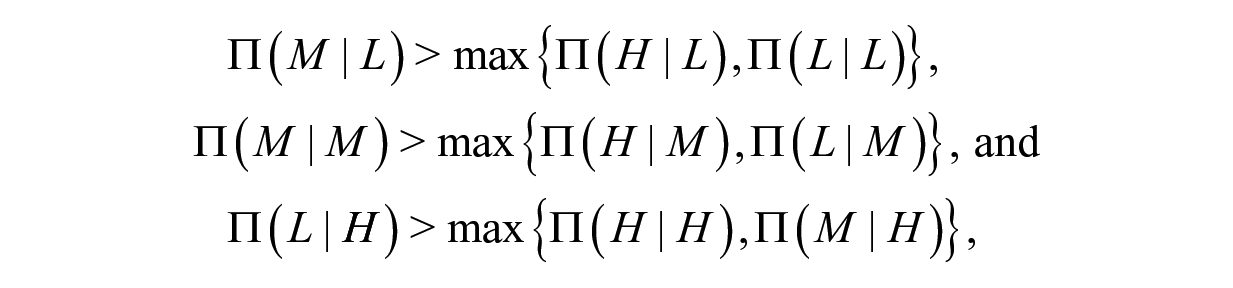
where

In that setting, Firm 2 would benefit if it could credibly commit to pay a small cost in order to avoid learning Firm 1’s output level before setting its own quantity and could communicate that commitment to Firm 1. In that case, the outcome where Firm 1 sets high output and Firm 2 sets low output will no longer be the result. If Firm 1 expects that Firm 2 will choose low output, then Firm 1 would prefer to choose medium rather than high output, knowing that Firm 2 will not observe the switch and adjust its quantity in response.
Instead, the result will be that both firms choose medium output. Having ruled out the possibility that Firm 1 chose high output, Firm 2 will select the medium quantity as the best choice in response to either low or medium output by Firm 1. And Firm 1, forecasting that Firm 2 will choose medium output, prefers the medium quantity for itself as well. That outcome (medium output by both firms) gives Firm 2 a higher profit than the outcome (high output by Firm 1, low output by Firm 2) in the case where Firm 2 could observe Firm 1’s quantity: because
B. Strategic Ignorance as Oligopolistic Conduct?
In that example, would a move by Firm 2 to first, commit to avoid collecting or observing any information about Firm 1’s output before choosing its own output quantity, and second, to communicate that commitment to Firm 1 in a credible way, meet the definition of oligopolistic conduct in Section II? That is, are the following two conditions satisfied: is carrying out the threat to avoid learning Firm 1’s output choice inherently unprofitable? And does the profitability of the move depend on Firm 2’s expectation that the threat will influence Firm 1’s response in a way that is profitable to Firm 2?
In my reading, the answer to each question is yes. Incurring a small cost to avoid information about Firm 1’s chosen quantity is clearly unprofitable ex post. Knowing Firm 1’s quantity once it is chosen would enable Firm 2 to pick exactly its profit-maximizing output in response, so missing that information cannot raise Firm 2’s profits. The fact that Firm 2 must incur a cost to avoid learning, then, means that following through on the threat of avoidance reduces the profits of Firm 2.
The answer to the second question is also yes. If Firm 1 does not believe that Firm 2 will carry out its threat to avoid learning Firm 1’s output level, then it will choose high output in the expectation that Firm 2 will observe that choice and respond by producing a low quantity. That outcome is the same as if Firm 2 had not made the move. Thus, Firm 2 believes that the move will be profitable only because the threat will influence Firm 1’s action.
There is a subtlety, however, in evaluating whether or not this example of strategic ignorance qualifies as oligopolistic conduct. Namely, should a refusal to pay attention to information be considered an action by Firm 2?
11
Parts of Prof. Markovits’s book bear indirectly on that issue. Section 9.2 presents an analysis of a related sort of conduct, the decision “not to reveal to the buyers information that would enable the buyers to avoid making mistaken product-purchase or product-purchase-price decisions” (p. 232). In Section 17.3, he argues that Article 101 of E.U. competition law should be interpreted as prohibiting certain types of “negative decisions,” where the ‘conduct’ in question is decisions not to do something—for example, not to invest, not to disclose to buyers negative information about the non-discloser’s product’s performance or lifetime cost to buyers, or not to disclose to government such information or information about the external costs generated by a product’s production and/or consumption. (p. 319)
It is not clear, though, that nondisclosure to consumers of information that they would find relevant and that the firm already possesses is a very close analogy, either conceptually or legally, for nonacquisition by the firm of information that it would itself find relevant. Here again Prof. Markovits’s skill in combining legal scholarship with theoretical analysis would be valuable. As I discuss in the concluding section, the issue of whether or not strategic ignorance may constitute oligopolistic conduct has practical importance.
V. Application: Algorithmic Pricing
Firms’ increasing use of artificial intelligence algorithms to set their prices has spurred both economic and legal research. 12 Can such algorithms, when matched with each other, generate prices above the competitive level? If so, how should the use of such algorithms be treated under U.S. and E.U. antitrust and competition law? Both of the questions raised in this comment are relevant for that research program.
As described in Section III.C, the game theoretic approach to resolving the ambiguity in the definition of oligopolistic conduct relies on constructing a definition of competitive conduct. Attempts to construct a definition of competitive conduct, in turn, have largely focused on setting restrictions on what factors a firm may take into account when evaluating the profitability of a potential move. Those restrictions parallel the distinction in Prof. Markovits’s definition between moves that are “inherently profitable” and those whose profitability depends on the rival’s response being influenced by the expectation that the firm may react in an otherwise-unprofitable way. The computer code behind a pricing algorithm specifies exactly which factors are evaluated and how. 13 Thus, a given algorithm could in principle be checked against a legal or economic standard of acceptability, if such a standard were developed.
Similarly, the designers of an algorithm can straightforwardly direct it to ignore information about rivals’ prices or about the state of demand. Implementing that form of strategic ignorance might increase the firm’s expected profit indirectly by influencing the prices set by rivals’ algorithms. A general framework for how to evaluate the desirability or legality of strategic ignorance would have an immediate application in designing regulations on the use of algorithms in that setting.
Understanding the roles of those two types of restrictions on algorithms—what objective they seek to maximize and what information they take as input—is not an abstract concern. Asker et al. present evidence suggesting that interacting algorithms are more likely to generate prices persistently above the competitive level when they (1) value future profits as well as immediate profit and (2) observe the profit resulting from the price that the firm actually set, but ignore the implications of that information for learning about what the profit would have been from other possible prices. That is, both types of restrictions matter. The corresponding two questions raised in this comment, therefore, are of growing practical importance.
Footnotes
Declaration of Conflicting Interests
The author(s) declared no potential conflicts of interest with respect to the research, authorship, and/or publication of this article.
Funding
The author(s) received no financial support for the research, authorship, and/or publication of this article.
1.
2.
To pick just one example, from p.323 of Volume II: . . . written U.S. antitrust law . . . prohibits specific anticompetitive-intent-motivated pricing-technique choices made by nondominant firms regardless of whether those choices involve the making of any agreement with or sale to a final consumer as opposed to another firm (undertaking) whereas written E.U. competition law . . . prohibits [such choices] if the choices are embedded in an agreement with another undertaking.
Analyzing the consequences of that difference for the behavior of profit-maximizing firms using the tools of economic theory would make a very interesting topic for a research paper. Nearly every section of the book includes at least one such promising topic.
3.
Sylvain Chassang & Juan Ortner, Regulating Collusion, 15(1)
4.
It is striking, incidentally, that although such collusion is a major focus of the literature on antitrust within economics, the words “collusion” and “collusive” do not appear in Prof. Markovits’s book.
5.
One way to frame that approach is the following: when Prof. Markovits writes of “the price-setter’ s intention to do anything inherently unprofitable to reward its rivals’ cooperation and/or to punish its rivals’ non-cooperation” (p. 222 of Volume I) or “threatening to retaliate [and] promising to reward” (252 of Volume I), rewards and punishments must be measured relative to some baseline future outcome that would have occurred if the perpetrator had not engaged in the initial anticompetitive action.
6.
S. Chassang et al., Robust Screens for Noncompetitive Bidding in Procurement Auctions, 90
7.
G. Y. Weintraub et al., Markov Perfect Industry Dynamics with Many Firms, 76 Econometrica, 1375–411 (2008) and C. L. Benkard et al., Oblivious Equilibrium for Concentrated Industries, 46 Rand J Econ, 671–708 (2015) incorporate that approach into their concept of “oblivious equilibrium.”
8.
9.
Russell Goldman et al., Information Avoidance, 55(1) J
10.
The first inequality is among those listed above, and the fact that each firm’s profits decreases when its rival chooses a higher quantity implies the second inequality.
11.
Goldman et al. distinguish “active information avoidance,” where “(1) the individual is aware that the information is available, and (2) the individual has free access to the information or would avoid the information even if access were free,” from “the broad and almost infinite range of situations in which people fail to obtain information that is in their power to secure” (p.97).
12.
See, for example, J. Asker et al., Artificial Intelligence, Algorithm Design and Pricing, 112
13.
Conceivably, a firm’s algorithm might condition its price not only on rivals’ price but even on the details of coding of the algorithms used by rivals. In game theoretic terms, a firm’s strategy in that case would be a function of its rivals’ strategies.