




Abstract
The U.S. system has relied heavily on antitrust class actions as a means of ensuring compensation and deterrence. Although this tool seems sensible in theory, the reality is that it remains highly controversial. On the one hand, commentators argue that class actions force defendants to settle cases lacking merit. Even if a settlement agreement is assumed to have a merit, class actions are accused of doing a poor job in compensating victims and deterring wrongdoers. On the other hand, the proponents of class actions claim that there is no reliable empirical evidence proving that class action schemes caused negative effects on antitrust litigation. The public debate about the effectiveness of class actions illustrate the controversial nature of American class actions fairly well. Therefore, using comparative insights from the predominant controversies, this study will determine how well antitrust class actions fulfill compensation objectives and to what extent they can facilitate deterrence.
Introduction
Private litigation has always played a major role in the antitrust enforcement of the United States. Even though private enforcement was meant to only complement public enforcement, in reality private claims far outstrip governmental actions. Private remedies are aimed at achieving either compensation or deterrence goals. When the American class action mechanism emerged, it became a very potent fixture to bridge the gap between both objectives. A primary purpose of the class action device is to enable large groups of victim to aggregate their claims and hence to claim damages or to seek injunctive relief as a result of the alleged violation. Throughout the development of these sorts of proceedings, the Supreme Court has given a broad remedial function for class actions to assure that the antitrust objectives are achieved. Yet the approach has recently changed in Twombly. 1 There, it was alleged that antitrust class actions can incentivize defendants to settle cases that lack merit. 2 Some critics characterize this phenomenon as a “blackmail settlement.” 3 Despite the Court’s criticism, some commentators argue that the decision has no merit itself: it relies on the “unsupported opinion of another appellate court judge” and no empirical study was performed. 4 The public debate between these opposing views well illustrates the controversial nature of private antitrust enforcement in the United States. Ironically, even if the phenomenon of blackmail settlement would be assumed to have no ground, a series of additional controversies underlie the understanding on class actions, both in compensating class members and deterring the wrongdoers.
Therefore, this article aims to assess the effectiveness of class actions in securing antitrust enforcement. Using comparative insights from the predominant controversies in the United States, it will determine how well antitrust class actions fulfil compensation objectives and to what extent they can facilitate deterrence. A particular emphasis is on cases where plaintiffs suffered harm but the cost of litigation exceeds the expected award (“negative expected value claims”). Thus, the debate over compensation focuses on three major controversies: Class members obtain little or no compensation. The compensation mechanism is framed to (largely) overpay attorneys. Class actions do not compensate the real victims.
The discussion on deterrence will analyze one major controversy: that class actions give little or no weight to deterrence. To give an additional flavor to the debate between critics and proponents, the optimal deterrence theory will be applied in order to assess the role of class actions in deterring infringers.
Part I of this article discusses the rationale for private enforcement and class actions in antitrust enforcement. Part II examines three key controversies underlying the compensation objective in small-stakes antitrust class actions. Part III considers the impact of class actions on deterring the wrongdoers (“rational actors”) by applying the standards of optimal deterrence theory.
I. The Rationale for Private Enforcement and Class Actions in Antitrust Enforcement
The U.S. policy of promoting competition is based on the Sherman Act of 1890 5 and the Clayton Act of 1914. 6 Section 1 of the Sherman Act prohibits any agreement in restraint of trade, while Section 2 forbids monopolistic behavior. 7 The Clayton Act is far more detailed than the Sherman Act, expanding the provisions on price discrimination, exclusive dealings, and the ability for individuals to sue for damages. 8 At the federal level, the U.S. Department of Justice (DOJ) and the Federal Trade Commission (FTC) have the authority to enforce antitrust laws. On the private side, U.S. antitrust law permits enforcement by victims of antitrust infringements. In enacting the antitrust laws, private enforcement was meant to supplement public enforcement, which lacks sufficient resources to detect and prosecute antitrust violations. However, private claims have become much more prominent and far outpace government claims. Over 90% of antitrust litigation was filed by private plaintiffs between 1975 and 2004. 9 More recently, in 2013, it was indicated that 98% of antitrust cases in federal courts were private actions. 10 In fact, private enforcement has become so powerful that private enforcers indeed fill in gaps of public enforcement of low detection and suboptimal fines.
A. Two Interrelated Goals of Private Antitrust Enforcement: Compensation and Deterrence
The U.S. Supreme Court has repeatedly held that the private right of action under the antitrust laws serves two purposes: compensation and deterrence. 11 As regards the first objective, the enactment of both the Sherman and Clayton Acts appreciated the compensation role of private claims. In order to facilitate the objective of compensation, federal antitrust law authorizes the award of automatic treble damages. 12 In fact, treble damages are the only meaningful tool to provide compensation to antitrust victims. 13 However, considering the complexities in compensating antitrust victims, treble damages are considered to provide only “rough justice” to sufferers. 14 Indeed, an overcharge can be so widespread that the estimation of actual harm may be an insurmountable burden.
Another viewpoint holds that private suits are necessary to deter potential wrongdoers. 15 This concept is based on the idea that public authorities have insufficient time and resources to prosecute all the unlawful conduct and hence private litigators can secure additional layer of antitrust enforcement. Trebling ensures that infringers internalize the sufficient cost of the harm caused by anticompetitive behavior. In that regard, the Supreme Court noted that the “treble-damages provision wielded by the private litigant is a chief tool in the antitrust enforcement scheme,” because the fear of treble damages creates “a crucial deterrent to potential violators.” 16 Moreover and most importantly, when trebling is combined with contingency fees, the attorney’s incentive to sue is raised to a maximum: there is a guarantee that he or she will reap a large award if the case is won or settled. In addition, the one-way-fee-shifting rule and broad discovery rules ensure a plaintiff-friendly climate. Together, these measures provide the necessary incentives for private attorneys to invest time and money in prosecuting lengthy, complicated, and expensive antitrust suits (the so-called “private attorney general”).
In case of a conflict between the antitrust goals, the Supreme Court seems to prioritize deterrence over compensation. 17 One of the notable case was Pfizer v. Government of India, 18 in which the Court ruled that consumers benefited from the “maximum deterrent effect” if trebling was applied to all infringers. 19 The other case is Hawaii v. Standard Oil 20 where the Supreme Court ruled that the Congress’ incentive of trebling encourages potential private litigants to serve as “private attorneys general.” 21 To sum up, the American system can justify the failures of compensation (for example, undercompensation of class members), given that the primary objective is to deter wrongdoers.
B. The Role of Class Actions in Antitrust Enforcement
In the United States, private actions can be brought on behalf of a class of plaintiffs under Rule 23 of the Federal Rules of Civil Procedure. The class action rule allows to consolidate multiple claims of victims who allegedly suffered harm from the alleged violation. Throughout the history, the antitrust enforcement mechanism has relied on antitrust class actions as means of securing compensation and deterrence. The U.S. Supreme Court held that allowing these claims to proceed collectively enhanced “the efficacy of private actions, by permitting citizens to combine their limited resources and to achieve a more powerful litigation posture.” 22 Indeed, the consolidation is very effective when antitrust infringement causes scattered harm among a large number of injured parties. In turn, it facilitates economies of scale in relation to the savings in litigation and court administrative costs. 23 The actual benefits of class actions can emerge from two different types of claims.
First, there are classes with positive value claims (“positive expected value claims”). In such groups, the potential award outweighs the anticipated expenses of litigation even if the plaintiff leads the case on his or her own. But with larger financial means, the class can litigate in a more efficacious way by employing more competent lawyers than victims would be able to do in individual cases. Therefore, the probability of winning the case increases exponentially. The aggregation is likely to also be beneficial for the defendants, where there might be a series of individual claims alleging the same injuries. From a practical point of view, the defendant has an easier time in organizing the defense and investing in winning the sole case.
Second, there is a situation where the plaintiffs suffered a harm but the cost of litigation exceeds the expected recovery (“negative expected value claims”). Therefore, these claims would not normally lead to litigation if not pursued by class actions. According to the U.S. Supreme Court, class action litigation allows for low value claims to be heard.
24
In addition, class actions may be the only possibility to aggregate claims of small worth, especially when suing the wrongdoer individually would not be “economically rational.”
25
In the end, class action litigation can be beneficial both for class members and for private litigators, who perform under a contingency fee agreement. An illustrative example: Suppose that potential antirust victims suffered an average harm of $100 due to a price-fixing cartel. The resulting individual claims are economically worthwhile, because litigation costs always exceed the expected award from positive judgment. But if there were 1 million class members, in theory the expected recovery can be up to $300 million after trebling. Thus, the lawsuit would have significant financial strength. If we consider that contingency fees range between 20% and 33%, there is great interest for an attorney to invest in the litigation, since his potential compensation can result in tens of millions.
Although class action litigation allows for aggregating lawsuits that would otherwise be financially infeasible, the negative expected value claims remain highly controversial to this day. The key criticism is centered on the fact that very few cases go to trial, because defendants are pressed to settle cases lacking merit.
C. The Major Criticism of U.S. Class Actions
Arguably, the certification is an essential part of the class action lawsuit. For the case to proceed as a class action, four threshold requirements must be met under Rule 23(a) of the Federal Rules of Civil Procedure: (1) numerosity, (2) commonality, (3) typicality, and (4) adequacy.
27
A court must also find at least one of the criteria listed under Rule 23(b).
28
The settlements generally fall into three basic categories: Automatic distribution settlements. Damage awards are automatically distributed to class members who do not exercise their right to opt out. Under this settlement category, class members are not required to submit claim forms so as to receive award. In order to proceed with this model, the entire class should be precisely identified. The awards are typically mailed to each of them. However, a substantial number of class members may not cash their checks.
29
Therefore, undistributed funds can be distributed via cy pres process (discussed below) or, in rare cases, be returned to the defendant. The attorney receives a fee that is proportionally calculated on the total value of the settlement, regardless of how many victims actually received damages. Claims-made settlements. This scheme is utilized when there is no reliable data to list the identities of victims. As such, class members are required submit a valid claim in order to obtain award. Typically, the total payout to the class will be smaller than in an automatic payment settlement and thus depends on how many class members submitted claim forms. Indeed, there is a possibility that in some cases (for example, when submitting claim form is cumbersome), only few members will receive compensation. Despite this unsuccessful outcome, the attorney receives a percentage based on the potential value of the settlement, regardless of how many victims submitted a valid claim form. This may lead to an ironical situation: the attorney’s fee can exceed the actual payout to the class.
30
Uncollected funds are rare (only when issued checks are not cashed) and the surplus is either distributed to a cy pres entity or back to the defendant. Cy pres settlements. There is no direct compensation to class members, but an award is made to a charitable organization whose activities are as closely as possible related with the antitrust victims. In order to avoid abusive cy pres distributions, the cy pres relief has become closely scrutinized by courts.
31
Despite settlements being a faster means of solving antitrust disputes, they are criticized for a variety of reasons. If the certification is formally approved by the court, it is well-established practice that the vast majority of cases settle. 32 The critical understanding of class actions was summarized by the former commissioner of the FTC, who considered antitrust class action suits “almost as scandalous as the price-fixing cartels that are generally at issue…[the plaintiffs’ lawyers] stand to win almost regardless of the merits of the case.” 33 Similarly, academics argue that antitrust class actions can be easily brought, but the defense expenses can be significant, and hence to force defendants to pay for settlement to get rid of the case. 34 In other words, the fear of ultimate loss, resulting in huge financial loss and reputational damage, might press the defendant to settle a class action wholly lacking in merit rather than to proceed to trial with unpredictable jury verdict. Two factors tend to strengthen this claim.
First, in contrast to the “American rule” where each party bears its own litigation, U.S. federal antitrust law entitles the prevailing plaintiff to recover not only treble damages, but also to obtain attorney’s fees as part of his costs of suit. 35 This provision is often referred to as “one-way fee shifting,” because defendants have no right to attorneys’ fees. The purpose of such a scheme is to encourage the class counsel to invest in private actions (especially for impecunious victims), while the interests of defendants are not the primary objective (even if they are found innocent). For the defendant, the only way to recoup his legal expenses is if the plaintiff was sanctioned under the inappropriate use of Rule 11 of the Federal Rule of Civil Procedure, which regards frivolous or improper pleadings. 36 However, the fact-intensive nature of antitrust actions highly complicates the task of discovering the violation under Rule 11. 37 If the case is settled, the one-way fee shifting is usually removed in settlement negotiations. In addition, if the class action is dismissed (for example, in a pretrial stage) or if the plaintiff loses the claim, each party bears its own litigation costs. It therefore means that defendants would never be recompensed for frivolous lawsuits brought by plaintiffs.
Second, discovery rules are designed disadvantageously to the defendants due to asymmetric discovery costs. As a general rule, the parties are entitled to request a broad range of the discovery material from the opposing party that would reveal the admissible evidence. 38 The discovery rules require a responding party to bear the costs of the other side’s requests. The issue of concern is that plaintiffs are able to propound extremely broad and burdensome requests without the fear of retaliation from the other side. 39 This is notable because a defendant (for example, a big corporation) routinely holds a broad latitude of documents and items (hard copies, electronic information, transactions, etc.), which might be geographically dispersed and dating back a decade or even more. A wide-ranging discovery usually also involves a significant amount of interrogatories and depositions, thereby creating a substantial financial burden on the defendant. 40 In addition, the defendant receiving a broad discovery request will be forced to pay close attention to the details of every element, as the disclosure material needs to be produced in a consistent and organized form. 41 In contrast with the defendant, the lead plaintiff(s) have a relatively small number of responsive discovery material, because the resulting harm of a class member is usually of low value. As a consequence, the related evidence can be collected and produced with little burden or expense. Another concern for the defendant is that plaintiffs might benefit from a tangible discovery (both fact and expert) even prior to class certification briefing. 42 If the case is prolonged, the defendant should take into consideration that the discovery costs increase in relation with the increase of time lags. Yet it should be stressed that there is a possibility for a portion or all of the discovery costs to be shifted to the plaintiff if the requests are unduly burdensome for the defendant. 43 However, in reality the defensive counterclaim is very complicated. The judge often struggles to screen frivolous discovery requests, because the plaintiff has the ability to structure an antitrust claim in a way that prevents adverse effects in the future. 44
The skeptical view of class actions has been confirmed by judicial decisions as well. Throughout the history of antitrust case law, the Supreme Court has given a broad function for class actions to secure the antitrust objectives. However, this attitude has changed in Bell Atlantic Corp. v. Twombly. 45 The Court asserted that class actions can force defendants to settle cases lacking merit. 46 Furthermore, it was ruled that the judicial system lacks confidence in screening meritless cases. 47 A few years before Twombly, in Verizon Communications, Inc. v. Law Offices of Curtis V. Trinko, 48 the Court stated that courts are incompetent to manage the daily monitoring of antitrust litigation. 49
Despite the Court’s skepticism, Davis and Lande argue that the Twombly decision has no merit in itself, because there was no empirical study conducted. 50 The Court made a modification for pleading standard (without any reasonable ground) that conflicts with the Federal Rules of Civil Procedure. 51 To facilitate support for class actions, Davis and Lande performed two studies of recent large and significant antitrust class action cases, combining forty cases in the first study 52 and twenty additional cases in the second one. 53 According to the results of the combined sixty cases, the fear of a blackmail settlement was considered as unjustified alert: a large majority of cases have merit. The main assessment relies on a test of a probability of success: the amount of over $50 million was considered above the nuisance value of a frivolous case. 54 It was found that the recovery was more than $100 million in 60% of cases, while in only a few cases led to significantly less than $50 million, and the smallest was $30 million. Furthermore, 88% of the cases studied received at least one validation that the plaintiffs’ case was meritorious. 55 Moreover, a federal judge approved all the discussed settlements as fair, reasonable, and adequate. 56 In order to reinforce the results, Davis and Lande point to cases where class attorneys earned praise from judges and therefore were awarded significant amounts in damages. 57
The public debate between these opposing views well characterizes the controversial nature of class actions in the United States. Ironically, even if a settlement agreement is assumed to have a merit, a series of additional controversies are claimed to occur in class actions: both in compensating victims/class members and deterring the violators. The purpose of the following study is to determine how well antitrust class actions fulfill compensation objectives and to what extent they can facilitate deterrence of antitrust enforcement.
II. A Controversy of Compensation in Small-Stakes Class Actions: A Perspective of Antitrust
Private antitrust litigation, and especially class actions, is facing broad criticism for failing to fulfill its compensatory goal. First, victims receive little or no compensation from class action lawsuits, but the plaintiff bar is overpaid. 58 When victims do receive compensation, the distribution of the settlement fund can be financially worthwhile, because the administrative costs may consume the entire recovery. 59 In addition, the class members usually recover only worthless coupons, or their award is distributed to unrelated charities. 60 As a counterclaim, the proponents of class actions assert that most criticism has been based on anecdotal evidence. 61 In order to contribute to the debate, this article will assess the main controversies. The major criticisms that have been stated about private (class action) antitrust enforcement can be classified into three categories.
A. Class Members Obtain Little or No Compensation
According to the critical approach, there is no need to present empirical evidence of the failure of the compensation goal; it is predetermined that antitrust class actions generate little or no compensation to class members. 62 One of the major issues is that indirect purchasers are prohibited from recovering antitrust damages at the federal level. 63 By prohibiting these actions, the Court prevents a majority of financial victims from receiving compensation. The overcharge usually causes harm at different levels of distribution chain. The further down the chain, the smaller the harm is, and thus there are less incentives to litigate individually. Therefore, it is programmed that many victims will be uncompensated, especially if they are end consumers.
Indirect purchasers, however, may recover damages in some state law actions. 64 But it is highly debatable whether indirect purchasers have the ability to bring a lawsuit as financial victims. The potential problems can be well illustrated through the Canadian example. In 2013, the trilogy of the Supreme Court’s (SCC’s) decisions in Pro-Sys Consultants Ltd v Microsoft Corporation, 65 Sun-Rype Products Ltd v Archer Daniels Midland Company, 66 and Infineon Technologies AG c Option Consommateurs 67 ultimately affirmed the right of indirect purchasers to claim damages. Despite the new ability to proceed with class actions, indirect purchasers still face difficulties in proving their harm at the merits stage. An actual example of the complexity for indirect purchasers is underlined in Sun-Rype, where the SCC denied the certification of a class action, since there was no evidence that the indirect purchasers could self-identify. The claim alleged that the defendants engaged in a price fixing violation of high fructose corn syrup (HFCS) sold to direct purchasers, and that some of the overcharge was passed on to indirect purchasers, including end consumers. 68 The Court asserted that direct purchasers had used HFCS interchangeably and indistinguishably with liquid sugar, thus making it impossible to define which product was eventually sold to indirect purchasing consumers. 69 It was concluded that the evidentiary standard was too high, because an “identifiable class cannot be established for the indirect purchasers.” 70 The Canadian example clearly demonstrates that identifying and compensating indirect purchasers of an antitrust overcharge might be very complicated, if not impossible at times.
Even if the real economic victims may be identified, the individual recoveries are usually so small that the administrative costs tend to consume the individual recovery. 71 An illustrative example is the Augmentin settlement of indirect purchasers that yielded $7.134 million and, as a consequence, sent notices to 800,000 potential injured consumers of the antidepressant drug Remeron. 72 However, only 65,000 submitted proofs of claim, resulting in an average payout of $109. Given that this number amounts to only 8% of all potential members, the remaining victims, like 92% of the effected consumers “absorbed their losses.” 73 Another example is the El Paso settlement of indirect purchasers, who consisted of 13 million California consumers and 3,000 businesses, in total generating the $1.4 billion value of the settlement. 74 Due to the substantial administrative costs, the individual distribution was financially unfeasible. As a result, it was decided to provide gas rate reductions in California in the upcoming two decades. 75 The most criticized part of the effectiveness of distribution was that the range of consumers changed dramatically from the time of the infringement and through the rate-reduction term. 76
Coupon settlements have been used as another undesirable scenario that fails to provide meaningful compensation to class members. The criticism has stemmed primarily from the fact that the redemption rates are very low. For example, in In re Cuisinart Food Processor Antitrust Litigation, 77 the claim rate was only 0.54%, while the actual redemption was even lower. 78 In Perish v. Intel Corp., 79 500,000 coupons offering a $50 discount on microprocessors generated only 150 coupons for class members. Low coupon redemption rates are notable because the redemption process imposes many restrictions, so that very few coupons can ever be redeemed. The best illustration was in In re Domestic Air Transportation Antitrust Litigation, 80 where the class action claimed a price-fixing conspiracy. The settlement provided $50 million in cash, and $408 million was granted in travel coupons. The usage of coupons, however, had many limitations. First, class members could not sell coupons to brokers or others willing to purchase them. In addition, tickets purchased with other promotions were excluded. 81 Second, the coupons were excluded during the blackout periods, such as Thanksgiving, Christmas, and New Year’s. Given such restrictions in place, less than 10% of the coupons were redeemed. 82
As a counterclaim, the proponents assert that class actions usually result in substantial compensation to class members. 83 For example, the Paxil and the Relafen settlements are taken as examples of producing significant recoveries for the class members. 84 As regards the claims of indirect purchasers, empirical analysis suggests that the administration costs amount to only 4.1%. 85 Moreover, if an abuse occurs it is mainly the fault of the judges, who should carefully exercise their control. Another interesting point is that individuals may not receive compensation not because of large attorney’s fees, but because of inertia. 86 Neither critics nor proponents have provided sufficient empirical evidence that compensation issues are (un-)common or (a-)typical. Yet there have been some attempts to estimate the actual recoveries in small-value class actions.
1. An overview of empirical data on compensation in small-stake class actions
So far, the existing empirical data builds up to a contrasting view on whether class action litigation and settlements provide meaningful compensation to victims. The discussion below summarizes the findings of the empirical studies in small-stakes settlements. 87 But it is aimed to crystalize the numbers that are applicable to antitrust cases. The results can be placed in three categories: showing (1) negative, (2) both positive and negative, and (3) positive outcomes (Table 1).
Small-Stake Cases Compensation Data (1986–2015).

The studies tend to differentiate (directly or indirectly) between settlements with automatic distribution and those with claims-made settlement proceeds. Based on these studies, a distinction should also be made between the “claiming rate” and the “compensation rate.” The claiming rate (CLr) considers the number of class members who file claim forms to receive payments. The compensation rate (Cr) addresses when class members receive some kind of compensation, and usually applies to settlements with automatic distribution.
Negative-sided category
This category critically overviews the effectiveness of compensation distributions to class members. The data demonstrates that small-stake class actions fail to deliver sufficient compensation to class members. The first study was led by Gramlich in 1986 (Gramlich study). 88 He studied twenty antitrust settlements where class members had been paid in coupons, but only in twelve cases was he able to redeem information from the settlement administrators and the parties. He found an average redemption rate of 26.3%. In ten settlement cases the plaintiffs were consumers and the average redemption rate was only 13.1%. 89 The study did not report whether settlements were distributed automatically, or with claims-made proceeds.
The second study was done in 2013 by the law firm Mayer Brown (at the request of the U.S. Chamber Institute for Legal Reform). 90 The results should be approached with caution, because each law firm has an interest in protecting its own and its clients’ interests. Coincidence or not, but the claiming rates are far lower than in other studies. Mayer Brown conducted a study of 148 putative class action lawsuits filed in or removed to federal court in 2009, 40 of which ended in settlements. Of these 40 settlements, the authors found data on distribution (claiming) rates in 6 of them: 0.000006%, 0.33%, 1.5%, 9.66%, and 12%, and 98.72%, respectively. The “astonishing 98.72%,” however, is not representative for small-stakes class actions because it involved the Employee Retirement Income Security Act (ERISA) litigation with an average payout exceeding $2.5 million. 91 The final conclusion of the study was that most class actions are dismissed, and those that settle typically provide few, if any, benefits to absent class members. 92 The authors, however, did not provide any valuable information on the average payout of these settlements, except for the ERISA litigation. Employee Retirement Income Security Act of 1974
The last study was done by the Consumer Financial Protection Bureau (CFPB 2015 study). 93 The Bureau searched for consumer class action settlements involving financial products between 2008 and 2012. Out of 419 settlements detected on the federal court sheet dockets, the claiming rates could only be found in 105 settlements. 94 The analysis estimated that 11 million class members received $1.1 billion in compensation over the 2008–2012 period. 95 In addition, the study reported that an average claiming rate was 21%. 96 Despite being the most comprehensive study so far, it has been strongly criticized for failing to abide its own stated methodology and for obscuring evidence of huge variation in claims rates across different case categories. 97 Furthermore, the study was accused of presenting a “rosy picture,” because 21% seems highly unlikely in large class actions where consumers have to fill out forms to obtain award; rather, it likely has to be lower than 5%. 98 One of the reasons for the lack of clarity of the CFPB study is that the reported rates are reflected in an aggregate average.
Both-sided category
This category reflects neutral results, whereas small-stake class actions can both provide proportionally sufficient and insufficient recoveries to class members. In 1999, Prof. Hensler and her coauthors (Hensler study) conducted a study where six class action settlements provided valuable information on compensation, yet only two of them were regarding small-stakes settlements. 99 In the first settlement, only 35% (out of 4 million) received compensation with an average payout of $5. In the second one, over 90% of 60,000 class members received compensation with an average payout of $134. 100 However, it is unclear what proportion of the harm victims received. The study notes that settlements were distributed through automatic distributions in both cases. 101
The second study was undertaken by Pace and Rubenstein (Pace-Rubenstein study). 102 The study searched for distribution rates in federal docket databases and found available information in six cases. 103 In four cases, where the monetary awards were distributed automatically, the compensation/fraction rate ranged from 65% (of 4,800 class members with an average payout of $35) to 99.5% (of 200 class members with an average payout of $2,000). 104 In two “claims made” settlements, the rates were far lower than in automatic distribution cases: 20% (of 3,500 class members; average payout of $1,000) and 4% (of 1 million class members; average payout of $30 in the form of software). 105 The second part of their project sought to determine distribution data from settlement administration companies. Although fifty-seven class actions were identified, relevant information was detected only in nine cases. 106 Three settlements had rates below 5% (two of which were below 1%), three cases had claiming rates between 20% and 40%, one was at 35% (with around 1 million class members), two cases were above 50%, one was at 65% (with 431 class members receiving an average award of $5,000), and one was at 82% (with 350 class members receiving an average award of $2,600). 107 It was concluded that claiming rates tend to be far lower in cases involving large classes, with the sole exception of 35% in a case of 1 million class members. 108 The Pace-Rubenstein study, however, did not reveal information about average payouts in each case, nor if distributions were automatic.
Positive-sided category
According to this category, class members receive actual compensation with high proportional value. The only study that falls into this category was performed by Fitzpatrick and Gilbert (Fitzpatrick-Gilbert study). 109 The authors analyzed fifteen class action settlements against the largest banks in the United States. 110 In these cases, the number of class members ranged from 28,000 to almost 14 million, with a mean of 2.1 million. The settlement funds ranged from $2.2 million to $410 million, with an average payout of $63 million. 111 Out of fifteen, thirtee settlements were automatically distributed, and two of them were claim-form settlements. In these thirteen cases, around 55% of class members realized compensation. 112 Contrary to other studies, the authors sought to provide data on the recovery rates, that is, the money delivered to class members in light of damages suffered by the class. Accordingly, the average recovery rate was 38% (of all the settlements), and 42% if two incidentally low recovery rates were not included. 113 Notably, the compensation rates were very low in the claim-form settlements: 1.76% and 7.39%, respectively. It remains unclear, however, whether the chosen type of class actions (MDL 2036) are the most representative consumer class actions, and especially in the case of antitrust, as they regard the issues of debit card transactions.
2. The compensation effectiveness: A study of antitrust
It appears that this empirical data covers a large majority studies that deal with consumer class actions. Given that there are at least 300 class actions in federal courts alone every year,
114
it is incomprehensible that so few studies have been performed to appreciate the issue. Indeed, there is no possibility to draw evidenced-based conclusions, but the above data nevertheless provide valuable insights into the effectiveness of compensation. In what follows, the antitrust litigation cannot be juxtaposed with some categories of small-stake class actions. In some studies, small-stake class actions were considered even if only few hundreds of victims were included in the class and the recoveries were very high (see Mayer-Brown and Pace-Rubenstein studies). For example, the law and economics literature estimates that the average duration of a cartel is around eight years.
115
In the case of antitrust monopolization, the wrongdoer (typically a large corporation) engages in anticompetitive conduct, and by using its widespread market power harms a significant amount of consumers.
116
Therefore, a typical small-value antitrust class action should meet the following criteria: The number of potential class members should start from thousands (1,000-9,999) but more likely from tens and hundreds of thousands (10,000–999,999) or even millions in some disputes. The average individual damage in antitrust class actions should be a small-stake and, thus, range between low ($100–$300) or very low ($1–$100) estimations.
Following this approach, the next point to address is what the compensatory success would mean in such class actions. Given the fact that a large majority of class actions are settled, the successful distribution should cover one of the following points (“success presumption”): The The
The above-mentioned empirical studies estimated the compensation rates concerning how many members receive compensation (at least some kind), except for the Fitzpatrick-Gilbert study. After filtering irrelevant settlements for a typical antitrust settlement (either the payout is very high or the class size is very small), applicable compensation rates can be detected in four settlements, and in the Fitzpatrick-Gilbert study, encompassing thirteen settlements. The first two were found in the Hensler study: 35% (of 4 million class members; average payout of $5) and over 90% (of 60,000 class members; average payout of $134). The other two were established in the Pace-Rubenstein study: 65% (of 4,800 class members; average payout of $35) and 35% (of over 1 million class members; the average payout is not defined). No part of the study sought to investigate actual compensation rates (Acr), that is, how these payouts fared in comparison to the entire settlement fund. However, it is clear that compensation rates of 35% automatically fail to pass the presumption test, while the 65% rate is also unlikely to ensure actual compensation for 40% of class members. This can be explained by relying on the Fitzpatrick-Gilbert study that calculated both the compensation and recovery rates. The study found that the compensation rate is on average 59%, while the mean recovery rate is 43%. 123 As a consequence, the results fail to pass the success presumption test, since the Acr is around 24% on average. 124 Even the highest combined value of Acr (65% compensation rate and 57% recovery rate) fails to pass the success presumption test with the result of 39%. 125 The 90% compensation rate found in the Hensler study seems to be the only settlement result that could potentially fulfill the success test, since it is more realistic that 40% of class members would obtain actual compensation for harm suffered. However, the 90% is obviously an outlier rate. According to some authors, the rates tend to get much lower where the case involves thousands of members and the mean award is low. 126 As mentioned before, large classes are very typical in antitrust cases.
From a broader perspective, the Fitzpatrick-Gilbert study sends a message to critics that some consumer class actions are not so ineffective: in fact, they do bring benefits to class members. The study is nevertheless primarily useful in small-stakes class actions relating to the disputes of overdraft bank fees, whereas the harm and the extent of that harm can be precisely identified via electronic services. But the same method is difficult to apply in antitrust cases where the “comfortable” electronic format is rare. Notably, antitrust offenses are sophisticated frauds that make the quantification of overcharge very complicated even in the simplest cartel infringements. 127 In order to calculate an overcharge, economists should quantify the difference between the actual and the counterfactual scenario. Sometimes, there is no reliable data to precisely identify victims of overcharge. Thus, the automatic distribution of settlement fund is unattainable in practice. As a result, claims-made settlements are the second (and the last) option to directly compensate antitrust victims. However, the comparative empirical results show that the success test fails in this category as well. None of the studies found results that pass the success presumption, with one outlier in the Pace-Rubenstein study. 128 When settlements use claim forms, the representative rates range between 1% and 15%. Even in the Fitzpatrick-Gilbert study, where two claim forms settlements were analyzed in the context of overdraft fees, the results were only 7.39% and 1.76%. The next result to the success presumption is the CFPB study (21%), yet it was criticized for the claiming rate being too high. 129 Needless to say, the extremely low claim rates in the Mayer-Brown study (0.000006% and 0.33%) seem to be possible in claim-form settlements. In fact, the rates can be very low when class members receive indirect notice about the possibilities to submit claim form, for example via media advertisements. 130 Also, the rates can be negligible when obtaining the modest award requires producing years-old bills, notarization, or mailing via postal services. 131 To sum up, claim-form settlements are principally framed to undercompensate class members.
The general conclusion is that antitrust class actions fail to pass the test of success presumption. Even more disappointingly, the applicable rates are far away from the required proportions to achieve the compensation objective. Indeed, the compensation goal fails due to the complex nature of antitrust overcharge. First, it creates many difficulties in identifying and compensating class members. Second, administrating the case and distributing damages requires significant expenses. Third, settlement awards are usually very low and typically lower than actual damages. In such circumstances, antitrust class actions are programmed to provide very low proportional compensation to an insignificant number of victims.
B. The Compensation Mechanism is Framed to (Largely) Overpay Attorneys
The previous discussion has demonstrated that antitrust class actions fail to accomplish the stated goal of compensation for class members. This, too, might suggest that the remuneration of the class counsel should be adjusted accordingly. However, the practice is different.
Judges have a great deal of discretion in how they set fee awards in class action cases. Under Rule 23(e) of the Federal Rules of Civil Procedure, judges determine a reasonable fee that should be awarded to class counsel. Courts typically choose between two methods. One is the percentage-of-the-settlement method, according to which the judge bases the attorney’s fee on the size of the settlement. The other is the lodestar approach, as a result of which the court calculates attorney’s reasonable fee by multiplying the number of hours reasonably worked for the case by a reasonable hourly fee. 132 Throughout the years, the percentage-of-the-settlement approach (also referred as a “contingency fee agreement”) has been dominant over the lodestar method. 133 Indeed, the percentage method brings legal certainty and transparency. According to the Second Circuit Court of Appeals, this method “align(s) the interests of plaintiffs and their attorneys more fully by allowing the latter to share in both the upside and downside risk of litigation.” 134 On the contrary, critics assert that the percentage method can yield outsized compensation to the lawyers who bring class actions. 135 It should be stressed that the Ninth Circuit adopted a presumption that 25% is the proper fee percentage in class action cases. 136 If we assume that the fee award is 25% on average, a contingency fee of $2.5 million in a settlement of $10 million does not seem so significant. But if the settlement award is in the hundreds of millions, the counsel can obtain very significant compensation. To that extent, the district court vividly explained that it would be “generally not 150 times more difficult to program, try and settle a $150 million case than [it would be] to try a $1 million case.” 137 In fact, the increase in the value of settlement depends directly on the size of the class rather than on the quality of counsel’s legal services. Another concern is that few, if any, class members have an appreciable incentive to monitor the behavior of the class counsel, because the harm is of low value. Furthermore, class counsel takes all litigation risks when he or she sign a contingency fee agreement. Thus, the lawyer is empowered to negotiate the terms of the settlement and to set own fees. It can be argued that there is no feasible mechanism to monitor attorney’s compensation, unless the judge determines the fees to be excessive and rejects the settlement as unfair. However, they are often satisfied with the agreed settlement, because they clear complex antitrust class actions from the docket. But what does the empirical data tell about the real values that go to the plaintiff bar rather than class members?
1. An overview of empirical data on attorney’s fees in antitrust cases
Like in compensation effectiveness to class members, there is a lack of empirical data on the attorney’s fees. To my knowledge, there are three studies that provide handful points regarding attorneys’ fees in antitrust cases (Table 2).
An Overview of Mean Attorneys’ Fees.
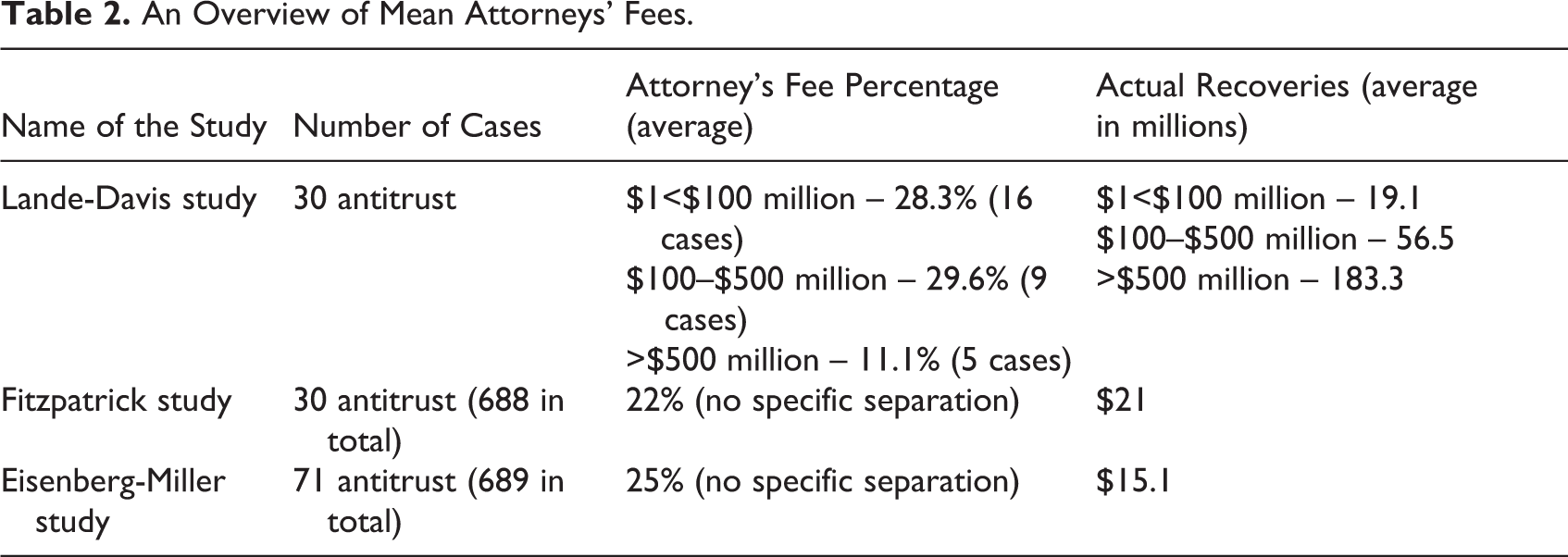
The first case is a study of Lande-Davis that was able to ascertain the attorney’s fee percentage in thirty cases. 138 Accordingly, in cases involving recoveries lower than $100 million, the courts awarded class counsel a percentage of the recovery that was between 30% and 33.3%, with two incidental exceptions generating 15% and 7%. For the recoveries between $100 million and $500 million, the awards ranged between 20% and 33.3%, with a mean of 29.5%. In cases over $500 million, the court awarded a much smaller percentage of the total settlement value, with a mean 11.1%. 139 The study did not provide the actual average recoveries by attorneys. But this average can be easily calculated, as all data necessary to make simple mathematical calculations are available. Thus, the mean actual recoveries are the following (respectively by the category): $19.1 million, $56.5 million, and $183.3 million.
The second study was done by Fitzpatrick, who calculated the attorney’s fees for all 2006–2007 federal class settlements. 140 He claimed that (only) 15% of the settlement amount (or $5 billion out of $33 billion) went to the plaintiff bar in fees and expenses. But the figure for antitrust class actions is different. First, the mean fees were much larger during the same period, with an average of 25%. 141 Second, antitrust attorneys are the best compensated among other subject areas, with a mean of $15.1 million per case. Even in securities cases—by far the most common class actions—the mean is $13.1 million, while lawyers in other fields obtain much lower compensation, varying from $0.11 million to $2.26 million. 142
The third study of Eisenberg-Miller collected data from class action settlements in both state and federal courts, found from court opinions published in the Westlaw and Lexis databases between 1993 and 2008. 143 The study, in essence, demonstrates similar results to the Fitzpatrick study. Eisenberg and Miller found that the amount of recovery was 22% in antitrust cases. According to the study, the antitrust attorneys were second best paid ($21.02 million) after the torts ($30.15 million). 144
2. The evaluation of attorney’s fees: Risk and reward
The results suggest that antitrust class counsels are one of the most if not the most well-paid practitioners among all legal fields. No study has yet managed to draw a line between overpayment and underpayment of attorneys. The above-mentioned data debates for the percentage of the total settlement. However, the inaccuracies of the percentage method are well illustrated in the Visa/MasterCard case, 145 where the class counsel received around $250 million in recovery, but the fee percentage was only 6.5. Even though this is one of the largest antitrust cases in history, it does not change the fact that large cases are fixed to overcompensate the class counsel. Consequently, this article argues that the counsel’s compensation should be assessed under two key criteria: (1) how much attorneys spend and (2) how much they obtain.
The existing empirical data does not provide the information needed to evaluate the total plaintiff’s costs in antitrust class actions. Finding this information is probably hindered due to confidentiality restraints encompassing the relationship between the attorney and the client. However, this does not mean that the potential costs cannot be observed. First, in In re Baby Products Antitrust Litigation, the Court approved the attorney’s total litigation expenses to the amount of $2.2 million, including the attorney’s fees, expert fees, and administration costs. 146 Second, defense attorneys report that average total costs for antitrust defendants range between $5 million and $10 million (even more in some cases). 147 As mentioned before, the plaintiff’s expenses are much lower than the defendants’ (largely due to broad discovery). Based on these observations, the following study will take into account the upper threshold of $5 million, which seem to fairly reflect the maximum size of plaintiff’s costs; larger amounts would equal the defendant’s expenses.
It should first be observed that engaging in class action litigation is a risky step that demands significant investment, both in terms of resources and time. Indeed, not every action is successful. No information is supplied about how often attorneys lose. However, the plaintiff bar usually reaps significant awards. In fact, it is very complicated to define the appropriate risk-to-reward ratio. One option would be to set a cap that prevents attorneys from receiving too much compensation, but, at the same time, this cap represents the counsel’s quality and ability to litigate antitrust case that involves substantial risk. The suggestion would be to limit the award that would be three times higher than the attorney’s costs. The idea arises from the antitrust rule of automatic trebling, which permits tripling the amount of the actual damages. To the same extent, the plaintiff’s counsel would be entitled to three times the costs she or he spent on litigation. It would allow a balance between risk and award: if the case is won, the class counsel may invest in two subsequent cases of the same magnitude. Therefore, a balance between costs and award would equal the ratio of 1:3, which could be regarded as a fair compensation presumption. For example, if the court approves the case costs of $2 million, the plaintiff’s lawyer should receive $6 million.
However, the current remuneration scheme fails to pass the compensation test. First of all, it should be observed that contingency fee payments on average range between $15 million and $75 million. 148 If the upper threshold of plaintiff’s expenditure ($5 million) is applied, the goal of fair compensation can be potentially fulfilled in the Eisenberg-Miller study ($5 million : $15 million). Yet it can occur only in exceptional cases, given that defense costs of $5 million are atypical. In the other two studies, the compensation ratios range from 1:4 to 1:15. Considering these results, it appears undeniable that the remuneration scheme is created to overpay attorneys. It is beyond the compensation rationale, because, as discussed before, class members are highly undercompensated. To sum up, it would be wrong to say that attorneys are largely overpaid, especially when they take cases that others are afraid of, but an element of overpayment has been identified.
C. Class Actions Do Not Compensate the Real Victims
When the settlement fund is distributed to the class members, either automatically or upon submission of claim forms, then victims receive compensation through a direct payment. However, there is a realistic possibility that settlement funds can be nondistributable or unclaimed by victims. First, a number of absent class members may not be able to be located, and a further distribution of award is impossible. 149 Second, even when their identities are known, it might be financially unfeasible to distribute awards to class members, because the case costs outweigh the individual awards. 150 Third, even where direct payments are feasible, absent class members may fail to submit claim forms. 151
Concerns surrounding these problems led U.S. courts to introduce the cy pres mechanism that is used to compensate victims indirectly. Under this scheme, the unclaimed awards are disbursed to cy pres recipients (usually to a charity) whose activities relate “as near as possible” to the interests of absent class members. 152 While this solution sounds laudable in theory, the cy pres remedy is subject to much criticism in practice.
The first criticism is that cy pres distribution fails to serve the interests of the absent class members: the courts approve the distribution of unclaimed funds to cy pres recipients that bear little relationship with class members who were directly injured by the violation. 153 For example, in In re Motorsports Merchandise Antitrust Litigation, 154 a class action suit was brought by NASCAR fans alleging the price-fixing infringement by vendors of merchandise sold at NASCAR races. The court approved a cy pres distribution to nine charitable organizations, including the Lawyers Foundation of Georgia and the American Red Cross, which had no tangible relationship with the absent class members. 155 In another antitrust case concerning a price-fixing conspiracy in the modeling industry, the district court approved a cy pres distribution to charities with a focus on women’s issues, yet only around 60% of the class members were women. 156
The second criticism is that cy pres distributions create a conflict of interest between the class counsel and the absent class members. The class counsel’s fee is typically calculated as a percentage of the entire class award,
157
so he or she will be paid the same regardless of whether the funds go to class members or to a cy pres charity. All the problems encountered are best illustrated in a widely publicized cy pres distribution in In re Baby Products Antitrust Litigation.
158
The district court approved the settlement of the claims for $35.5 million, under which the class members who submitted a valid proof of purchase would receive 20% of the actual purchase price, and the ones who did not would receive only $5.
159
The settlement agreement was appealed, because it turned out that most class members failed to submit proof of purchase and therefore would receive $5 each (generating approximately $3 million), while around $14 million would be paid for attorney’s fees and approximately $18.5 million was reserved for cy pres recipients.
160
In turn, the Third Circuit Court of Appeals vacated the lower court’s decision. More specifically, the Court confirmed the issue of the potential for conflict between the counsel and class members in cy pres distributions: “Cy pres distributions also present a potential conflict of interest between class counsel and their clients because the inclusion of a cy pres distribution may increase a settlement fund, and with it attorneys’ fees, without increasing the direct benefit to the class.”
161
“[T]he current distribution of settlement funds arguably overcompensates class counsel at the expense of the class.”
162
Thus, Baby Products is the best illustration of how the cy pres distribution can bring great rewards to the class counsel, but many class members remain largely undercompensated. Another undesirable class action settlement chosen by critics (although not concerning antitrust) is Lane v. Facebook Inc., 163 in which class members received no compensation at all. The lawyers representing the class received about $3 million, and $6.5 million of the funds were reserved for cy pres recipient(s). 164 There was no effort made to pay even a portion of the settlement fund to the absent class members. The most noteworthy criticism this decision attracted was that the cy pres award went to set up a new charity (Digital Trust Foundation). 165 Ironically enough, Facebook’s director of public policy was one of three directors who ran the foundation, and Facebook’s attorney, together with class counsel, made up the Board of Legal Advisors. The settlement was affirmed by the Ninth Circuit, but not without controversy. Another anecdotal example is Diamond Chemical Co. v. Akzo Nobel Chemicals, B. V., 166 in which the court approved a cy pres award to create the Center for Competition Law at the George Washington Law School. The proposal was made by class counsel, an alumnus of the law school, who was later nominated by the law school as a result of the cy pres award. 167
These cases clearly demonstrate that abusive cy pres awards occur in practice. However, critics routinely point to cases that attracted much reproach, but they remain silent as to whether frivolous cy pres awards occur in a high proportion of cases and whether they are typical. Thus, the proponents of class actions correctly note that if the figure is only true in 5% of the cases, the critics are overstating the issue. 168 This controversy can be assessed by establishing the presumption of failure, yet this approach requires reliance on some assumptions. First, it should be accepted that cy pres distributions would never be ideal. Second, fraudulent cy pres awards should be prevented from occurring more often than in incidental cases. Therefore, it seems feasible to establish a 20% failure cap (out of ten, more than two cy pres settlements are frivolous). While the one-tenth proportional failure seems to be the norm under the nonenforcement of unjust laws, another one-tenth can be justified due to the complexity in relating the nature of antitrust infringement to the activities of the cy pres charity. To sum up, the abusive cy pres awards are confirmed under two conditions: first, the cy pres entity is created solely for the benefit of the class counsel rather than for the benefit of class members; second, the money is distributed to a charity that is unrelated to the injured class members. Under such circumstances, the criticism is confirmed if one or another or both abuses occur in more than 20% antitrust cy pres cases.
In order to assess the controversy, the study of Redish and two others (Redish study) should be discussed further. 169 The study found that federal courts granted or approved cy pres settlements in thirty-five cases between 2001 and 2008, and that sixteen settlements can be regarded as faux class actions. 170 Under these type of distributions, the cy pres measure is primarily used for the benefit of the class counsel rather than the absent claimants. Under such circumstances, there is no intention to compensate the absent class members. However, it is not defined whether there is a direct correlation with the unrelated cy pres entity, yet it does not change the fact that attorneys were overpaid in sixteen (45%) cy pres settlements at the expense of the class. Under the failure test, the abuse numbers should be even higher. In some cases, the class counsel may be not overcompensated, but settlement funds may be distributed to unrelated charities.
However, there is no possibility to draw definite evidence-based conclusions from this study alone. It does gives a preliminary benchmark that at least one-fourth (four cases out of sixteen) of fraudulent distributions relate to antitrust settlements between 2001 and 2008: In re Airline Comm’n Antitrust Litig, 171 ; In re Motorsports Merch. Antitrust Litig, 172 In re Compact Disc Minimum Advertised Price Antitrust Litigation, 173 and Diamond Chemical Co. v. Akzo Nobel Chemicals, B. V. 174 However, as far as I am aware, prior empirical studies (including the Redish study) have not examined how many antitrust cy pres settlements there were between 2001 and 2008. Such analysis would allow for a comparison of the overall numbers with fraudulent actions. Despite the absence of key data, it can be argued that there is a high potential for frivolous actions to occur in more than 20% of antitrust cases. This is notable because antitrust distributions cover the largest portion of announced frivolous settlements, showing that a wide nature of antitrust overcharge is predetermined to attract the most abuse when settlements take the cy pres form.
D. Synopsis
For the purposes of this analysis, the presumptions of success and failure have been presented. Following this approach, each criticism has been approved to a greater or lesser degree, and they are broadly consistent with each other. First, applying the 40% success presumption of the actual compensation rate in automatic distribution cases, it was determined that antitrust class actions largely fail to provide actual compensation for at least 40% of class members. In claims made settlements, the 25% success presumption also failed, because the mean rates range between 1% and 15%. Second, the compensation mechanism is programmed to overpay antitrust class counsel. After the assessment of the risk-to-reward ratio, it was found that attorneys obtain disproportionately high rewards. However, large overpayments were denied due the high risk ratio. Third, among all subject areas the frivolous cy pres distributions are most often announced in antitrust cases. It therefore means that there is a high possibility that frivolous actions occur in more than 20% of cases. To sum up, the compensation goal in antitrust collective litigation fails to a large extent.
III. A Controversy of Deterrence
Even if it may sound paradoxical, the failure of the compensatory objective can be justified. Those who believe in economic efficiency argue that the real goal of small-stakes class actions is to maximize deterrence. 175 The class action device furthers deterrence by aggregating small claims that are too little to pursue individually. If the suit aggregates claims that might not have otherwise been brought, the infringer is confronted with the ensured collective litigation and, hence, with the increased magnitude of the liability. This, in turn, forces defendants to internalize more of the negative effects caused by the anticompetitive behavior, thereby pushing deterrence closer to the optimal level. Furthermore, where a large number of victims are automatically included in the class, the collective action alerts the society about the real value of the harm that is actually caused by the wrongdoer. Finally, by aggregating small-stakes claims, the class can “exploit the same scale economies as the defendant.” 176
The same rationale applies to the cy pres remedy, whereas absent class members usually receive no direct benefit from settlements. By distributing the funds to charities, the courts ignore the objective of compensating direct victims. Indeed, the principal purpose is to punish the wrongdoer and therefore to facilitate the deterrence objective: “[t]here is no indirect benefit to the class from the defendant’s giving the money to someone else. In such a case the ‘cy pres’ remedy…is purely putative.” 177 Put more generally, cy pres relief is desirable to force the internalization of illegal gains from the violation.
Some studies have questioned the effectiveness of class action litigation as a means of strengthening the deterrence of U.S. antitrust rules. 178 It is simply considered as an insufficient device to achieve deterrence. If this conclusion is true, and given the failure of the compensation, class actions would benefit only the plaintiff bar and thus would be hard to justify. The proponents of class actions, again, deny the critics’ assertions. In order to appreciate the controversy, the effectiveness of deterrence is further discussed by weighing both sides in the class action wars. A comparative overview is highlighted in Table 3 and further discussed in this section.
A Comparative Overview of Deterrence Debate Points.

A. Low Deterrence Value
The core element of the class action lawsuit is the seeking of class certification. Due to the defendants’ aggressive defense, antitrust class actions may reach the certification stage and be denied on the basis of failing to meet the requirements under Rule 23. Most importantly, the courts utilize strict evidentiary standards for the class certification in antitrust cases. In the In Re Hydrogen Peroxide Antitrust Litigation, 179 the 3rd Circuit established that the class certification requires “rigorous analysis” of factual and legal evidence. 180 This examination extends to assessing the testimony of both defendant’s and plaintiffs’ experts. 181 In addition, the standards for meeting the requirements under Rule 23 must be met by a “preponderance” of evidence, rather than by a mere “threshold showing.” 182 Therefore, there is a high chance that defendants may succeed in opposing the class certification. In such case, the class action rule serves no use. As mentioned before, if a court certifies a class action, the large majority of class action lawsuits are settled; very few certified class actions proceed to trial. Consequently, treble damages are typically removed from the negotiation process and, after all, defendants admit no liability for having violated antitrust laws. From this issue flows another concern: that the private attorney general mechanism is not the right tool to facilitate deterrence. Lawyers make huge investments in antitrust cases and are thus the ones who decide when and whether to settle the case. 183 The individual damages caused by antitrust wrongdoers are typically very small, so few if any class members have an incentive to monitor the settlement negotiations. As a consequence, defendants are satisfied to “buy off” the attorney in exchange for a favorable settlement agreement. 184 The opposite may also be true: the class counsel may coerce defendants to go into settlements out of fear, regardless of whether the claim has merit or not. 185 Thus, the settled class action lawsuits undercut the deterrence of class litigation. From a cartel perspective, a majority of class actions follow successful government actions. 186 Consequently, private attorneys use the efforts of public enforcers for their own benefit, for example, by reducing their own costs in expensive fact discovery proceedings. 187 According to this view, private actions are unable to cure public shortcomings like, for example, a low detection rate.
Another critical argument is that corporate managers (who should be foremost affected) are not deterred by private litigation. First, the time period between the beginnings of anticompetitive behavior until the judgment is considered the important deterrence criteria against corporate managers. In a typical antitrust case, the period may last from at least five years to more than ten years. 188 It is highly unlikely that corporate managers and midlevel executives will still hold their positions at the time of the judgment. 189 In case of settlement cases, the early deterrent impact is also improbable, because, even if the day of judgment is speeded up, the average time from the planning of anticompetitive conduct to any settlement payout is still more than five years. 190 Second, corporate managers are unlikely to internalize the wrongdoing immediately after launching the antitrust claim. As mentioned before, empirical studies showed that government antitrust actions reduce the share value by 6% on average, and filling a private lawsuit by around 0.6%. 191 Thus, “[a] half-percent drop in market capitalization” is highly unlikely to cause negative impacts on corporate managers. 192
B. High Deterrence Value
While significant obstacles exist, proponents of class actions continue to claim that private antitrust enforcement provides meaningful deterrence. First and foremost, the supporters criticize theory-based assessments, which are more anecdotal than empirically based. 193 The counterargument is supported by the empirical analysis. A comprehensive study on forty successful antitrust class actions found that private recoveries are substantial enough to have significant deterrence power. 194 Although the study attracted widespread attention on both sides of the Atlantic, 195 it was also the subject of much criticism. 196 In order to reinforce the results, the authors performed a supplemental study of twenty antitrust cases. 197 After the assessment of the total recoveries in sixty private cases through 1990–2011, the authors made the powerful claim that private antitrust enforcement probably deters more than the anticartel program of the DOJ Antitrust Division. 198 In a comparative context, it was found that victims received substantial compensation ranging from $33.8 billion to $35.8 billion, which is far higher than the combined DOJ criminal sanctions (corporate fines, individual fines, and criminal fines) totaling $11.7 billion, 199 or $15.4 billion if the deterrent value of a prison sentence is increased. 200 Another study of over 100 international cartels prosecuted between 1990 and 2008 found similar results: a total of $29 billion in announced private settlements and $7.6 billion for international cartel fines collected by the DOJ. 201 Contradicting to the critics’ claim that class action litigation is usually preceded by government actions, the study revealed that out of sixty cases, twenty-four were not preceded by public enforcement, and a further twelve had a different background than government actions. 202 Furthermore, in the first study, only ten of forty private cases were follow-ons to DOJ enforcement efforts, and sixteen were discovered by private parties. 203 This figure, as authors observed, is consistent with another study, which found that only 20% of private cases were follow-on cases. 204 It may suggest that private cartel enforcement precedes public enforcement as well. Therefore, the threat of private enforcement might even coerce wrongdoers to confess to the DOJ through the leniency program. 205
Furthermore, the proponents assert that critics misrepresent the actual time lags. The most important determinant is the time from the latest cartel manager’s decision to continue cartel until judgement. To that extent, the data suggests that the applicable range is less than four years. 206 From the perspective of the defendant’s stock value, it is asserted that private antitrust actions have a far higher impact than is originally envisaged. Although the filing of private antitrust lawsuits reduces the value of defendant’s shares on average by 0.6%, the total 6.6% stock drop is mainly associated with the inevitable private litigation following the government action. 207 This is notable because the anticipated private sanctions are four times as costly as sanctions from public enforcers. There is also a claim that an average stock drop of 0.6% is surprisingly high, given that government action is typically followed by private litigation. 208
C. The Effectiveness of Deterrence: A Study of Optimal Deterrence
There is no common standard of how to estimate the effectiveness of deterrence. This phenomenon is interpreted differently by both sides. Critics argue that the complicated certification procedure and the successive inevitable settlement diminish any deterrence value of class actions. Proponents customize the criteria of significant financial value of settlements. To give an additional flavor to this debate, the impact of class actions upon the standards known to the optimal deterrence theory is further examined. Under this theory, the total amount of the sanctions should be equal to the infringement’s anticipated “net harm to others,” 209 divided by the multiplication of probability of detection and proof of the infringement. 210 The representative equation of the optimal deterrence theory is the following:

The generally accepted view is that cartel managers behave as rational actors who conduct a cost-benefit analysis in order to see the magnitude of a likely penalty and the probability of being detected. 211 If the sanction is optimal, antitrust violators should be deterred, because the expected costs outweigh the expected benefits of the anticompetitive conduct. But, in order to define the optimal sanction, the multiplier should be set for the combined rate of detection and subsequent successful conviction. The most feasible multiplier appears to be 1/3. 212 This proportion comes from the fact that potentially 1/3 of all cartels (under the most optimistic scenario) are detected. 213 When this multiplier is applied in the equation of optimal deterrence, the optimal penalty equals three times of the ‘net harm to others’.
Under the antitrust model, there are at least three interrelated components that enhance deterrence: corporate fines, personal fines and damages claims. But despite the risk of being punished through the different layers of the enforcement mechanism, there is no indication that the optimal deterrence has been achieved. 214 This is reinforced by the fact that wrongdoers ‘tend to be recidivists.’ 215 The major question is whether antitrust collective litigation pushes deterrence closer to an optimal level. Another important question is how corporations respond to the threat of litigation in small-stakes class actions. Indeed, the magnitude of the increase in deterrence depends upon the likelihood of antitrust class actions increasing the probability of cartel detection and conviction. Another factor is estimating how the total damages of class action lawsuits may correspond with the ‘net harm to others’. Each of the element will be discussed in turn.
To start with, it should be stressed that private actions that follow after government actions have little or no effect on detection. By contrast, stand-alone actions have much higher impact on the probability of detection. According to the studies of Connor and Lande-Davis mentioned above, a large share (40%-50%) of private cartel cases are stand-alone lawsuits, while follow-on cases are only around 20%-30%. Relying on this data, it can be claimed that private enforcement has a potential of substituting actions of private enforcers. However, this potential applies only to certain circumstances. According to attorneys, only around 10% of potential class actions are brought by law firms. 216 Therefore, private attorneys take low risk cases, while a majority of cases remain unprosecuted. This is not to deny the reality that public enforcers also take low-risk cases, as many cases are detected and prosecuted after the leniency program. But this mechanism is the main concern for rational infringers that cartel violations may be detected.
There is always a potential that a whistleblower (a co-infringer) will report violations to antitrust authorities. In addition, public enforcers have the enforcement resources that private enforcers lack: grand juries, lawyers specialized in cartel enforcement, and the support of the Federal Bureau of Investigation. 217 It then follows that government actors are able to create a considerable threat at the time when rational actors perform their cost-benefit analysis. Notably, the personal sanctions (criminal fines and jail sentences) against cartel managers foremost depend on how active the DOJ criminal enforcement is. Therefore, the strength of public enforcement is the most important element affecting rational actors’ behavior. To that regard, stand-alone actions of private enforcers serve only an auxiliary function to cartel detection.
With regard to the probability of conviction, it mainly relates to the possibility of class actions to be certified. Even if the lawsuit is brought, its chances to survive through the certification stage is far less than 100%. During the last years, judges have become more reluctant to certify antitrust class actions. 218 But if the class action is certified, the probability of conviction is 100% or very close to that proportion, since a vast a majority of class actions are settled.
Another point regards the impact of class actions on the ‘net harm to others’. The standard calculation of the ‘net harm to others’ encompasses cartel overcharges and the allocative inefficiency. 219 The potential impact of class actions may include two elements in the context of the ‘net harm to others’, which is the expected cost of litigation and the final damages after settling. As regards the first element, the expected costs to oppose class certification, or lead the case after the certification may be valued in millions (largely due to expensive discovery procedures). According to the empirical data, the average time to settlement is around 3.3 years. 220 It might demand very high litigation expenses, with the possibility to consume up to $10 million or more out of the defendant’s pocket. 221 If a class is certified, the following response is to estimate the expected price of settlement. Even if trebled damages are typically waived in the settlement agreement, it is wrong to assume that the potential value of trebling is excluded in the settlement negotiation process. At its core, automatic trebling creates a good bargaining position for the plaintiff. The further assessment of deterrence weighs the components in Table 3 by assessing a rational actor’s position.
Certification: Given the complicated nature of certification, it is the primary element that rational agents weigh when conducting a cost-benefit analysis. Another point is to assess the judges’ reluctance to proceed with certain types of antitrust litigation. Only then may the rational agents assess the potential risks from settlement.
Settlement: Rational players must have forethought to the probability of conviction being almost 100% when the case is certified, because they will seek settlement, i.e. a lenient form of conviction. In turn, settled actions have a larger potential to internalize the damages caused due to far higher awards than government actions.
Trebling: Trebling is very important in negotiating terms of the settlement. However, the impact on the magnitude of a likely penalty is significantly reduced due to the fact that cases usually settle for amounts that are more close to actual damages than treble damages. Therefore, there is little probability that rational players calculate their illegal behavior on the basis of the potential value of trebling, because it is very rarely applied in practice.
Liability: Defendants admit wrongdoing in settlements, but they usually admit no liability (moral or legal). Thus, there is no effect on a rational actors’ behavior when they assess the costs and benefits of the infringement. In some cases, for example in cy pres settlements, the defendants may receive positive public response due to the significant ‘donation’ to charities. 222
The relationship between two enforcement modes: Both enforcement methods take the less risky cases that have a relatively large chance of success. Yet, public enforcement, with its wide investigation tools, is better suited to detect wrongdoings than private enforcement. At the same time, private enforcement (especially class action lawsuits) is a more effective tool to increase the significance of liability when the case is certified.
Cartel managers: The managers foremost engage in a personal cost/benefit analysis of the probability of facing criminal or monetary sanctions. The data suggests that around 69% of individuals are convicted in DOJ proceedings. 223 Furthermore, there is an existing fear that some corporations might prefer prison sentences for their own executives rather than giving significant payouts in private litigation. Thus, the time lags of infringements are not so valuable under optimal deterrence theory, because a criminal conviction can follow the manager even if he or she no longer holds the same position in the corporation.
Stock prices: The total 6.6% drop in share value is an aggregate of both enforcement modes. The simple model suggests that stock prices are driven by expectations 224 , thereby suggesting that the anticipated private litigation may have immediate effects on deterrence. In this respect, it must be borne in mind that the actual drop of share value by filing a private suit should be higher than 0.6%, but there is no reliable method to determine the exact impact (proportions) on stock prices.
Based on these conclusions, one could argue that class action litigation extends the deterrence objective through the prism of optimal deterrence. It is probably true that government actors have more tools and resources than private litigators to increase the probability of detection. However, it is equally true that private litigation is more efficient in increasing the magnitude of a monetary penalty. This is because a class action lawsuit has the ability to aggregate the negative expected value claims, sometimes totaling in millions of class members. Even if these claims are low individually, the anticipated aggregate value may push the wrongdoer to internalize the cost of the harm caused closer to the optimal level. In fact, there is no other tool that could impose the same high monetary value.
Hence, it undeniably appears that achieving optimal deterrence would fail if private litigation, and class actions especially, were not included in the scheme together with the other two indispensable elements of deterrence: corporate fines and personal fines. Despite having a high potential to extend the monetary liability, class action litigation faces crucial obstacles. First, the complicated certification procedure reduces the probability of conviction. If the class is certified, the case is typically settled for amounts closer to actual damages rather than treble damages. As shown before, low settlement values provide low proportional recovery to an insignificant number of victims, meaning that wrongdoers internalize a low cost for the harm caused. As a consequence, class action litigation is not so efficient in increasing the level of the ‘net harm to others’ as it may seem from the first blush.
When compared with other two elements, class actions only serve a secondary function in achieving the objective of optimal deterrence. The crucial point is that government enforcement deter rational offenders even before they engage in anticompetitive conduct, while private remedies are rather assessed when the investigation is started or the action is brought to the court. This is because damages actions are subject to many restrictions, while public enforcement is reinforced by the possibilities of employing extensive investigatory tools. In addition, criminal prosecution of cartel managers primarily depends on how effective public enforcement is. Thus, it is perhaps overly optimistic to claim that ‘private antitrust enforcement probably deters more anti-competitive conduct than the US Department of Justice’s anti-cartel program’ 225 . For private remedies to serve a better deterrent function, and potentially the equal deterrent function as public enforcement, some amendments are needed. In order to increase the rate of detection, private enforcers should be provided with additional incentives. One option may be that public enforcers would provide investigatory support when a stand-alone action is brought. Another option is to allow a more lenient approach in certifying antitrust class actions. 226 In order to increase the total fine of collective litigation, the settlement awards may be capped for higher than actual award (for example, requiring to settle for double damages). Hence, it may force the wrongdoer to internalize the higher cost of the harm caused.
However, this hypothetical scenario cannot be implemented in practice. First, state investigatory powers will need to support private actions financially and in terms of resources. There is no reasonable justification for this amendment, since government enforcers lack resources for prosecuting all potential actions of their own. Second, a robust policy on certification has become a central safeguard against abusive litigation. Hence, relaxing certification may exacerbate ‘blackmail settlement’. Third, capping settlement would jeopardize the free will of the parties to decide on the final outcome of the case.
Even if we suppose that this hypothetical scenario was implemented, it would not ensure optimal deterrence. One issue is that there the combined rate of detection and prosecution (the multiplier) will be enhanced, but this increase should be minimal, and not a ‘game changer’. First, there is no guarantee that each class will be certified and that each case will collect sufficient evidence for proving damages. Second, capped settlements may have dissuasive effects for plaintiffs, since defendants may be more reluctant to settle in some cases, either before or after certification. This is because the ultimate damages may not differ much from treble damages, for example, if double damages were set. In fact, capped settlements may reduce plaintiffs’ incentives to sue in cases where early settlements would not be predicted. In such circumstances, the 1/3 multiplier could be improved only minimally. Another point is that capped settlements would not ensure the penalty, which would correspond to the required level of fines: around triple net harm to others. Under the most optimistic scenario, it can be assumed that double damages will be awarded to class members. After the deduction of case-related costs (contingency fees, administrative and expert fees), there is a possibility that class members will receive high proportional awards, or even full awards in some cases. However, this level is far away from the optimal penalty, which would require to award at least three times of ‘net harm to others’.
In conclusion, it should be stressed that the debate over optimal deterrence theory mainly regards cartel infringements. However, it does not mean that the private attorney general serves the same deterrent effects in other type of infringements, for example in case of monopolization. The fact that at least 90 percent of all federal antitrust cases are private actions is of crucial importance. It therefore suggests that private attorneys general bring much needed deterrence to antitrust enforcement, especially when public enforcers have neither the time nor the resources to prosecute all anticompetitive conduct. However, another viewpoint is that the effectiveness of cartel prosecution is the most important determinant factor in assessing the deterrence model. Indeed, hard-core cartels require much more attention due to their covert nature. If the probability of detection is low, such a system cannot be considered to provide much deterrence. To sum up, the effective anti-cartel deterrence system should be a function of three equal components acting together – competition authorities’ fines, private (class action) damages claims and personal fines. Under the current scheme, however, the private antitrust remedies are framed to serve only a secondary function.
Conclusion
The primary goal of this chapter has been to determine whether antitrust private enforcement, and more specifically class actions, accomplish the stated goals of compensation and deterrence. In order to assess the compensatory effectiveness, this chapter has presented the success and failure presumptions. By applying the actual compensation rate of 40% in automatic distribution settlements and a 25% claiming rate in claims-made settlements, it was found that antitrust class actions fail to pass the defined threshold in small-stakes class actions. More importantly, the class action device is determined to provide very low proportional compensation to an insignificant number of antitrust victims. This is notable due to the unique nature of antitrust litigation: widespread overcharge, significant administrative fees, expensive counterfactual assessments and low settlement awards. Another criticism of attorneys’ overpayment has also been confirmed. Despite of class members remaining largely undercompensated, the class counsel usually reaps significant rewards without any connection to the (lack of) success of the distribution. It was argued that amounts higher than three times that of the expenditure costs can be already considered as overpayment. Consequently, the empirical data proved that the class counsel typically receives higher proportional compensation, which sometimes can even be a tens of times higher compensation than the expenditure. In order to appreciate the cy pres controversy, the 20% failure presumption has been set; that is, if more than two out of ten cy pres settlements are frivolous. Because of the limited data available, there was no attempt to draw definite conclusions. However, it was found that dubious cy pres distributions often occur in antitrust cases, suggesting that a majority of antitrust distributions attract dubious actions.
A crucial point in this respect is that the failure of the compensation goal accelerates the expansion of deterrence through private attorney general actions. Given that the aggregation of a large group of victims is allowed without a particular objective to provide effective compensation, and while the disproportionately high payment is reserved for the antitrust plaintiff bar, private attorneys have sufficient incentives to enforce antitrust rules aggressively. In order to arrive at this conclusion, the chapter assessed the elements of controversy through the optimal deterrence theory. It was found that the DOJ enforcement has more effect on the probability of detection, but the class action litigation scores higher points in maximizing the monetary penalty. However, the full effect of deterrence is diminished due to the following factors. First, the courts are reluctant to certify antitrust class actions. Second, cases are settled for amounts closer to the actual damages rather than treble damages. Third, class members receive much less than actual damages, meaning that the infringers internalize only low costs from the harm caused. Due to these obstacles, class action litigation does not deter rational actors during or before the antitrust violation; it has an effect only when the investigation is started. While the optimal deterrence should be a function of three equal components acting together—corporate fines, personal sanction and damages actions—the current scheme only allows for private litigation to serve a secondary function. However, even if private remedies were enhanced by additional support from public enforcers, by relaxing rules on certification and by capping settlements for higher than actual awards, optimal deterrence would not be achieved. It is highly questionable whether attorneys would bring more cases under the proposed model, as capping settlements may bring dissuasive effective for attorneys’ incentives to sue. Therefore, the multiplier of 1/3 in detecting and convicting cartels would remain similar. Another viewpoint is that capped settlements would potentially ensure full award for class member, but this value is much lower than the optimal penalty, which necessitates awarding the damages as high as three times of the ‘net harm to others’.
The legal issues and conclusions debated in this chapter should be of particular relevance not only for the United States, but also for the European Union. The underdevelopment of private antitrust enforcement has led the EU to facilitate damages actions by adopting the Directive on antitrust damages actions. 227 Critically, only the Recommendation—a non-binding document—was proposed to facilitate collective actions. However, a binding measure is expected in the near future. The achievement of objectives in the EU private antitrust enforcement is very complicated, since the Directive enshrined the principle of full compensation, and deterrence can only be seen as a side effect. But the US example has shown that the effectiveness in compensating victims cannot be achieved if there is no strong deterrence. Simply, private attorneys would not be incentivized to bring class actions.
Footnotes
Author’s Note
The author is grateful to Prof. Steven J. Cernak and Prof. Daniel A. Crane for very helpful research assistance. All opinions in this article, however, are solely those of the author.
Declaration of Conflicting Interests
The author(s) declared no potential conflicts of interest with respect to the research, authorship, and/or publication of this article.
Funding
The author(s) disclosed receipt of the following financial support for the research, authorship, and/or publication of this article: The author was granted the EU Fulbright Schuman scholarship for conducting research at Stanford University and the University of Michigan during the academic year 2015-2016. The research was jointly financed by the U.S. State Department and the Directorate-General for Education and Culture of the European Commission. Therefore, this article is based on the study performed in the United States.