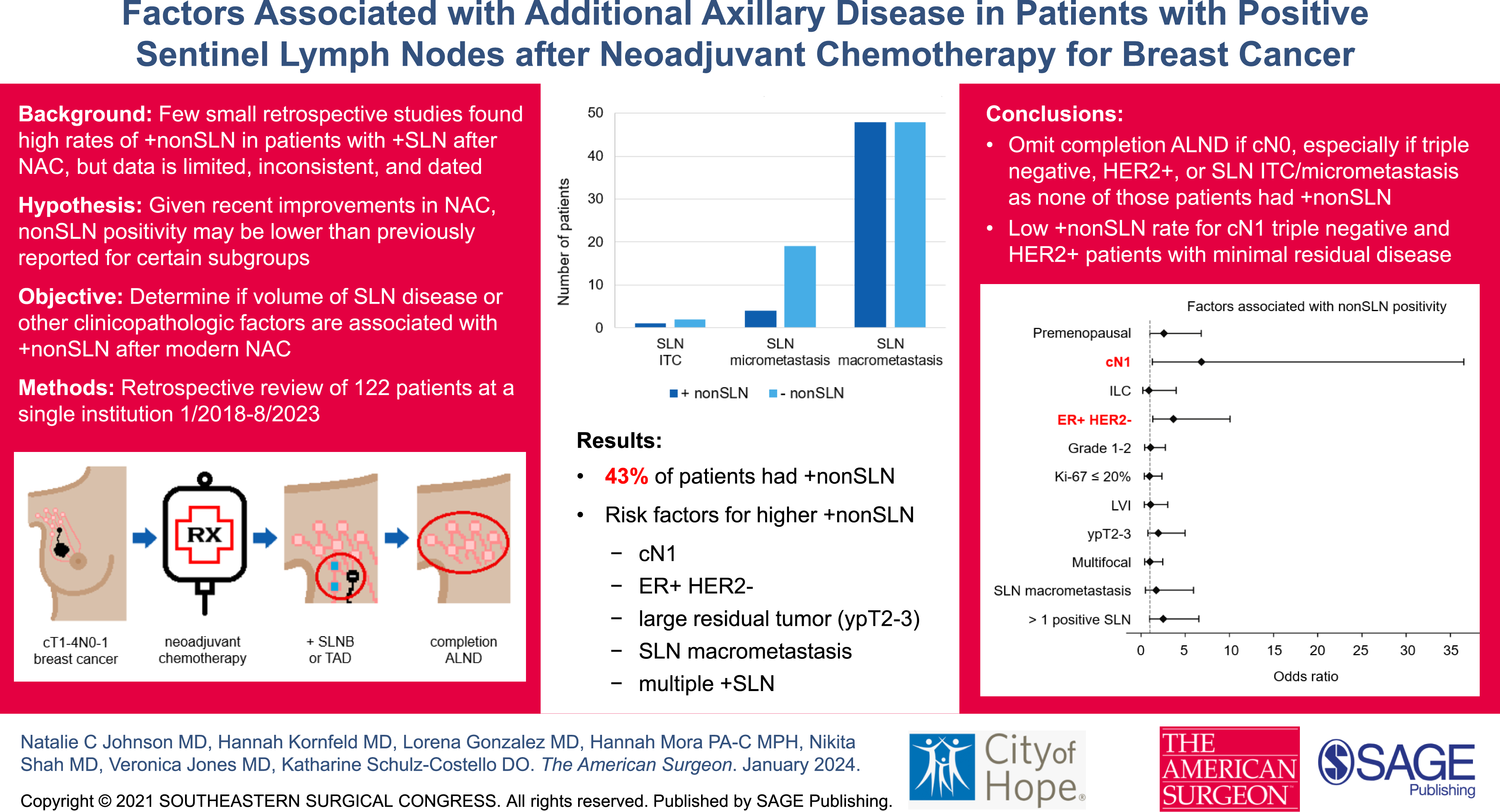
Background: In previous studies, breast cancer patients with positive sentinel lymph node(s) (SLN) after neoadjuvant chemotherapy (NAC) frequently had additional nonSLN involvement. Per guidelines, residual SLN disease warrants completion axillary lymph node dissection (cALND), which has increased morbidity. Given recent improvements in NAC, we hypothesized that nonSLN positivity may be lower than previously reported for certain subgroups.
Methods: We retrospectively reviewed breast cancer patients who received NAC and had positive lymph nodes on SLN biopsy or targeted axillary dissection and underwent cALND at one institution in 1/2018-8/2023. Associations between nonSLN positivity and clinicopathologic factors were assessed with Fisher’s exact test and multivariable logistic regression.
Results: There were 122 female patients. Median age was 48 years. Initially, 15 patients (12.3%) were cN0 and 107 patients (87.7%) were cN1. Largest SLN deposit was macrometastasis in 96 patients (78.7%), micrometastasis in 23 patients (18.9%), and isolated tumor cells in 3 patients (2.5%). Overall, 53 patients (43.4%) had nonSLN involvement. NonSLN positivity was higher in patients with cN1, ER+ HER2-, ypT2-3, SLN macrometastasis, and multiple positive SLN. On multivariable analysis, cN1 and ER+ HER2- remained associated with nonSLN positivity.
Discussion: Among patients with positive SLN after NAC, clinically node positive and ER+ HER2- patients were more likely to have nonSLN involvement. Our findings support guidelines to consider omitting cALND in clinically node negative patients. With improving NAC, optimal axillary sampling, and radiation, omitting cALND may be safe in some clinically node positive triple negative or HER2+ patients with low volume residual disease, but further research is needed.
National Comprehensive Cancer Network. NCCN Clinical Practice Guidelines in Oncology: Breast Cancer, Version 5.2023. Plymouth, MA: National Comprehensive Cancer Network. https://www.nccn.org/professionals/physician_gls/pdf/breast.pdf. Updated December 5, 2023. Accessed December 29, 2023.
2.
RyuJMLeeSKKimJY, et al.Predictive factors for nonsentinel lymph node metastasis in patients with positive sentinel lymph nodes after neoadjuvant chemotherapy: nomogram for predicting nonsentinel lymph node metastasis. Clin Breast Cancer. 2017;17(7):550-558.
3.
SandersSBHoskinTLStaffordAPBougheyJC. Factors influencing non-sentinel lymph node involvement in patients with positive sentinel lymph node(s) after neoadjuvant chemotherapy for breast cancer. Ann Surg Oncol. 2022;29(12):7769-7778.
4.
LeonardiMCArrobbioCGandiniS, et al.Predictors of positive axillary non-sentinel lymph nodes in breast cancer patients with positive sentinel lymph node biopsy after neoadjuvant systemic therapy. Radiother Oncol. 2021;163:128-135.
5.
JerussJSNewmanLAAyersGD, et al.Factors predicting additional disease in the axilla in patients with positive sentinel lymph nodes after neoadjuvant chemotherapy. Cancer. 2008;112(12):2646-2654.
6.
ChunJWKimJChungIY, et al.Non-sentinel node metastasis prediction during surgery in breast cancer patients with one to three positive sentinel node(s) following neoadjuvant chemotherapy. Sci Rep. 2023;13(1):4480.
7.
LiedtkeCGörlichDBauerfeindI, et al.Validation of a nomogram predicting non-sentinel lymph node metastases among patients with breast cancer after primary systemic therapy - a transsentina substudy. Breast Care (Basel). 2018;13(6):440-446.
8.
MooTAEdelweissMHajiyevaS, et al.Is low-volume disease in the sentinel node after neoadjuvant chemotherapy an indication for axillary dissection?Ann Surg Oncol. 2018;25(6):1488-1494.
9.
CserniGGregoriDMerlettiF, et al.Meta-analysis of non-sentinel node metastases associated with micrometastatic sentinel nodes in breast cancer. Br J Surg. 2004;91(10):1245-1252.
10.
KumarSBramlageMJacksLM, et al.Minimal disease in the sentinel lymph node: how to best measure sentinel node micrometastases to predict risk of additional non-sentinel lymph node disease. Ann Surg Oncol. 2010;17(11):2909-2919.
11.
GiulianoAEBallmanKVMcCallL, et al.Effect of axillary dissection vs no axillary dissection on 10-year overall survival among women with invasive breast cancer and sentinel node metastasis: the ACOSOG Z0011 (alliance) randomized clinical trial. JAMA. 2017;318(10):918-926.
12.
BartelsSALDonkerMPoncetC, et al.Radiotherapy or surgery of the axilla after a positive sentinel node in breast cancer: 10-year results of the randomized controlled EORTC 10981-22023 AMAROS trial. J Clin Oncol. 2023;41(12):2159-2165.
13.
AkayCLAlbarracinCTorstensonT, et al.Factors impacting the accuracy of intra-operative evaluation of sentinel lymph nodes in breast cancer. Breast J. 2018;24(1):28-34.
14.
Klauber-DeMoreNOllilaDWMooreDT, et al.Size of residual lymph node metastasis after neoadjuvant chemotherapy in locally advanced breast cancer patients is prognostic. Ann Surg Oncol. 2006;13(5):685-691.
15.
WongSMAlmanaNChoiJ, et al.Prognostic significance of residual axillary nodal micrometastases and isolated tumor cells after neoadjuvant chemotherapy for breast cancer. Ann Surg Oncol. 2019;26(11):3502-3509.
16.
Mailhot VegaRDeladismaAMMobleyEM, et al.Axillary surgery efficacy for patients with breast cancer receiving neoadjuvant chemotherapy on NSABP B40 and B41. J Clin Oncol. 2023;41(16_suppl):524.
17.
Alliance for Clinical Trials in Oncology. Comparison of axillary lymph node dissection with axillary radiation for patients with node-positive breast cancer treated with chemotherapy. ClinicalTrials.gov identifier: NCT01901094. https://clinicaltrials.gov/study/NCT01901094. Updated May 3, 2023. Accessed January 3, 2023.
18.
ZhangKZhuQShengDLiJChangC. A new model incorporating axillary ultrasound after neoadjuvant chemotherapy to predict non-sentinel lymph node metastasis in invasive breast cancer. Cancer Manag Res. 2020;12:965-972.
19.
ParsonsHABlewettTChuX, et al.Circulating tumor DNA association with residual cancer burden after neoadjuvant chemotherapy in triple-negative breast cancer in TBCRC 030. Ann Oncol. 2023;34(10):899-906.
20.
PeñaKBKepaACochsARiuFParadaDGumàJ. Total tumor load of mRNA cytokeratin 19 in the sentinel lymph node as a predictive value of axillary lymphadenectomy in patients with neoadjuvant breast cancer. Genes (Basel). 2021;12(1):77.