




Abstract
Background
In January of 2019, Washington State (WA) passed Initiative 1639 making it illegal for persons <21 years-old to buy assault weapons (AWs). This study aimed to evaluate the effects of WA-1639 on firearm-related incidents involving AWs by those <21 years-old in WA, hypothesizing a decrease in incidents after WA-1639.
Methods
Retrospective (2016-2021) data on firearm violence (FV) events were gathered from the Gun Violence Archive. The rate of FV was weighted per 100,000 people. Total monthly incidents, injuries, and deaths were compared pre-law (January 2016-December 2018) vs post-law (January 2019-December 2021) implementation. Mann-Whitney U tests and Poisson’s regression were used for analysis.
Results
From 4091 FV incidents (2210 (54.02%) pre-law vs 1881 (45.98%) post-law), 50 involved AWs pre- (2.3%) and 15 (.8%) post-law. Of these, 11 were committed by subjects <21 years-old pre-law and only one occurred post-law. Total incidents of FV (z = −3.80, P < .001), AW incidents (z = −4.28, P < .001), and AW incidents involving someone <21 years-old (z = −3.01, P < .01) decreased post-law. Additionally, regression analysis demonstrated the incident rate ratio (IRR) of all FV (1.23, 95% CI [1.10-1.38], P < .001), all AW FV incidents (3.42, 95% CI [1.70-6.89], P = .001), and AW incidents by subjects <21 years-old (11.53, 95% CI [1.52-87.26], P = .02) were greater pre-law vs post-law.
Discussion
Following implementation of WA-1639, there was a significant decrease in FV incidents and those involving AWs by individuals <21 years-old. This suggests targeted firearm legislation may help curtail FV. Further studies evaluating FV after legislation implementation in other states is needed to confirm these findings.
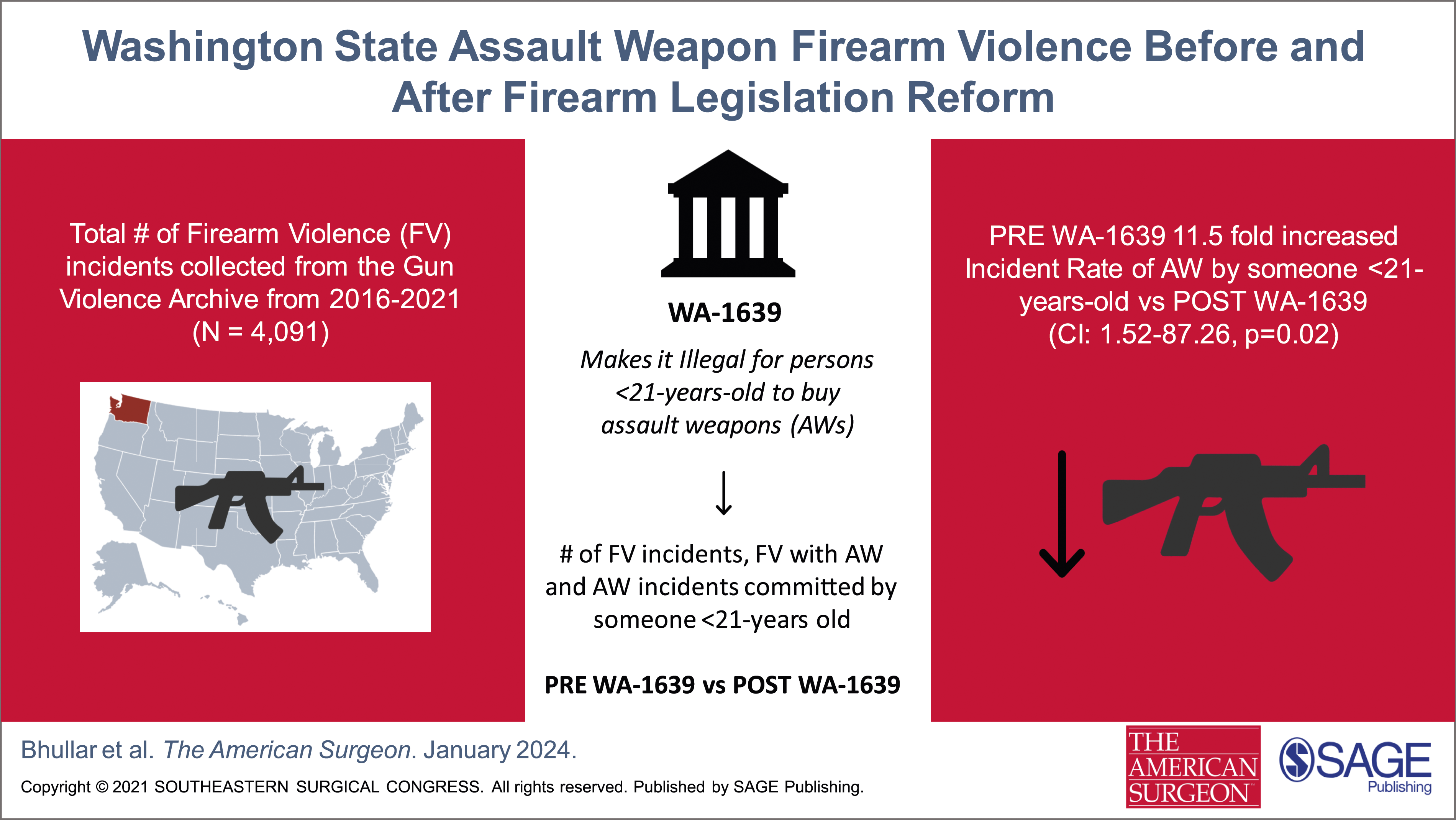
Key Takeaways
• WA-1639 was associated with decreased incidents of assault weapon violence committed by subjects <21 years-old in Washington State. • WA-1639 was associated with decreased incidents of all firearm violence in Washington State.
Introduction
Firearm violence (FV) presents a significant public health challenge in the United States. In 2022 alone, the Centers for Disease Control and Prevention recorded over 48,000 firearm-related deaths in the United States. 1 The federal assault weapons ban (FAWB), which expired in 2004, prohibited the production and civilian use of specific automatic, semiautomatic, and large capacity magazine weapons. During the FAWB’s enforcement period, there was a notable 70% reduction in mass shooting fatalities. 2 Without a federal ban, some states have passed assault weapon firearm legislation. 3 Several studies have previously investigated whether legislation influences FV in generalized populations with mixed results.3-6 Analysis of legislative restrictions and incidence of mass shooting events have shown that states with less restrictive firearm legislation and greater firearm ownership have higher rates of mass shootings and firearm-related homicide.3-5 In contrast, other studies challenge the effectiveness of stringent firearm legislation in reducing FV.2,6 However, with increasing rates of firearm purchase, including assault weapons (AWs), 7 some states have enacted legislation aimed at reduction of AW violence. Washington State 1639 Initiative (WA-1639), implemented in January 2019, made it illegal for a person less than 21 years-old to buy a semiautomatic assault rifle, and for any person to sell or transfer a semiautomatic AW to a person under 21 years-old. Additional provisions included comprehensive background checks, mandatory waiting-periods, and training requirements for lawful AW purchases. 8
This study aimed to evaluate the impact of WA-1639 on reducing FV involving AWs in Washington State. We hypothesized post-law, there will be a decline in FV incidents involving AWs by subjects under 21 years of age. Furthermore, we hypothesized a decrease of all AW incidents and deaths, irrespective of age, and an overall decrease in FV related to all weapon types (AW, handgun, long gun, etc.).
Methods
This study was deemed exempt by the institutional review board and a waiver of consent granted due to use of the Gun Violence Archive (GVA), a de-identified national database. The preparation of this article followed the guidelines provided in the Strengthening the Reporting of Observational Studies in Epidemiology (STROBE) Statement. The GVA is an independent, apolitical database that reports FV in the United States by collecting data from over 7500 sources including local and state police, news, media, data aggregates, and government sources daily. Each reported incident and its associated characteristics including incident type, ages of those involved, fatality count, and more are manually validated and reported within the publicly available online database.9,10
Retrospective data on FV incidents within WA were gathered from the GVA between January 2016 and December 2021. The data included monthly counts of incidents, deaths, and injuries from all FV events, as well as those specifically involving AWs. We further categorized these events into subgroups: incidents with AWs where the subject was below or above 21 years of age, and incidents with illegally acquired AWs by subjects under 21 years-old weighted per 100,000 people using annual WA population estimates obtained from the Washington State Office of Financial Management. 11 A subject was defined as the individual who fired the weapon. When registering events involving AWs, the GVA includes FV with AR-15s, AK-47s, and all other variants as reported by law enforcement during the time of the incident. Furthermore, illegally acquired guns are defined as those which were stolen or unlawfully obtained as determined by law enforcement at the time of firearm recovery.
Our primary outcome was incidents of FV using AWs. Secondary outcomes included the number of deaths and injuries. The primary group of interest was AW FV by subjects less than 21 years-old. Other subgroups included all AW FV regardless of subject age and all FV regardless of weapon type (ie, handgun, long gun, and AW).
Statistical Analysis
Mann-Whitney U tests were used to compare total monthly incidents, injuries, and deaths based on pre-law (January 2016-December 2018) vs post-law (January 2019-December 2021) time periods. Analyses of Mann-Whitney U tests were performed using IBM SPSS Statistics, version 29 (IBM Corp., Armonk, NY, USA). The Mann-Whitney U test analyzes differences in the mean ranks of data points, determined by their numerical ranking from low to high. Poisson’s regression models were used to estimate the incident rate ratio of incidents, injuries, and deaths before vs after WA-1639 went into effect. Annual population estimates 11 were used as the exposure variable, and robust variance estimators were used. Model goodness of fit was checked with chi-square tests. Poisson’s regression models were performed utilizing StataCorp. 2023. Stata Statistical Software: Release 18. College Station, TX: StataCorp LLC. All P-values were two-sided and were statistically significant at a level of <.05.
Results
From 4091 FV incidents, 2210 (54.02%) occurred pre-law and 1881 (45.98%) post-law. There were 50 incidents involving AWs pre- (2.3%) and 15 (.8%) post-law. Of these, 11 (22.0%) were committed by subjects under 21 years-old pre-law, while only one incident (6.7%) occurred post-law.
Mean Rank a of Incidents, Deaths, and Injuries Before and After Introduction of WA Initiative 1639.
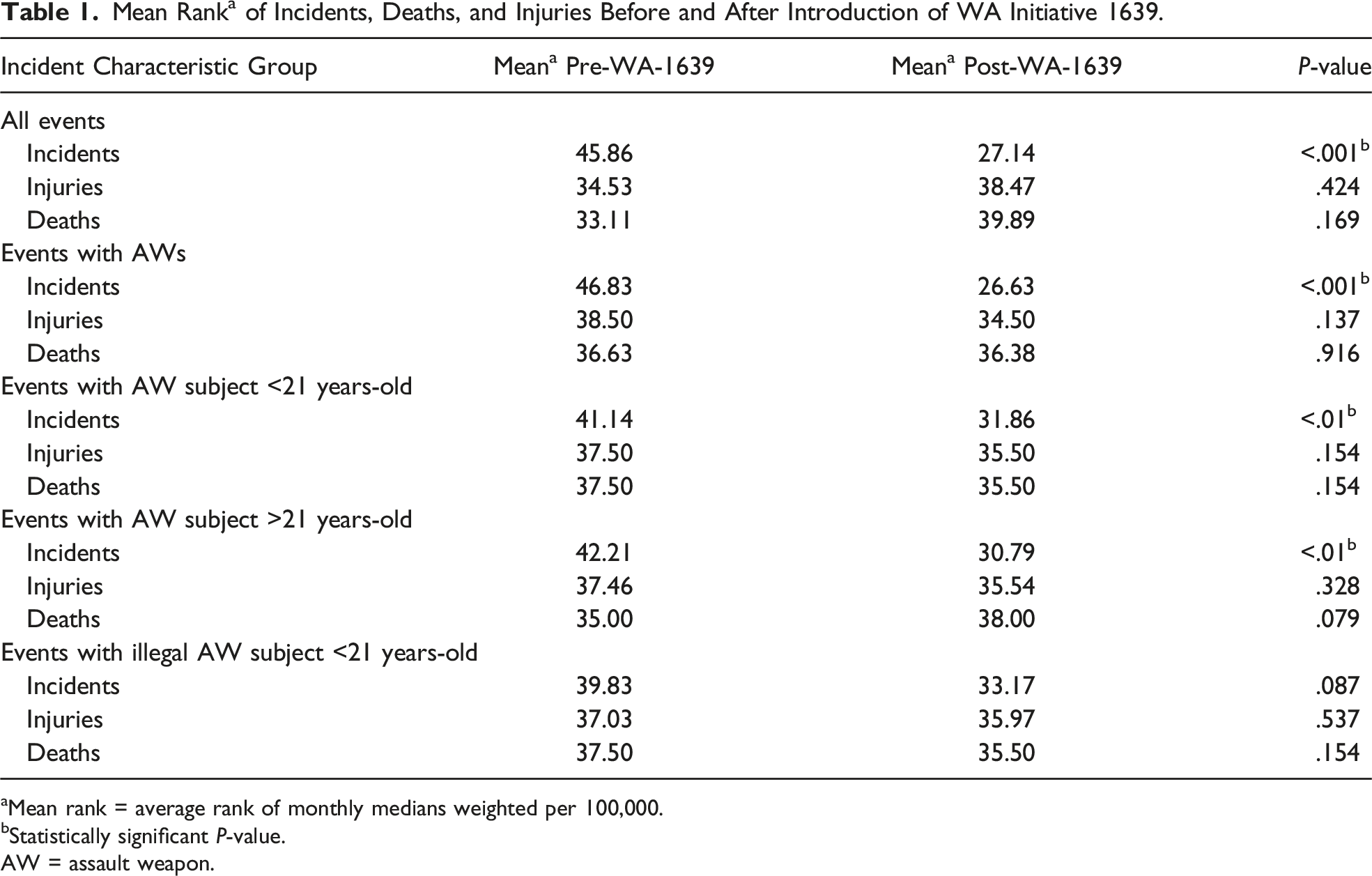
aMean rank = average rank of monthly medians weighted per 100,000.
bStatistically significant P-value.
AW = assault weapon.
Poisson’s Regression Incident Rate Ratios Pre- vs Post-implementation of WA-1639.
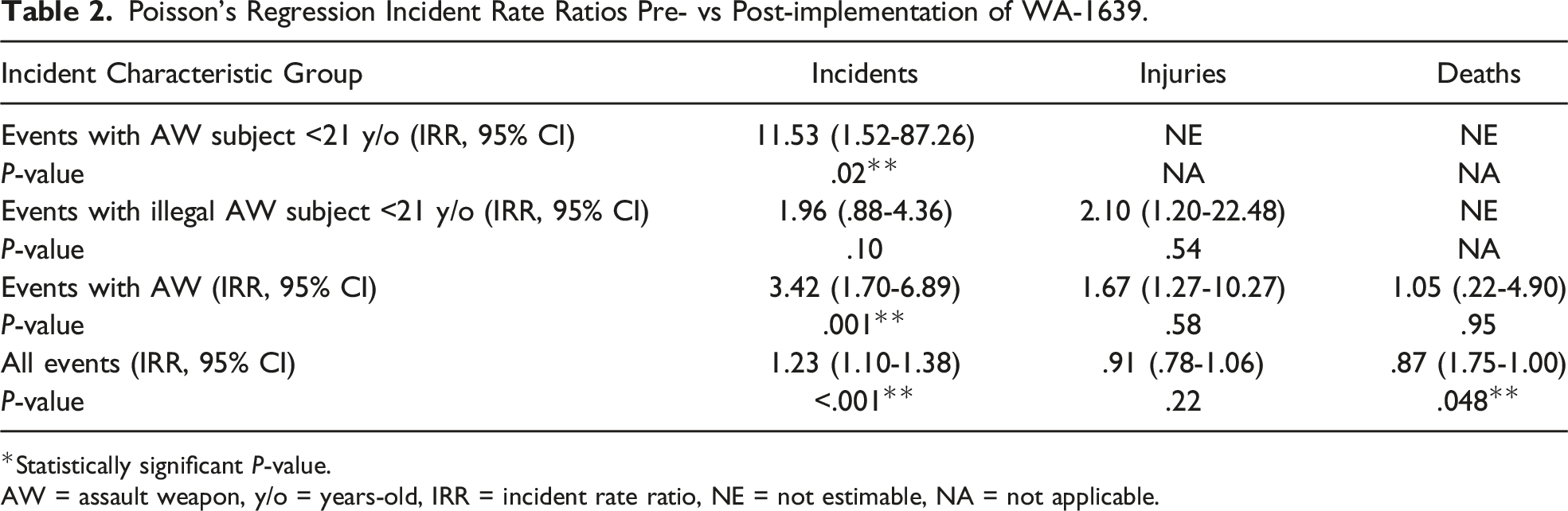
*Statistically significant P-value.
AW = assault weapon, y/o = years-old, IRR = incident rate ratio, NE = not estimable, NA = not applicable.
Discussion
This retrospective database study sought to evaluate the impact of WA-1639 on overall FV with a focus on AW violence, which continues to plague the United States. 1 The study demonstrated that there was a significant reduction in overall FV incidents after the implementation of WA-1639, along with a decrease in AW-specific incidents committed by individuals both under and over 21 years of age. These results support the hypothesis that restricting access to AWs may be an effective strategy for reducing FV.
Increased access to firearms is associated with FV, especially in those younger than 21 years-old. 12 Specifically, adolescents use firearms for suicide and are more likely to use long guns such as AWs in suicide attempts when compared to older adults. 13 Nestadt et al 13 found that nearly 45% of adolescents used long guns in suicide, compared to 20% of adults >65 years-old. Our study’s observation of decreased AW-related FV incidents in Washington, including a reduction in incidents by those under the age of 21 years-old, may be partially attributed to a decline in suicide attempts using AWs. Additionally, states that have increased the age to purchase a handgun from 18 to 21 years-old have experienced a decrease in adolescent suicides. 14 Therefore, extending the minimum age for purchasing AWs could potentially mirror these reductions in youth-associated AW FV.
While reducing FV incidents is a crucial objective, the ultimate goal of firearm legislation and prevention is to reduce firearm-related fatalities. Although the FAWB was effective in decreasing deaths during its tenure, 2 our study demonstrated that WA-1639 was not associated with a decrease in FV fatalities. Past studies investigating firearm legislation including AW bans have found that states with more restrictive laws have a lower incidence of firearm injuries and fatalities compared to those without such laws.3-5 Although not statistically significant, there was a slight decrease in deaths and injuries in our analysis for FV by subjects under 21 years-old (for both injuries and deaths mean rank pre- vs post-law was 37.5 vs 35.5). Thus, our study might simply lack statistical power to detect small changes in deaths, especially given Washington’s comparatively low rates of AW FV. Additionally, changes in incident type reflected by a steady rise in annual mass shootings in Washington State 10 may explain the decrease in AW FV incidents without a concurrent decrease in injuries or deaths as more people may be injured or killed in a single mass shooting event. Future research is needed in other states with increased rates of FV to ascertain if AW bans definitively help decrease firearm-related deaths.
This study is inherently limited by factors associated with its retrospective design, lack of an a priori sample size or power calculation to determine significance, and use of the GVA database. The GVA database is susceptible to both misclassification errors and unreported incidents. Specifically, regions of the United States lacking access to police departments and media to report FV incidents (eg, rural communities) likely suffer from underreporting of incidents. Furthermore, incidents were found using weapon type as a search rule; thus, incidents categorized incorrectly by weapon type or those in which the type of weapon used was not specified may have led to inaccurate reporting of AW FV. Additionally, our study includes data collected during the COVID-19 pandemic. While this may have skewed results, multiple prior studies have demonstrated an increase in FV during the COVID-19 pandemic,7,15,16 whereas our study found decreased overall and AW-specific FV, which suggests an even more powerful effect of the WA-1639 legislation. Our analysis also lacks information on potential confounding variables including the effects of other legislation in WA and changes to social and structural determinants of FV such as economic opportunity, accessible education, and housing which are known to effect FV. 17 Finally, given the retrospective nature of the study and that WA-1639 included other restrictive provisions such as background checks, we cannot evaluate causation.
In conclusion, the implementation of WA-1639 legislation, which includes an AW ban for individuals under 21 years-old, correlated with a reduction in overall FV incidents and AW-related incidents, including those committed by someone under 21 years-old. While promising, future research is needed to validate these results in additional states as FV prevention is multifaceted and challenging to research. In the meantime, policymakers should consider these findings as part of a broader effort to develop evidence-based strategies to address FV in the United States.
Footnotes
Declaration of Conflicting Interests
The author(s) declared no potential conflicts of interest with respect to the research, authorship, and/or publication of this article.
Funding
The author(s) received no financial support for the research, authorship, and/or publication of this article.